Wireless video can simplify a live production by reducing cable runs between cameras, switchers, monitors, and streaming computers. The right transmitter system can also make camera placement more flexible without sacrificing useful resolution or responsiveness.
These 10 video transmitters for live streaming cover professional HDMI and SDI workflows, compact UVC setups, multi-receiver systems, and solutions designed for devices such as the DJI Osmo Pocket 3. Use the guide below to match specifications with your production needs.
Best 10 Video Transmitters for Live Streaming Picks for 2026
Best 4K Multi-Receiver Pick

- 4K30 and 1080p60 transmission
- Up to 1,300-foot range and 60ms latency
- UVC streaming plus support for four receivers
Best For: Production teams needing 4K monitoring and live streaming
Best HDMI/SDI Hybrid
Accsoon CineView Master 4K Lite

- 4K60 HDMI and 1080p SDI support
- Up to five wireless or wired receiving devices
- H.265 encoding with low claimed latency
Best For: Professional productions using mixed HDMI and SDI gear
Best Budget UVC Workflow
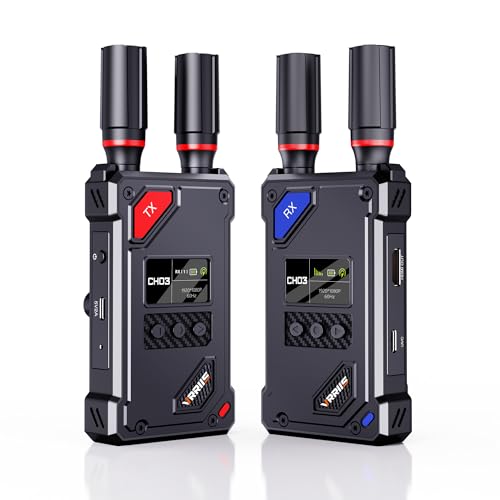
- 1080p60 transmission with UVC output
- 20 selectable channels with signal information
- HDMI loop-out and multiple power options
Best For: OBS streaming and 1080p mobile production
Best Pocket 3 Setup

- Direct USB-C connection for DJI Osmo Pocket 3
- UVC and HDMI outputs for streaming or production
- 0.05-second latency with 20 selectable channels
Best For: Pocket 3 creators streaming to OBS and HDMI gear
Best Overall Pro Workflow

- 4K30 HDMI and HDMI/SDI connectivity
- 1,300-foot range with 50ms latency
- UVC, RTMP, and four-receiver support
Best For: Live events and professional multi-monitor productions
Best Lightweight Silent Setup

- Fanless 2W design for quiet operation
- 1080p60 transmission up to 984 feet
- 40ms latency with two receivers included
Best For: Portable, quiet event and interview setups
Best Long-Range 4K Value

- 4K30 transmission with 1,500-foot listed range
- UVC streaming output up to 1080p60
- One transmitter supports up to five receivers
Best For: Long-range 4K monitoring and computer-based streaming
Long-Range HDMI Link
1080p Wireless Transmitter Kit

- 1080p/60Hz video with stated 0.05s latency
- HDMI loop out and dual receiver outputs
- Supports up to five receivers
Best For: Multi-screen live streaming and monitoring setups
On-Set Monitoring Hub
Wireless HDMI System with 7-Inch Screen
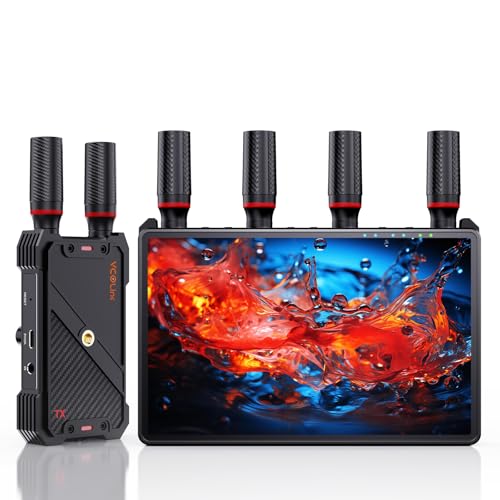
- Built-in 7-inch receiver monitor
- 1080p/60Hz transmission with stated 1312ft LOS range
- One transmitter can serve up to five receivers
Best For: Live production teams needing built-in monitoring
Pocket 3 Streaming Bridge
Wireless UVC Video Transmitter

- UVC output for direct computer streaming
- Supports up to 1080p/60Hz and 20 channels
- Designed for DJI Osmo Pocket 3 workflows
Best For: Pocket 3 creators streaming to OBS or a PC
Best 4K Multi-Receiver Pick – Hollyland Pyro H
The Hollyland Pyro H is a strong choice among video transmitters for live streaming when you need 4K support, long range, and monitoring for multiple crew members. Its HDMI loop-out, dual-band operation, smart channel scanning, and UVC support cover both on-set viewing and computer-based streaming.
Best For: Film crews, live broadcasters, and creators who need 4K transmission and monitoring on up to four receivers.
Pros:
- Supports up to 4K30 video transmission and 1080p60.
- Offers up to 1,300 feet of range with claimed 60ms latency.
- Supports up to four receivers and Hollyview app monitoring.
- UVC support enables direct computer live streaming without a separate capture device.
Cons:
- The kit is HDMI-based and does not list SDI connectivity.
- Its maximum range depends on shooting conditions and interference.
The Pyro H stands out for teams that want a flexible wireless monitoring system with a clear path to UVC streaming. It is particularly appealing when 4K output and multi-person collaboration matter more than the smallest possible setup.
Best HDMI/SDI Hybrid – Accsoon CineView Master 4K Lite
The Accsoon CineView Master 4K Lite is built for buyers comparing video transmitters for live streaming and professional production. It combines HDMI and 3G-SDI support, H.265 encoding, dual-band transmission, and multiple receiving options for cameras, mobile devices, and compatible Accsoon equipment.
Best For: Filmmakers, event crews, and streamers who need both HDMI and SDI inputs with multi-device monitoring.
Pros:
- Supports up to 4K60 through HDMI and 1080p through 3G-SDI or HDMI.
- Provides claimed latency below 35ms at 1080p60 and below 65ms at 4K60.
- Can distribute to up to five devices: four wireless and one wired.
- Includes USB-C video output and listed camera-control support for select Sony and Canon models.
Cons:
- The USB-C output is for compatible mobile devices and is not UVC for computers.
- Some camera-control features are limited to listed camera models and connection modes.
This is the most production-oriented option in the group for setups that mix HDMI and SDI sources. Check your phone, tablet, computer, and camera compatibility carefully, especially if your workflow requires direct computer UVC input.
Best Budget UVC Workflow – Vrriis Wireless Video System
The Vrriis wireless system is a practical option for video transmitters for live streaming when a simple 1080p workflow is enough. Its receiver provides UVC output for software such as OBS, while the transmitter adds HDMI loop-out, manual channel selection, and several power options for mobile setups.
Best For: Streamers and event users who want plug-and-play 1080p streaming with OBS and local HDMI monitoring.
Pros:
- Provides UVC output through USB-C without requiring a separate capture device.
- Supports 1080p at 60Hz and claims 0.05-second latency.
- Offers up to 1,500 feet of line-of-sight range in open conditions.
- Includes 20 manually selectable channels and HDMI loop-out.
Cons:
- It does not support 4K transmission.
- Walls, metal, brick, and glass can reduce coverage or cause signal loss.
- NP-F batteries are supported but not included.
The Vrriis system makes sense for a straightforward camera-to-OBS setup where 1080p is sufficient. Its channel display and flexible power support are useful in changing locations, but range claims should be treated as line-of-sight estimates rather than indoor guarantees.
Best Pocket 3 Setup – Wireless HDMI Creator Combo
Designed around the DJI Osmo Pocket 3, this creator combo is a specialized pick among video transmitters for live streaming. The direct USB-C connection can turn the Pocket 3 into a wireless webcam, while the receiver offers both UVC and HDMI output for computers, switchers, displays, and streaming platforms.
Best For: DJI Osmo Pocket 3 users who want wireless OBS streaming, multi-screen monitoring, and portable production.
Pros:
- Plugs directly into the Pocket 3 through USB-C without an adapter.
- Provides UVC and HDMI output for computers, displays, and switchers.
- Claims 1,640 feet of line-of-sight range and 0.05-second latency at 1080p60.
- Includes 20 selectable channels, loop-out, and reverse charging for the Pocket 3.
Cons:
- The Pocket 3 workflow supports horizontal video, not vertical video.
- Walls, metal, brick, and glass can reduce range or cause signal loss.
- Its most distinctive features are centered on the DJI Pocket 3 rather than a general camera setup.
This is the most targeted choice for Pocket 3 creators who need a clean wireless path into OBS or HDMI production equipment. The standard HDMI input adds flexibility for other sources, but buyers primarily using another camera should consider a more general-purpose transmitter.
Best Overall Pro Workflow – Hollyland Pyro S TX
For demanding productions, the Hollyland Pyro S TX is one of the most capable video transmitters for live streaming. It combines HDMI and SDI connectivity, 4K30 video over HDMI, 1,300-foot range, and 50ms latency, while also adding UVC and RTMP streaming support.
Best For: Live events, film sets, ENG/EFP work, and multi-person monitoring setups.
Pros:
- Supports up to 4K30 over HDMI and includes HDMI and SDI connections.
- Transmits up to 1,300 feet with approximately 50ms latency.
- Connects one transmitter to as many as four receivers.
- Offers UVC plug-and-play streaming plus RTMP capability.
Cons:
- This listing includes the transmitter only, so compatible receivers are needed for wireless monitoring.
- Its broader feature set may be more than simple HDMI-only setups require.
The Pyro S TX stands out when range, connection flexibility, and professional monitoring tools matter. Auto Dual-Band Hopping and app features such as waveform and vectorscope monitoring make it a strong choice for more complex live production workflows.
Best Lightweight Silent Setup – SYNCO XVision 1080p
The SYNCO XVision is a practical option for creators who want lightweight video transmitters for live streaming without fan noise. Its 1080p60 transmission, 40ms latency, HDMI loop-out, and included one-transmitter/two-receiver configuration support responsive monitoring for events and mobile shoots.
Best For: Weddings, interviews, live music, outdoor shoots, and collaborative monitoring.
Pros:
- Fanless 2W design helps minimize operating noise and power use.
- Supports 1080p60 transmission over distances up to 984 feet.
- Provides approximately 40ms latency for near-real-time monitoring.
- Includes two receivers and supports monitoring across multiple endpoints.
Cons:
- NP-F batteries are not included.
- It is an HDMI-focused system rather than an HDMI/SDI solution.
- The supplied configuration is centered on 1080p rather than 4K transmission.
With its compact 119g body, foldable antenna, auto-memory pairing, and USB-C or NP-F power options, XVision is well suited to portable crews. It is especially appealing when quiet operation and simple setup are more important than 4K resolution.
Best Long-Range 4K Value – VRRIIS WL096 PRO
The VRRIIS WL096 PRO pairs 4K30 transmission with a long listed range and built-in UVC output, making it a flexible choice among video transmitters for live streaming. Its pre-paired design, adjustable 5GHz channels, and LCD status displays aim to simplify setup while supporting multi-device monitoring.
Best For: 4K live streaming, outdoor filming, surveillance-style monitoring, and multi-receiver viewing.
Pros:
- Supports 4K30 video transmission using H.265.
- Offers a listed range of up to 1,500 feet.
- UVC output supports computer streaming at up to 1080p60 without a capture card.
- One transmitter can send to up to five receivers and includes loop-out monitoring.
Cons:
- Approximately 0.1-second latency is not intended for highly responsive applications such as gaming.
- UVC output is limited to 1080p60, despite 4K transmission support.
- The system is not waterproof.
The WL096 PRO offers a broad feature set for its category, including 20 selectable channels, multiple power options, and LCD connection information on both units. Consider it when 4K source handling, long range, and direct computer streaming are priorities, but avoid it for latency-critical work.
Long-Range HDMI Link – 1080p Wireless Transmitter Kit
For shoppers comparing video transmitters for live streaming, this Vrriis kit offers a practical point-to-point wireless HDMI connection with 1080p at 60Hz, low stated latency, and a loop-out connection for local monitoring. It is designed for cameras, laptops, set-top boxes, TVs, and projectors, though real-world range depends heavily on obstacles and interference.
Best For: Live streaming and event setups that need wireless 1080p monitoring, flexible power options, and support for multiple receivers.
Pros:
- Supports up to 1080p at 60Hz with a stated 0.05-second latency.
- Includes transmitter HDMI loop out and dual HDMI output on the receiver.
- Supports up to one transmitter and five receivers for multi-screen monitoring.
- Can run from USB-C power, adapters, or compatible NP-F batteries.
Cons:
- The advertised 1300-foot range is for an open field; walls, glass, brick, and metal can reduce coverage.
- Batteries are not included.
- Transmission distance decreases as additional receivers are added.
This is a versatile choice when you want cable-free HDMI distribution without installing software. Its loop out, IR support, and multiple power methods are useful for production monitoring, but it is best deployed with a clear line of sight.
On-Set Monitoring Hub – Wireless HDMI System with 7-Inch Screen
This all-in-one option stands out among video transmitters for live streaming by combining wireless 1080p transmission with a built-in 7-inch receiver monitor. It also supports HDMI output to a larger display, local transmitter monitoring through loop out, and one-to-five receiver distribution for collaborative production work.
Best For: Film crews, live events, and streamers who want built-in receiver monitoring without carrying a separate field monitor.
Pros:
- Receiver includes a built-in 7-inch HD screen with adjustable brightness and volume.
- Delivers stated 1080p at 60Hz transmission up to 1312 feet in line-of-sight conditions.
- Supports one transmitter to as many as five receivers for shared monitoring.
- Offers HDMI loop out, IR remote control, headphone monitoring, and flexible power options.
Cons:
- The long-range specification assumes a clear line of sight.
- An HDMI cable for connecting an external monitor is not included.
- Smartphone or tablet compatibility requires a Type-C-to-HDMI cable.
The integrated screen makes this system particularly convenient for mobile shoots and live production. It is a strong fit when private operator monitoring and larger client or crew displays are both useful, although additional cables may be needed for some sources and external monitors.
Pocket 3 Streaming Bridge – Wireless UVC Video Transmitter
For creators using the DJI Osmo Pocket 3, this system is one of the more specialized video transmitters for live streaming. Its receiver provides UVC output directly to a computer, allowing up to 1080p at 60Hz streaming through software such as OBS without a separate video capture device. It also supports HDMI equipment and multi-receiver monitoring.
Best For: Osmo Pocket 3 users who want wireless camera-to-computer streaming through OBS or similar PC software.
Pros:
- Receiver UVC output connects directly to a computer as a high-definition webcam.
- Supports live-stream output up to 1080p at 60Hz without separate capture hardware.
- Offers 20 adjustable channels with an LCD showing connection, signal, resolution, and battery information.
- Supports one transmitter to five receivers and includes HDMI loop out for local monitoring.
Cons:
- Its most distinctive features are optimized for the DJI Osmo Pocket 3.
- The stated 1640-foot range requires open, unobstructed conditions; walls and metal can severely affect transmission.
- NP-F batteries must be purchased separately.
This is the most purpose-built choice in the group for Pocket 3-based streaming workflows. The UVC output simplifies computer streaming, while channel selection and status information help with setup, but buyers using other cameras should confirm compatibility and connection requirements first.
How We Picked These Video Transmitters for Live Streaming
We prioritized systems that support common live-production connections and offer clearly stated performance specifications. The selection includes HDMI and SDI compatibility, UVC output for computer-based streaming, loop-through connections, dual-band operation, adjustable channels, and support for multiple receivers. We also considered advertised range, latency, resolution, setup flexibility, and whether each system suits a portable, studio, or event workflow.
Wireless range claims are measured under ideal conditions, so real-world performance can vary with walls, interference, antenna placement, and competing 2.4GHz or 5GHz networks. Treat range as a comparison point rather than a guarantee.
Quick Comparison
- Best for professional flexibility: Choose an HDMI/SDI system with 4K support and dual-band transmission.
- Best for computer streaming: Look for a receiver with UVC output, which can appear as a video source in compatible streaming software.
- Best for multiple viewing points: Select a system that supports several receivers or includes monitor-oriented outputs.
- Best for straightforward HDMI setups: A 1080p HDMI kit with loop-out can be simpler and more affordable.
- Best for mobile creators: Compact systems designed for devices such as the Osmo Pocket 3 can reduce equipment and cabling.
Key Buying Factors for Video Transmitters for Live Streaming
Inputs, Outputs, and Compatibility
Confirm that the transmitter matches your camera’s output. HDMI is common on mirrorless cameras and compact devices, while SDI is preferred for many professional cameras and longer wired runs. On the receiver side, HDMI loop-out can feed a monitor or switcher, and UVC output can connect directly to a computer. Check connector types, supported resolutions, and whether adapters are required.
Resolution and Latency
4K transmission is useful for monitoring, recording, or future-proofing, but many live streams still deliver in 1080p. Low latency matters for presenters, camera operators, and live switching. Compare the advertised delay, but remember that the complete workflow also includes camera processing, the switcher, capture hardware, and streaming-platform latency.
Range, Reliability, and Interference
Long-range specifications are most valuable when paired with stable channel management and clear line of sight. Dual-band systems may handle crowded environments better, while manual channel selection can help troubleshoot interference. Keep transmitters and receivers away from obstructions and provide adequate power for extended events.
Receiver Capacity and Power
If several people need the same feed, verify the maximum receiver count and whether additional receivers are sold separately. For field work, compare battery options, USB power support, mounting hardware, and heat management. A kit that is easy to power is often more useful than one with a higher headline range.
Who Should Buy Which Video Transmitters for Live Streaming?
Professional crews should favor HDMI/SDI support, 4K capability, dual-band operation, and dependable multi-receiver expansion. Streamers using OBS or similar software should prioritize UVC output and confirm operating-system compatibility before purchase. Event and church productions may benefit from long-range systems with loop-out and several receivers for confidence monitors. Traveling creators should choose a compact, low-power kit matched to their camera’s output, especially when using an Osmo Pocket 3. For simple home streaming, a reliable 1080p HDMI system may provide the best value without adding unnecessary complexity.