A good subwoofer can add depth and impact to music, movies, and games without overwhelming a compact space. The challenge is finding a model with enough controlled bass for your room—not simply the highest wattage or largest driver.
These 10 subwoofers for small rooms include compact 6.5-, 8-, and 10-inch options, plus wired, wireless-ready, and Bluetooth-equipped designs. Use the buying guide below to match output, connections, and placement flexibility to your system and listening space.
Best 10 Subwoofers for Small Rooms Picks for 2026
Best Compact Pick

- Compact 6-inch design for space-limited setups
- 210-watt maximum output with 33 Hz response
- RCA and auxiliary connectivity; optional W3 adapter
Best For: Small rooms, desktops, gaming, and compact home theater
Best Down-Firing Value
Klipsch Reference R-8SW Subwoofer

- 8-inch spun-copper IMG woofer
- Down-firing driver with 150-watt peak power
- RCA/LFE connectivity and remote control
Best For: Compact home theater and music systems
Best for Flexible Connectivity

- 8-inch front-firing driver reaches 30 Hz
- Bluetooth 5.0 plus TRS, RCA, and auxiliary inputs
- Adjustable crossover and room-tuning controls
Best For: Small studios, desktops, gaming, and flexible multimedia setups
Best for Maximum Impact
Klipsch R-100SW 10-Inch Subwoofer

- 10-inch front-firing woofer for deep bass
- 300-watt peak all-digital amplifier
- Adjustable crossover, phase, and volume controls
Best For: Small to medium rooms prioritizing powerful movie and gaming bass
Compact Clear-Bass Pick

- 8-inch woofer for space-conscious setups
- Twisted flare port supports tight bass
- 100W dynamic power with 28Hz response
Best For: Small home theaters and music systems
Flexible Placement Pick
- Compact 8-inch down-firing design
- 250W output for robust bass
- Optional wireless use with W3 kit
Best For: Small rooms needing flexible placement
High-Output Movie Pick

- 10-inch woofer with 300W RMS power
- Adjustable volume, crossover, and phase
- RCA and high-level connectivity
Best For: Compact theaters prioritizing powerful bass
Best Compact Power

- 35Hz bass with DSP control
- LFE, RCA, AUX, and high-level inputs
- Compact MDF cabinet with phase control
Best For: Small-room systems needing flexible setup and adjustable deep bass
Best Slim Design
- 70W RMS Class-D power
- Slim 6.69-inch-wide cabinet
- Adjustable crossover and phase selector
Best For: RCA-based stereo systems where width-saving design matters
Best Smallest Footprint
BESTISAN SW65D 6.5-inch Subwoofer
- Compact 6.3-inch-wide enclosure
- RCA, AUX, LFE, and high-level connections
- Side-firing woofer with bass-reflex cabinet
Best For: Small TV and home theater setups with varied wired connections
Best Compact Pick – Audioengine S6 Mini Subwoofer
The Audioengine S6 is a practical choice for shoppers seeking subwoofers for small rooms. Its compact 6-inch design, front-firing driver, and 210-watt maximum output provide a space-conscious way to add deeper bass to music, movies, gaming, and home theater setups.
Best For: Small living spaces, desktop audio, gaming, and compact home theater systems.
Pros:
- Compact footprint measures about 9.92 by 8.74 by 9.96 inches.
- Front-firing 6-inch driver and 210-watt maximum output add substantial bass.
- Supports wired RCA and auxiliary connections, with optional W3 wireless-adapter compatibility.
Cons:
- Its 6-inch driver may not deliver the same room-filling impact as larger subwoofers.
- Wireless operation requires the compatible W3 adapter.
The S6 stands out when floor space is limited but you still want a dedicated powered subwoofer. Its 33 Hz frequency response and compact cabinet make it a balanced fit for close-range listening and smaller rooms.
Best Down-Firing Value – Klipsch Reference R-8SW Subwoofer
Klipsch Reference R-8SW Surround Subwoofer, 150 Watts Peak Power (Brushed Black Vinyl, 8-Inch)
Check Price On AmazonThe Klipsch Reference R-8SW is a compact wired subwoofer for shoppers comparing subwoofers for small rooms. Its 8-inch spun-copper IMG woofer, down-firing design, and all-digital amplifier are suited to adding rich bass to music, television, and home theater systems.
Best For: Small to medium living rooms and straightforward RCA/LFE home theater installations.
Pros:
- 8-inch woofer provides a fuller bass presentation than many mini subwoofers.
- Down-firing driver and compact cabinet help integrate the subwoofer into a room.
- Offers RCA and LFE connectivity with remote control operation.
Cons:
- At roughly 15.75 by 11.75 by 13.25 inches, it needs more space than ultra-compact models.
- It is wired and does not include Bluetooth connectivity.
The R-8SW is a sensible middle ground: larger than a mini subwoofer but still relatively compact. Choose it when you want a dedicated 8-inch driver and simple receiver connectivity without moving to a larger cabinet.
Best for Flexible Connectivity – PreSonus Eris Sub 8BT
The PreSonus Eris Sub 8BT is a versatile option among subwoofers for small rooms, particularly for desks, studios, and multimedia systems. Its front-firing 8-inch driver reaches down to 30 Hz, while Bluetooth 5.0 and multiple wired inputs make setup flexible.
Best For: Music production, desktop listening, gaming, and small-room systems that need adjustable crossover controls.
Pros:
- 8-inch woven-composite driver delivers low frequencies down to 30 Hz.
- Bluetooth 5.0 complements balanced TRS, RCA, and front-panel auxiliary inputs.
- Highpass, lowpass, and tuning controls help adapt the bass to the room and main speakers.
- Front headphone output and automatic power-saving mode add convenience.
Cons:
- Its approximately 10-meter Bluetooth range may be limiting in larger spaces.
- The feature-rich design may be more than needed for a basic TV-only setup.
The Eris Sub 8BT is especially compelling when placement and speaker matching matter. Adjustable filtering and room-tuning controls can help prevent muddy bass, while the connection variety supports both professional and consumer equipment.
Best for Maximum Impact – Klipsch R-100SW 10-Inch Subwoofer
The Klipsch R-100SW is the largest and most powerful option here for shoppers considering subwoofers for small rooms with room for a fuller cabinet. Its 10-inch front-firing woofer, 300-watt peak amplifier, and 32 Hz frequency response target deep, high-impact bass for television, gaming, music, and home theater.
Best For: Small to medium rooms where deeper, more forceful bass is a priority.
Pros:
- 10-inch spun-copper IMG woofer offers strong low-end output.
- 300-watt peak power provides substantial headroom for movies and games.
- Includes volume, low-pass crossover, phase control, and RCA/LFE inputs.
- Five-year woofer and two-year amplifier warranties are specified.
Cons:
- Its 14.5 by 12.5 by 16.4-inch cabinet and 26-pound weight take up more space.
- Connectivity is wired through RCA, with no wireless communication.
The R-100SW makes sense when compactness is important but not the only priority. Its larger driver and higher power can produce more authoritative bass, though careful placement and level adjustment are worthwhile in a small room.
Compact Clear-Bass Pick – Yamaha NS-SW050BL
For shoppers comparing subwoofers for small rooms, the Yamaha NS-SW050BL offers an approachable 8-inch design with 100W of dynamic power. Its twisted flare port and Advanced YST II technology are designed to support clear, tight bass without requiring a large floor footprint.
Best For: Small home theaters and music setups that need a compact, wired subwoofer with straightforward placement.
Pros:
- Compact 8-inch woofer suits space-conscious rooms.
- Twisted flare port contributes to clear, tight bass.
- Advanced YST II technology and 28Hz stated frequency response.
- Includes a 2-year manufacturer warranty.
Cons:
- Its 100W dynamic output is more modest than the larger models here.
- Wired connectivity limits placement flexibility compared with a wireless setup.
- Plastic enclosure may feel less substantial than MDF alternatives.
The NS-SW050BL is a sensible choice when compact dimensions and controlled bass matter more than maximum output. It is particularly well matched to smaller rooms, desktop systems, and modest home theater setups.
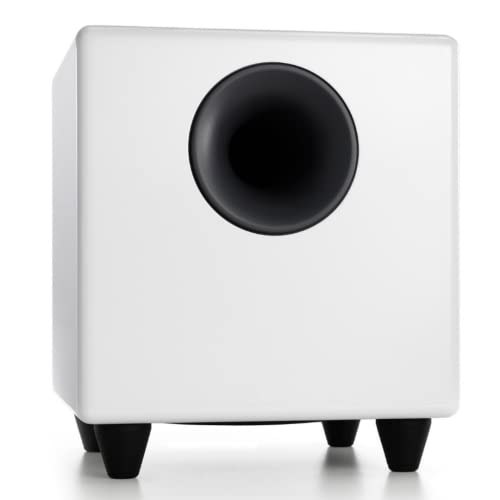
Flexible Placement Pick – Audioengine S8
The Audioengine S8 is a compact 8-inch powered subwoofer for listeners seeking subwoofers for small rooms with more placement flexibility. Its down-firing design, 250W output, and nearly 11.3-inch square footprint make it a practical fit for home theater, gaming, and studio-style listening spaces.
Best For: Small rooms where flexible positioning, strong bass output, and optional wireless expansion are priorities.
Pros:
- Compact 11.26-inch square dimensions ease placement.
- 250W output provides robust bass from an 8-inch driver.
- Down-firing design produces deep, resonant bass.
- Can be made wireless with the optional Audioengine W3 kit.
Cons:
- Wireless operation requires the separately sold W3 kit.
- Its wired inputs may require additional setup for some systems.
- The supplied specifications list a white finish, which may not suit every room.
The S8 stands out for combining a small enclosure with substantially more stated power than the Yamaha. Choose it when you want fuller bass and the option to add wireless connectivity later without moving to a much larger subwoofer.
High-Output Movie Pick – Rockville Rock Shaker 10-inch
The Rockville Rock Shaker brings a larger 10-inch woofer and 300W RMS power to the subwoofers for small rooms category. It can deliver a more forceful presentation for movies, music, and gaming, but its substantially larger cabinet requires careful placement in a compact space.
Best For: Small-to-medium home theaters where powerful bass and broad connection options matter more than a minimal footprint.
Pros:
- 10-inch woofer with 300W RMS and 600W peak output.
- Adjustable volume, crossover, and phase controls aid system matching.
- RCA and high-level inputs and outputs support varied setups.
- MDF enclosure and detachable foam grille provide a durable, finished design.
Cons:
- Its 18.9-by-18.3-by-14.6-inch footprint is large for a truly small room.
- It uses wired RCA connectivity and has no wireless communication.
- Its listed 1-year warranty is shorter than the warranties supplied with the other options.
The Rock Shaker is the performance-oriented option here, especially for impact-heavy movie soundtracks and gaming. Before choosing it for a small room, measure the available space carefully; its output and control set are appealing, but the cabinet is considerably less compact.
Best Compact Power – BESTISAN Magicube 80
For shoppers comparing subwoofers for small rooms, the BESTISAN Magicube 80 offers a compact 8-inch design with 80W RMS power and 120W peak output. Its DSP control, adjustable crossover, and flexible inputs make it easy to blend deep bass with bookshelf speakers, soundbars, or home theater systems.
Best For: Small-room music and home theater setups that need deep, adjustable bass and broad connection compatibility.
Pros:
- Reaches down to 35Hz with built-in DSP for controlled low-end response.
- Supports LFE, AUX/RCA, and high-level speaker connections.
- Compact MDF cabinet includes adjustable 30Hz–160Hz low-pass filtering and phase control.
- Auto-standby activates after 15 minutes without a signal.
Cons:
- Its 10-inch-wide footprint may still require careful placement in very tight spaces.
- It is wired rather than wireless.
The Magicube 80 is a versatile pick when you want substantial bass without a large enclosure. Its tuning controls and connection options are particularly useful for integrating it into a smaller, mixed-component audio system.
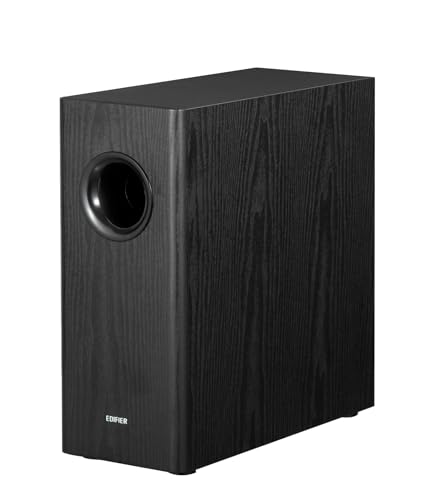
Best Slim Design – Edifier T5s Powered Subwoofer
The Edifier T5s is a practical choice among subwoofers for small rooms, pairing an 8-inch long-throw woofer with 70W RMS Class-D amplification. Its slim cabinet, front-firing driver, and adjustable controls are designed to add bass without taking over the room.
Best For: Compact stereo or home audio setups, especially Edifier speakers and systems with RCA connectivity.
Pros:
- Delivers 35Hz bass from an 8-inch woofer.
- Slim 6.69-inch-wide cabinet helps conserve floor space.
- Includes adjustable 30Hz–160Hz low-pass filtering and 0°/180° phase selection.
- Comes with 3.5mm-to-RCA and RCA cables, plus auto-standby.
Cons:
- Connectivity is limited to wired RCA-based setups.
- The no-sub-out connection method requires main speakers with LINE IN.
- At over 15 inches deep, it may need careful placement despite its slim width.
The T5s stands out where width is the main constraint. It is easiest to recommend for RCA-equipped speakers or amplifiers, with useful tuning controls for blending bass in a compact listening area.
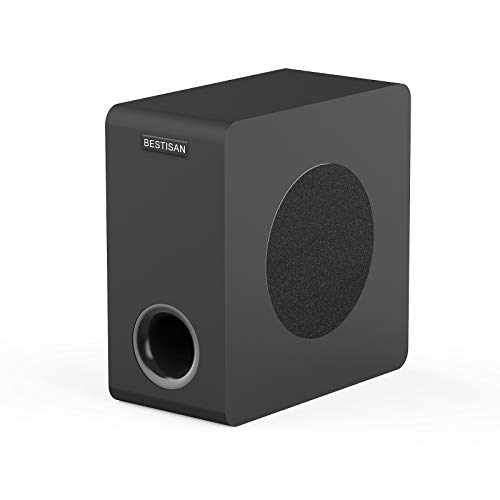
Best Smallest Footprint – BESTISAN SW65D 6.5-inch Subwoofer
For especially space-conscious rooms, the BESTISAN SW65D provides a 6.5-inch side-firing woofer in a compact enclosure measuring 6.3 inches wide. It supports RCA, AUX, LFE, and high-level connections, making it a flexible option for adding bass to a TV, soundbar, bookshelf speaker system, or receiver.
Best For: Small home theater and TV setups that need a compact subwoofer with multiple wired input options.
Pros:
- Space-saving 6.3-inch-wide cabinet with a 6.5-inch side-firing woofer.
- Offers RCA, 3.5mm AUX, LFE, and high-level speaker inputs and outputs.
- Bass-reflex cabinet with internal bracing is designed to reduce resonance.
- Includes remote control operation and a stated 35Hz–200Hz frequency response.
Cons:
- The supplied details list a 40Hz frequency response in the specifications, differing from the advertised 35Hz–200Hz range.
- Best performance guidance recommends source devices outputting no more than 850mV.
- Its side-firing design requires clearance beside the cabinet.
The SW65D is a strong fit when cabinet width and connection flexibility matter most. Its side-firing layout can work well in a small room, provided there is enough space beside the enclosure for proper placement.
How We Picked the Best Subwoofers for Small Rooms
We focused on models that suit apartments, bedrooms, offices, and other compact listening spaces. Selection criteria included cabinet and driver size, published power ratings, low-frequency response, connectivity, setup flexibility, and the likelihood of producing useful bass without excessive room boom. We also included a range of prices and formats so buyers can upgrade desktop speakers, TV audio, stereo systems, or home theaters.
Power and frequency figures are useful comparison points, but they do not tell the entire story. Room dimensions, placement, crossover settings, and the main speakers all affect the final result.
Quick Comparison
- Most compact: A 6.5-inch or small 8-inch model is generally easiest to place near a desk, media console, or bookshelf system.
- Best all-around size: An 8-inch subwoofer usually offers a practical balance of extension, output, and cabinet size for small rooms.
- More impact: A 10-inch model can deliver stronger movie effects, but it may need more careful placement and level adjustment.
- Flexible connections: Bluetooth or wireless-ready designs can simplify installation where running a subwoofer cable is inconvenient.
- Home theater focus: Look for a dedicated LFE input or clearly specified line-level compatibility with your receiver.
Key Buying Factors for Subwoofers for Small Rooms
Size and Output
Choose the smallest model that can meet your listening goals. For nearfield music or desktop use, compact designs can provide convincing low-end reinforcement. For a small living room used for movies, an 8-inch subwoofer is often the safer starting point. A larger driver is not automatically better if the room causes resonances or the subwoofer is played too loudly.
Connections and System Compatibility
Check whether your amplifier, receiver, soundbar, or powered speakers provide a subwoofer output, stereo line outputs, or speaker-level connections. Some models are designed primarily for home theater, while others are better suited to powered monitors or desktop systems. Bluetooth can be convenient, but it may not replace a wired LFE connection for every setup.
Placement and Adjustment
Small rooms often have pronounced bass peaks. Start with the subwoofer near the front wall, avoid placing it tightly in a corner, and adjust volume and crossover gradually. If the model includes phase, crossover, or DSP controls, use them to blend the bass with your main speakers rather than making the subwoofer dominant.
Response Claims and Controls
Published frequency response gives a useful baseline, but measurement conditions vary. Prioritize a reputable design, adjustable level, and appropriate inputs over an impressive low-frequency number alone.
Who Should Buy Which Subwoofers for Small Rooms?
Desktop and nearfield listeners should favor the most compact options, especially when desk space and low-volume control matter. Small stereo or TV systems will often benefit from an 8-inch powered model with straightforward line-level connectivity. Movie and gaming fans may prefer a 10-inch option for greater impact, provided they can manage placement and output. Buyers seeking easy installation should consider Bluetooth or wireless-ready models, while home theater owners should confirm LFE compatibility before ordering.
Whichever model you choose, leave room to adjust the level after installation. In a compact room, the best result is usually tight, blended bass that adds weight without drawing attention to the subwoofer itself.