The right encoder can turn a camera, switcher, or production feed into a reliable stream without tying up a computer. This roundup compares 10 streaming encoders for video production across HDMI and SDI workflows, 4K support, network protocols, recording, and installation features.
Whether you need a portable unit for YouTube Live or a more robust encoder for studio, venue, or broadcast use, focus on signal compatibility, bitrate control, connectivity, and the platforms you actually use.
Best 10 Streaming Encoders for Video Production Picks for 2026
Versatile Production Hub

- HDMI and SDI inputs with source mixing
- 4K H.264/HEVC encoding
- Up to six destinations plus recording
Best For: Hybrid HDMI/SDI live production
Protocol-Rich Workhorse
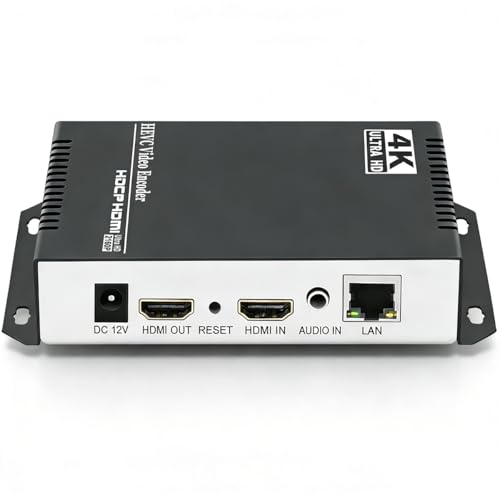
- H.265/H.264 encoding up to 4K30
- Up to four protocol outputs
- Captions, logos, and video adjustments
Best For: Multi-platform HDMI streaming
SDI Production Specialist
Magewell Ultra Encode SDI Plus

- 4K SDI encoding up to 30p
- 128GB internal recording storage
- NDI|HX, PoE, Wi-Fi, and multi-protocol streaming
Best For: Professional SDI production and contribution
Flexible HDMI Streamer

- 4K input with H.265/H.264 support
- Up to four simultaneous protocol outputs
- Branding, captions, and audio adjustments
Best For: Flexible HDMI-to-IP streaming
Best Overall
Magewell Ultra Encode HDMI Plus

- 4K HDMI encoding with loop-through
- Multi-protocol and multi-destination streaming
- Simultaneous recording with NDI|HX support
Best For: Professional HDMI live production and IP workflows
Best SDI Option
URayCoder HEVC SDI to IP Encoder

- SDI input for broadcast equipment
- Up to four simultaneous video streams
- Broad protocol and overlay support
Best For: SDI broadcast and multi-destination streaming
Best Multi-Output Value

- One 4K30 or four 1080p30 outputs
- OLED status display and HDMI loop-out
- H.265/H.264 with SRT and RTMP support
Best For: Flexible HDMI IPTV and live event setups
Best for Pro Hybrid Rigs

- 12G-SDI and HDMI 2.0 inputs
- Dual-channel H.265/H.264 streaming
- Wi-Fi 6, PoE, and local recording
Best For: Broadcast and live-production rigs needing flexible wired and wireless connectivity
Best for Multi-Protocol Distribution
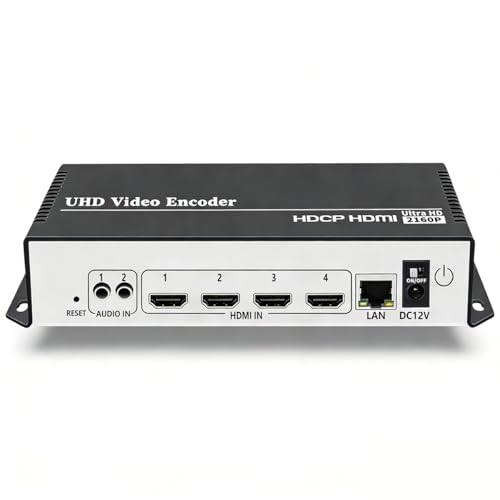
- 4K30 input with H.265/H.264 encoding
- Four simultaneous protocol-based outputs
- Overlays and detailed video controls
Best For: Multi-platform and enterprise network-video distribution
Best Value for HDMI Streaming

- 4K30 HDMI encoding
- Four simultaneous network streams
- Broad protocol and overlay support
Best For: Single-camera HDMI live streaming and IPTV workflows
Versatile Production Hub – Magewell Ultra Encode AIO
The Magewell Ultra Encode AIO is a strong choice among streaming encoders for video production when your workflow includes both HDMI and SDI sources. It combines 4K encoding, source mixing, multi-destination streaming, overlays, and simultaneous recording in a rack-mountable unit.
Best For: Live production teams needing flexible HDMI/SDI connectivity, 4K output, and integrated recording.
Pros:
- Accepts HDMI and SDI, with picture-in-picture and side-by-side mixing.
- Supports 4K encoding with H.264 or HEVC compression.
- Streams to up to six destinations and records at the same time.
- Includes overlays, scaling, cropping, Wi-Fi, PoE, and API control.
Cons:
- 4K SDI encoding is limited to 30p, while HDMI supports up to 60p.
- Its broad feature set may be more than simple single-source streams require.
Choose this model when input flexibility and production control matter as much as the encoder itself. It is particularly well suited to hybrid HDMI/SDI environments and workflows that need recording without adding another device.
Protocol-Rich Workhorse – URayCoder 4K HDMI Encoder
For buyers comparing streaming encoders for video production, this URayCoder model emphasizes broad protocol support and flexible HDMI-to-IP conversion. It accepts 4K input, provides configurable overlays and video adjustments, and can output multiple streams for online platforms or network workflows.
Best For: HDMI-based streaming setups that need multi-platform output and extensive protocol compatibility.
Pros:
- Supports H.265 and H.264 encoding with 4K input up to 30fps.
- Can output up to four streams using different protocols.
- Offers RTMP(S), SRT, HLS, WebRTC, UDP, RTSP, and other formats.
- Supports logos, captions, timestamps, cropping, rotation, and audio options.
Cons:
- Uses HDMI connectivity rather than SDI.
- 4K frame rate is limited to 30fps.
- The supplied notes do not specify recording storage or onboard recording.
This encoder is a practical fit for installations that value protocol variety and configurable output over SDI connectivity. Its multi-stream capability can simplify distribution to several platforms without requiring additional encoding hardware.
SDI Production Specialist – Magewell Ultra Encode SDI Plus
The Magewell Ultra Encode SDI Plus is designed for professional SDI workflows that need standalone 4K encoding, network flexibility, and recording. Among streaming encoders for video production, it stands out with 128GB of internal storage, NDI|HX support, PoE, and simultaneous streaming and recording.
Best For: Broadcast, corporate AV, education, worship, and remote-production systems built around SDI sources.
Pros:
- Encodes SDI video up to 4096×2160p30 using H.264 or HEVC.
- Supports RTMP(S), SRT, NDI|HX, HLS, and UDP/RTP workflows.
- Includes 128GB internal storage plus USB and network recording options.
- Provides PoE, Wi-Fi, 4G/5G modem support, overlays, web control, and API access.
Cons:
- It is designed for SDI sources and does not list HDMI input.
- 4K SDI encoding is limited to 30p.
- 4G/5G USB modems are supported but not supplied.
This is a focused choice for SDI-first production environments. Its internal storage and NDI|HX integration make it useful when the same compact device must handle contribution, IP workflows, live distribution, and recording.
Flexible HDMI Streamer – URayCoder H.265/H.264 Encoder
This URayCoder encoder is a straightforward option for HDMI-based streaming encoders for video production, with support for 4K input, H.265/H.264 compression, and a wide range of network protocols. Its adjustable video, audio, and branding controls suit creators distributing to platforms such as YouTube, Facebook, or OBS-based workflows.
Best For: Budget-conscious HDMI streaming setups needing protocol flexibility, overlays, and network distribution.
Pros:
- Supports 4K input up to 30fps and up to 120fps at 2K or lower resolutions.
- Handles RTSP, RTMP(S), SRT, HLS, WebRTC, ONVIF, and other protocols.
- Can output up to four streams for multi-platform delivery.
- Includes text, scrolling captions, logos, timestamps, and image adjustments.
Cons:
- Connectivity is HDMI-focused, with no SDI input listed.
- 4K operation is limited to 30fps.
- The supplied notes do not mention onboard recording storage.
This model makes sense when you need a configurable HDMI-to-IP encoder without moving into a larger production appliance. Its protocol coverage and multi-output design provide useful flexibility for online streaming and IPTV-style distribution.
Best Overall – Magewell Ultra Encode HDMI Plus
The Magewell Ultra Encode HDMI Plus is a strong all-around choice among streaming encoders for video production. It combines 4K HDMI input, loop-through monitoring, multi-protocol streaming, NDI|HX support, and simultaneous recording in a compact unit suited to live production and AV workflows.
Best For: HDMI-based live production, events, education, corporate AV, and IP video workflows.
Pros:
- Encodes HDMI video up to 4096×2160p30 with loop-through output.
- Supports RTMP, RTMPS, SRT, NDI|HX, HLS, and TS over UDP/RTP.
- Streams and records simultaneously to internal, USB, or network storage.
- Includes overlays, scaling, cropping, PoE, Wi-Fi, and optional 4G/5G modem support.
Cons:
- Designed for HDMI sources rather than SDI inputs.
- 4G/5G USB modems are not included.
Choose this model when you need a flexible encoder that can handle both straightforward HDMI streaming and more advanced NDI|HX or recording workflows. Its broad connectivity and control options make it particularly adaptable for professional installations.
Best SDI Option – URayCoder HEVC SDI to IP Encoder
The URayCoder HEVC/H.265 SDI encoder is built for productions using SDI-equipped cameras and broadcast hardware. It supports multiple simultaneous streams, extensive delivery protocols, and adjustable video overlays, making it a practical option for broadcast, IPTV, and distributed streaming setups.
Best For: SDI-based broadcast, IPTV, multi-platform streaming, and custom integration projects.
Pros:
- Accepts SDI video and supports H.265 and H.264 encoding.
- Can output up to four video streams simultaneously.
- Supports HTTP, RTSP, RTMP/RTMPS, SRT, HLS, UDP, RTP, multicast, and unicast.
- Offers text, logo, time overlays plus crop, rotate, flip, and mirror controls.
Cons:
- Uses SDI input, so it is not intended for HDMI-only sources.
- Its extensive configuration may be more than a basic single-stream setup requires.
This encoder stands out when SDI compatibility and simultaneous delivery to several destinations matter most. SDK, API, and CGI documentation also make it a reasonable fit for system integrators and secondary-development projects.
Best Multi-Output Value – ORIVISION 4K HDMI Encoder
The ORIVISION EH1401 is a versatile HDMI encoder for buyers who need either one 4K stream or four simultaneous 1080p streams. With H.265/H.264/MJPEG encoding, loop-out monitoring, an OLED status display, and SRT support, it suits compact IPTV, event, education, and broadcast workflows.
Best For: HDMI streaming setups needing flexible 4K or multi-channel 1080p output.
Pros:
- Offers a choice of one 4K30 stream or four 1080p30 streams.
- Supports H.265, H.264, and MJPEG encoding with HDMI loop-out.
- Includes an OLED display for IP address, resolution, and status monitoring.
- Supports RTMP, RTMPS, SRT, RTSP, HTTP, UDP, and ONVIF workflows.
Cons:
- 4K input requires selecting the 4K EDID option through the web interface.
- It has one HDMI input, limiting source expansion without additional equipment.
The EH1401 is a useful middle ground for teams that sometimes need 4K and sometimes need several 1080p outputs. Its front-panel OLED and low-power design also help with monitoring and deployment in compact installations.
Best for Pro Hybrid Rigs – C6 4K HDMI & SDI Encoder
For production teams comparing streaming encoders for video production, the CNDLive C6 stands out for its combination of 4K HDMI and SDI inputs, Wi-Fi 6, PoE, and modern network protocols. It is designed for live workflows that need flexible connectivity, low-latency transmission, and local recording.
Best For: Broadcast, church, and live-production setups using HDMI or SDI cameras and requiring wired or wireless streaming.
Pros:
- Supports both 12G-SDI and HDMI 2.0 inputs for versatile production integration.
- NDI|HX3, Wi-Fi 6, SRT, and RTMP support accommodate varied streaming workflows.
- Dual-channel H.265/H.264 encoding can stream to two platforms simultaneously.
- TF card and USB recording enable local capture while streaming.
Cons:
- At 3 pounds, it is less compact than lightweight single-input encoders.
- Its broader feature set may be more than needed for simple HDMI-only streaming.
The C6 is a strong choice when a production rig needs professional inputs, PoE convenience, two-channel streaming, and an onboard recording option in one device.
Best for Multi-Protocol Distribution – UHE265-4-4K Network Encoder
This URayCoder model is suited to demanding streaming encoders for video production workflows that distribute one 4K HDMI source across multiple destinations. Its extensive protocol support, four simultaneous outputs, and configurable overlays make it useful for broadcasters and streamers managing varied delivery systems.
Best For: Multi-platform streaming, IPTV, enterprise video distribution, and productions that need protocol flexibility.
Pros:
- Accepts 4K input at up to 30fps and supports up to 120fps at 2K and lower resolutions.
- Supports HTTP, RTSP, RTMP(S), SRT, HLS, WebRTC, multicast, and other protocols.
- Can output four video streams with different protocols simultaneously.
- Offers captions, logos, timestamps, cropping, rotation, and audio-input options.
Cons:
- It is built around a single HDMI input, so it does not replace a multi-camera switcher.
- The extensive configuration options may require more setup than a basic encoder.
Choose this encoder when distribution flexibility matters most. Its four-output architecture and broad protocol support are particularly valuable for complex streaming or network-video deployments.
Best Value for HDMI Streaming – UHE265-1L-4K Encoder
For creators seeking practical streaming encoders for video production, the URayCoder UHE265-1L-4K provides a compact HDMI-to-network path with H.265/H.264 encoding and broad protocol compatibility. It can serve live platforms, streaming servers, and IPTV-style workflows without requiring a more elaborate production system.
Best For: HDMI-based YouTube, Facebook, Twitch, Vimeo, IPTV, and streaming-server applications.
Pros:
- Supports 4K input and output at up to 30fps, plus up to 120fps at 2K and lower resolutions.
- Works with RTMP, RTSP, SRT, HLS, HTTP, UDP multicast, WebRTC, and additional protocols.
- Can produce up to four streams using different protocols simultaneously.
- Includes overlay tools, image adjustments, HDMI or line-in audio, and lifetime technical support.
Cons:
- It has one HDMI input and is not intended for direct SDI integration.
- Its 4K frame-rate limit is 30fps.
This is a flexible single-source encoder for productions centered on HDMI equipment. It offers unusually broad protocol and customization support for straightforward live-streaming and network-delivery setups.
How We Picked the Best Streaming Encoders for Video Production
We evaluated these models by looking at the features that most affect real production workflows: input type, maximum resolution and frame rate, codec support, streaming protocols, network connectivity, recording options, monitoring, and installation flexibility. We also considered whether an encoder is better suited to a single-camera setup, a mobile production kit, a studio, or a larger IP video system.
Protocol breadth matters because platforms and delivery networks vary. Support for RTMP or RTMPS is useful for common social platforms, while SRT, RTSP, HLS, UDP, WebRTC, and NDI can be important for contribution, internal distribution, remote production, and low-latency workflows.
Quick Comparison
- Best for professional HDMI workflows: Look for 4K input, loop-through, recording, and stable wired networking.
- Best for SDI production: Choose an SDI encoder when cable distance, locking connectors, and broadcast equipment compatibility matter.
- Best for flexible installations: PoE simplifies deployment by carrying power and data over one Ethernet cable.
- Best for mobile streaming: Wi-Fi support, compact construction, and broad protocol compatibility reduce setup time.
- Best for multi-source systems: Multi-channel or dual-input models can reduce hardware and simplify routing.
Key Buying Factors for Streaming Encoders for Video Production
Input and Output Compatibility
Match the encoder to your source first. HDMI is common for mirrorless cameras, camcorders, laptops, and switchers, while SDI is preferred for longer cable runs and professional cameras. Check whether the unit accepts the exact resolution and frame rate you plan to use. HDMI loop-through is useful when you need to send the source to a monitor or another device at the same time.
Resolution, Codecs, and Bitrate
4K support does not always mean 4K streaming at every frame rate. Verify the maximum input, encoded output, and number of simultaneous streams. H.264 offers broad compatibility; H.265 or HEVC can deliver similar quality at lower bitrates but may have more limited playback and platform support.
Network Protocols and Reliability
RTMPS is a practical choice for many cloud platforms, while SRT is valuable for unstable networks and long-distance contribution. Wired Ethernet is generally preferable for critical broadcasts. Wi-Fi can help with portability, but it should not be the only connection considered for important events.
Recording and Production Features
Built-in recording can provide a local backup or an immediate master file. Consider storage requirements, file format, audio handling, overlay or mixing features, NDI support, preview tools, and whether the encoder can be managed remotely. OLED displays and status indicators are particularly helpful when the unit is mounted away from a computer.
Who Should Buy Which Streaming Encoders for Video Production?
Content creators and small teams should prioritize simple HDMI setup, RTMPS compatibility, reliable Ethernet, and recording. Professional studios and venues will usually benefit from SDI, PoE, NDI, redundant workflow options, and stronger monitoring. Mobile producers should favor compact hardware with Wi-Fi, SRT, and flexible power. Organizations distributing video internally should focus on RTSP, HLS, multicast, WebRTC, and multi-channel capability rather than social-platform features alone.
Before buying, confirm your camera output, required frame rate, network upload capacity, destination platform, audio connections, and power plan. Those checks will narrow this list more effectively than choosing solely by advertised resolution.