Choosing stage lighting is about more than brightness. The right setup should match your venue, performance style, control system, and the amount of equipment you want to transport and configure.
This roundup compares 10 options, from compact RGB par-light kits to moving heads, follow spots, COB fixtures, and all-in-one packages. Use the guide below to narrow the choices by coverage, control, color quality, and setup needs.
Best 10 Stage Lights for Live Performances Picks for 2026
Best All-in-One Kit
120W RGBW 4-Par Gigbar with Stand

- Complete kit with tripod, bag, remote, and power cord
- DMX and sound-activated control options
- Lightweight 7.2-foot setup for mobile events
Best For: Mobile DJs and performers needing quick, portable setup
Best Moving-Effect Fixture
150W RGBW Four-Arm Moving Head

- Four rotating arms and 540-degree head movement
- Beam, strobe, pulse, sweep, chase, and dimming effects
- Five control modes with included DMX cable
Best For: DJs wanting animated lighting and broad movement
Best Follow Spotlight
200W Manual Multicolor Stage Spot

- 200W LED with a stated 32.8–65.6-foot illumination range
- Six manually selectable colors
- Adjustable 3.84–6.6-foot tripod
Best For: Theaters and events needing focused performer illumination
Best Two-Light Value

- Two compact moving-head fixtures in one set
- Eight gobos, eight colors, and rotating effects
- DMX512, sound, auto, and master-slave modes
Best For: Small-stage DJs seeking synchronized moving effects
Best Value Par Light Pack

- Four compact 36W RGB par lights
- Remote, sound, auto, master-slave, and DMX512 control
- Floor or truss mounting with 25-degree beams
Best For: DJs, mobile performers, and small live events
Best All-in-One System
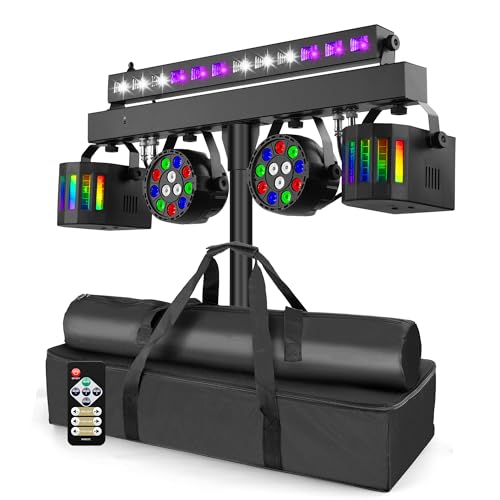
- Includes pars, Derby effects, UV, and strobe LEDs
- 7.2-foot stand with carry bags
- Sound, remote, auto-program, and DMX512 control
Best For: DJs, wedding entertainers, and mobile bands
Best for Flexible Programming

- Four 36W fixtures with 36 RGB LEDs each
- Nine modes, including sound, strobe, fade, and auto
- Remote and 7-channel DMX512 control
Best For: Small stages, events, and flexible home setups
Focused Spotlight Pick

- 200W COB output with listed 20,000-lumen maximum
- Adjustable barn doors control light spill
- DMX512 and master-slave support
Best For: Focused lighting for churches, concerts, weddings, and events
Bulk Uplighting Value

- 12 compact RGB par lights for coordinated coverage
- Remote, sound-activated, and DMX512 modes
- Adjustable stands for floor, table, or hanging use
Best For: Parties, weddings, DJs, and colorful event uplighting
Dynamic Movement Choice

- Two fixtures with RGBW color mixing
- 540° pan and 180° tilt movement
- DMX512, sound, remote, and automatic modes
Best For: DJs, live shows, clubs, and moving stage effects
Best All-in-One Kit – 120W RGBW 4-Par Gigbar with Stand
For buyers seeking stage lights for live performances with minimal setup, this 120W RGBW package combines a four-par light bar, tripod, carry bag, remote, and power cord. Its 7.2-foot stand, sound activation, and DMX compatibility make it adaptable for mobile DJs, bands, weddings, parties, and church events.
Best For: Mobile DJs and performers who want a portable, ready-to-use lighting package.
Pros:
- Complete package includes stand, bag, remote, and power cord.
- RGBW LEDs provide varied color effects, including warm and cool tones.
- Supports DMX, sound-activated operation, dimming, and adjustable 0–20Hz strobe effects.
- Lightweight design and included tote bag simplify transport and storage.
Cons:
- The corded setup requires access to a power source.
- The four-par bar is less individually directional than separate moving-head fixtures.
This is a practical starter-to-intermediate system for performers who value fast deployment and broad coverage over highly complex beam movement.
Best Moving-Effect Fixture – 150W RGBW Four-Arm Moving Head
This 150W fixture is designed for stage lights for live performances that need movement, beams, strobes, and changing patterns. Four rotating arms, a 540-degree moving head, and five control modes give DJs and event planners plenty of ways to create dynamic coverage.
Best For: DJs and event planners who want animated, multi-effect lighting in a compact fixture.
Pros:
- Combines RGBW beams, strobes, pulses, sweeps, chases, and dimming.
- Four arms rotate 90 degrees while the head swivels 540 degrees.
- Offers DMX512, sound-activated, remote, auto-run, and master-slave modes.
- Includes a DMX cable and uses a metal base with an ABS lamp body.
Cons:
- It is a single fixture, so larger stages may require multiple units.
- The moving effects may be more than needed for simple, static accent lighting.
Choose this model when motion and visual variety matter more than a simple wash. Its control flexibility also allows it to work for beginners or more structured DMX setups.
Best Follow Spotlight – 200W Manual Multicolor Stage Spot
For stage lights for live performances that need focused illumination, this 200W follow spotlight uses a glass lens to project light approximately 32.8 to 65.6 feet. Manual color selection and an adjustable tripod make it suited to performers, theaters, event spaces, and presentations requiring a concentrated beam.
Best For: Theater operators, event hosts, and performers who need a manually controlled spotlight.
Pros:
- 200W LED output is designed for long-distance focused illumination.
- Six selectable colors can be adjusted with the control knob.
- Tripod height adjusts from 3.84 to 6.6 feet.
- Cast aluminum housing, glass lens, triangular bracket, and non-slip feet support stability.
Cons:
- Manual control is less convenient than DMX or sound-activated operation.
- It provides focused spotlighting rather than broad, animated stage coverage.
- The corded design requires a nearby power source.
This is a focused tool rather than an all-purpose light show. It makes the most sense when highlighting a speaker, soloist, performer, or defined area is the main goal.
Best Two-Light Value – U`King 25W Moving Head Pair
This two-piece set offers compact stage lights for live performances with rotating beams, gobos, and color effects. Each 25W moving-head fixture supports DMX512, sound activation, automatic operation, and master-slave control, making the pair useful for mobile entertainment and synchronized setups.
Best For: DJs and small-stage users who want two coordinated moving-head fixtures.
Pros:
- Two fixtures provide more balanced coverage than a single compact light.
- Includes eight gobos, eight colors, gobo rotation, shaking, and half-color effects.
- Each head scans 540 degrees horizontally and 270 degrees vertically.
- Supports automatic, sound-activated, DMX512, master-slave, and strobe modes.
Cons:
- The 25W output is more suited to smaller venues than large stages.
- No remote control is included.
- The listed warranty period is shorter than some competing fixtures.
This pair is a good fit for buyers prioritizing movement and pattern variety on a smaller budget. Use DMX or master-slave mode when synchronized effects are more important than maximum brightness.
Best Value Par Light Pack – 36W RGB 4-Pack
For shoppers comparing stage lights for live performances, this four-pack offers a practical way to add synchronized RGB color across a small stage or event space. Each 36W par light supports remote, sound-activated, auto, master-slave, and DMX512 control, making the set flexible for both simple setups and more advanced lighting rigs.
Best For: DJs, mobile performers, parties, and small live performance setups needing multiple compact RGB fixtures.
Pros:
- Four compact lights provide broad coverage for the price.
- Supports remote control, sound activation, auto mode, master-slave operation, and DMX512.
- 36 RGB LEDs and a 25-degree beam angle produce dynamic color effects.
- Lightweight ABS-and-metal construction supports floor or truss mounting.
Cons:
- These are RGB fixtures rather than RGBW lights, so they do not provide a dedicated white LED channel.
- At 36W per fixture, they may be better suited to smaller venues than large stages.
This pack is a strong choice when quantity and control flexibility matter more than high-output professional fixtures. The included remotes also make it usable without an additional controller for many basic lighting needs.
Best All-in-One System – 5-in-1 DJ Light Stand
This 5-in-1 package is an all-in-one option for stage lights for live performances, combining RGBW par lights, Derby effects, UV lighting, and white strobe LEDs on a portable stand. Its sound activation, IR remote, control panel, and DMX512 support let users move from quick setup to programmed operation.
Best For: DJs, wedding entertainers, live bands, and event hosts who want a complete lighting system with its own stand.
Pros:
- Combines two RGBW par lights, two RGBW Derby lights, and a center UV/strobe bar.
- Includes an adjustable stand reaching up to 7.2 feet and carry bags for transport.
- Offers sound activation, IR remote control, six auto programs, and DMX512.
- RGBW, UV, and strobe effects add more variety than basic RGB pars.
Cons:
- The complete system weighs about 9.68 kg, so it is less lightweight than a simple par-light pack.
- The listed manufacturer’s warranty is six months.
Choose this system if you value an integrated stand and varied effects over the ability to position four separate fixtures independently. It is especially convenient for performers who regularly set up and break down their own lighting.
Best for Flexible Programming – 36W RGB Par Lights
These four 36W RGB par lights are a versatile choice for stage lights for live performances, with nine operating modes covering static colors, fades, jumps, strobes, sound activation, master-slave synchronization, and DMX512 control. Adjustable brackets allow each fixture to sit on the floor or attach to a truss or stage bar.
Best For: Performers, event planners, and home users who want multiple RGB fixtures with straightforward remote operation and DMX compatibility.
Pros:
- Four fixtures use 36 RGB LEDs each for layered color effects.
- Nine lighting modes provide useful variety for parties, theaters, weddings, and performances.
- Supports remote control and professional 7-channel DMX512 operation.
- Adjustable brackets and included stands support floor, stage-bar, or truss placement.
Cons:
- The RGB design does not include a dedicated white LED channel.
- Each light is 36W, which may limit coverage in larger venues.
This set suits buyers who want more built-in modes than a basic color-changing light while retaining the option to expand into DMX control. Its four-fixture format also makes it easier to distribute color across a small performance area.
Focused Spotlight Pick – COB Barn-Door Stage Light
For stage lights for live performances that need concentrated, adjustable illumination, this 200W COB fixture combines warm white and white output with barn doors for controlling spill. Its DMX512 support and mounting options make it suitable for permanent or temporary setups.
Best For: Churches, concerts, weddings, and venues needing a bright, focused spotlight.
Pros:
- 200W COB LED produces up to a listed 20,000 lumens.
- Adjustable barn doors help shape the beam and reduce unwanted light.
- Supports DMX512, master-slave operation, and sound control.
- Includes dual mounting brackets and a cooling fan.
Cons:
- Its 60-degree beam angle is less flexible than a moving-head fixture.
- It provides warm white and white rather than full RGB color mixing.
- The listed dimensions are relatively large for a single spotlight.
This is a practical choice when brightness and beam control matter more than color effects or automated movement. The barn doors are especially useful for keeping light off walls, performers, or nearby scenery.
Bulk Uplighting Value – 12-Pack RGB Par Lights
For stage lights for live performances that need broad event coverage, this 12-piece RGB par-light set offers a coordinated way to add color around a stage, room, or dance floor. Each compact fixture supports remote, sound-activated, automatic, and DMX512 control.
Best For: DJs, wedding venues, parties, and users who need multiple compact uplights.
Pros:
- Includes 12 lights with 36 RGB LED beads per fixture.
- Offers remote control, sound activation, DMX512, gradient, and master-slave modes.
- Dual adjustable stands allow floor, tabletop, or hanging placement.
- Low 8–10W-per-light design helps limit power use.
Cons:
- Each fixture is limited to a listed maximum compatible light-source wattage of 10W.
- Plastic construction may be less rugged than metal-bodied professional fixtures.
- The package is designed for colorful ambient lighting rather than high-output spotlighting.
This set makes sense when quantity and synchronized color are more important than intense illumination. The multiple control modes also let beginners start with the remote and expand to DMX control later.
Dynamic Movement Choice – RGBW Moving Head Lights
For stage lights for live performances that need movement and changing effects, this two-pack of RGBW moving-head fixtures provides automated pan and tilt, color mixing, strobe effects, and several control options. Each light uses seven 10W 4-in-1 LEDs with a 25-degree beam angle.
Best For: DJs, live shows, clubs, bars, and event setups that benefit from moving color effects.
Pros:
- RGBW 4-in-1 LEDs create adjustable color washes.
- 540-degree X-axis and 180-degree Y-axis movement expands coverage.
- Supports DMX512, sound activation, remote, master-slave, and automatic modes.
- Two fixtures can create coordinated movement across a performance area.
Cons:
- The 70W-per-fixture output is lower than the 200W COB spotlight option.
- Moving-head programming may require more setup than basic par lights.
- The included manufacturer warranty is listed as 90 days.
This pair is a strong fit when motion, RGBW color, and changing stage looks are central to the show. Choose it over static uplights when automated pan-and-tilt coverage will add more value than sheer spotlight intensity.
How We Picked the Best Stage Lights for Live Performances
We evaluated these fixtures by considering output, beam style, color options, control methods, portability, and suitability for different event sizes. The selection includes several lighting categories because a small DJ setup has different needs from a band, theater production, wedding venue, or touring act.
We also looked for practical features such as DMX512 compatibility, sound activation, remote control, adjustable stands, moving-head movement, gobos, barn doors, and master-slave operation. These features can simplify programming, improve visual variety, or make a kit easier to use without a dedicated lighting technician.
Quick Comparison
- Best for compact color washes: 36W RGB par-light four-packs.
- Best for broad event coverage: 12-piece par-light packages or complete systems with stands.
- Best for dynamic beams: moving-head fixtures with RGBW LEDs, gobos, or multiple channels.
- Best for focused illumination: a 200W follow spot with a stand.
- Best for controlled white light: a 200W COB fixture with barn doors and adjustable color temperature.
Key Buying Factors for Stage Lights for Live Performances
Beam Type and Coverage
Par lights create broad washes that work well for filling a stage with color. Moving heads add motion, beams, and patterns, while a follow spot concentrates light on a performer. Check the beam angle and mounting options if you need even coverage rather than concentrated effects.
Brightness and Venue Size
Wattage is only one indicator of output. Lens design, LED efficiency, beam focus, and the amount of ambient light also matter. Smaller fixtures can suit home events, intimate venues, and accent lighting; larger 150W or 200W units are better candidates for bigger stages or brighter rooms.
Control and Programming
Sound activation and wireless remotes are convenient for quick setups. DMX512 is more useful when you need repeatable cues, synchronized fixtures, dimming, movement, or precise color control. Confirm channel counts and whether cables or a controller are included.
Color and White-Light Quality
RGB fixtures provide vivid effects, while RGBW models generally offer cleaner white and more flexible color mixing. COB fixtures with adjustable white color temperature can be preferable for performers, presenters, or cameras that need more natural illumination.
Setup, Noise, and Transport
Consider fixture weight, stand stability, power connections, cooling fans, and storage. A complete kit may reduce compatibility problems, but separate fixtures can be easier to upgrade or replace. Moving heads also need clearance and a secure mounting position.
Who Should Buy Which Stage Lights for Live Performances?
Mobile DJs and party hosts should prioritize complete packages, sound activation, stands, and remote control for fast deployment. Bands and performers may prefer a combination of RGBW moving heads and par lights so they can create both movement and consistent stage washes.
Theater groups and presenters should consider a follow spot or COB fixture with barn doors when performer visibility and controlled white light matter more than animated effects. Event planners and larger venues may benefit from multi-fixture kits with DMX512 and master-slave operation for synchronized scenes.
Before buying, confirm the included accessories, power requirements, control method, mounting hardware, and return policy. Those details often determine whether a fixture works smoothly in your existing setup.