Passive speaker selector switches make it easier to route one amplifier to multiple speaker pairs, rooms, or listening zones. The right model can add convenient on/off control while helping you organize a home audio system without relying on a receiver with built-in distribution.
This roundup compares 10 options ranging from compact two-way switchers to multi-zone controllers with independent buttons, volume controls, impedance protection, and higher power ratings.
Best 10 Passive Speaker Selector Switches Picks for 2026
Flexible A/B Switching
P2 Passive Amp/Speaker Selector
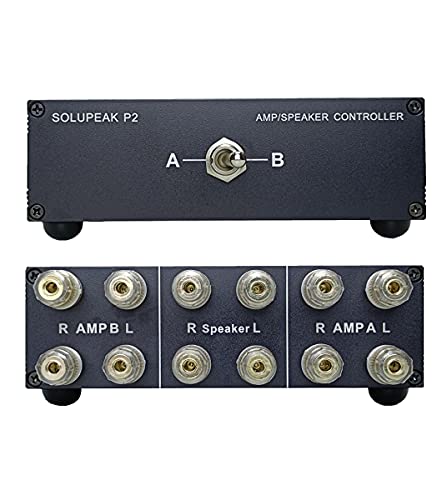
- Reversible amp and speaker switching
- Gold-plated jacks accept up to 12-gauge wire
- 100W RMS per channel; no power required
Best For: Comparing two amplifiers or switching between two speaker pairs
Four-Zone Distribution
Pyle 4-Channel Speaker Selector

- Selects up to four speaker pairs
- Push-button plug-and-play operation
- Handles 100W per channel with 8-ohm minimum speakers
Best For: Distributing stereo audio across multiple speaker pairs
Simple Gear Comparison

- Switches two amps to one pair or one amp to two pairs
- Gold-plated ports accept up to 12-gauge wire
- No external power; 100W RMS per channel
Best For: Quick A/B switching between amps or passive speakers
Multi-Room Protection

- Distributes audio across four speaker zones
- Optional impedance-protection circuit
- Up to 140W per channel without protection enabled
Best For: Multi-zone home theater and whole-home audio distribution
Best Simple 2-Zone Pick
PROZOR 2-Zone Speaker Switch Box

- Independent A/B zone controls
- 150W RMS per channel; 4–16Ω support
- Passive design with no external power
Best For: Simple two-zone home or office audio systems
Best Multi-Zone Control
Monoprice SSVC-4.1 Speaker Selector
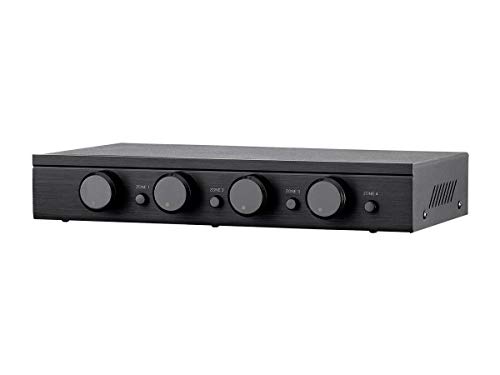
- Four independently controlled speaker zones
- Individual volume and on/off controls
- Automatic impedance protection circuitry
Best For: Four-zone distributed audio from one amplifier
Best Feature-Rich A/B System
Douk Audio VU3 PRO Speaker Selector

- 2-in/2-out amplifier and speaker switching
- 350W maximum pass-through with broad compatibility
- Remote control and dual adjustable VU meters
Best For: High-power amplifier and speaker comparison systems
Best Multi-Room Pick
PROZOR 4-Zone Speaker Selector

- Switches up to four speaker pairs independently
- Passive operation with no external power
- Supports 4–16Ω speakers and 150W RMS per channel
Best For: Four-zone home, patio, shop, or studio audio
Best Simple Two-Zone Option

- Controls two speaker pairs from one amplifier
- No external power supply required
- Front-panel ON/OFF switching with aluminum chassis
Best For: Simple two-zone stereo speaker setups
Best for Independent Volume Control
Pyle PSLSW6 6-Channel Selector

- Controls up to six speaker pairs
- Independent volume controls for each pair
- Overload protection and master speaker switch
Best For: Multi-zone home theater and stereo systems
Flexible A/B Switching – P2 Passive Amp/Speaker Selector
The P2 is a practical choice among passive speaker selector switches when you need either two amplifiers feeding one speaker pair or one amplifier switching between two speaker pairs. Its passive, plug-and-play design and one-press A/B control make equipment comparisons straightforward without cable swapping.
Best For: Audiophiles comparing two amplifiers or switching one amplifier between two speaker pairs.
Pros:
- Supports reversible 2-in/1-out or 1-in/2-out configurations.
- Gold-plated banana jacks accept speaker wires up to 12 gauge.
- Passive operation requires no external power and is rated for 100W RMS per channel.
Cons:
- In 1-in/2-out mode, only speaker pair A or B can operate at a time.
- Tube amplifiers must be in standby or turned off before switching.
With sturdy internal 14 AWG wiring and a compact enclosure, the P2 is a focused option for simple A/B testing and speaker selection, provided you follow the switching precautions with tube amplifiers.
Four-Zone Distribution – Pyle 4-Channel Speaker Selector
The Pyle PSS4 is designed for systems that need passive speaker selector switches with four selectable channels. Its push-button operation provides a simple way to connect up to four separate speaker pairs, making it suited to multi-zone stereo distribution.
Best For: Home audio setups distributing one stereo system to up to four speaker pairs.
Pros:
- Provides four selectable speaker channels labeled A/B/C/D.
- Push-button, plug-and-play operation is straightforward.
- Accepts speaker wires up to 14 gauge and handles 100W per channel with speakers rated at least 8 ohms.
Cons:
- Requires speaker systems with a minimum impedance of 8 ohms.
- The supplied notes do not specify an impedance-protection circuit.
This selector is a practical fit for basic four-pair distribution, but verify speaker impedance and system power requirements before connecting multiple channels.
Simple Gear Comparison – PROZOR 2-Way Speaker Switcher
The PROZOR is a compact option among passive speaker selector switches, allowing two amplifiers to share one speaker pair or one amplifier to switch between two speaker sets. Gold-plated banana connections and a no-power design support quick A/B changes without repeated cable swaps.
Best For: Switching between two amplifiers or two passive speaker sets in a straightforward stereo system.
Pros:
- Supports 2-in/1-out and 1-in/2-out configurations.
- Banana plug ports accommodate speaker wire up to 12 gauge.
- Rated for 100W RMS and 200W peak per channel with no external power required.
Cons:
- Only one input or output position can be selected at a time; simultaneous playback is not supported.
- Internal wiring is 18 AWG, lighter than the 14 AWG wiring specified for some competing models.
For users who prioritize easy A/B comparisons and broad connection compatibility, the PROZOR offers useful flexibility in a small passive switcher, with an 18-month warranty listed in the supplied details.
Multi-Room Protection – Monoprice 4-Channel Selector
The Monoprice 4-Channel Speaker Selector is built for distributing audio to as many as four speaker zones. It stands out among passive speaker selector switches by offering an optional impedance-protection circuit, helping keep the load seen by the amplifier constant when multiple speakers are connected.
Best For: Home theater and whole-home audio systems using up to four speaker zones.
Pros:
- Distributes audio to up to four separate speaker zones.
- Optional protection circuit supports consistent amplifier impedance with multiple speakers in use.
- Supports up to 70W per channel with protection enabled or 140W without it.
Cons:
- Power handling depends on whether the protection circuit is enabled.
- The supplied specifications do not detail connector compatibility for speaker-wire connections.
The Monoprice is the most zone-oriented choice in this group, especially when impedance management matters. Match the protection setting and power level to your amplifier and speaker layout.
Best Simple 2-Zone Pick – PROZOR 2-Zone Speaker Switch Box
If you need straightforward passive speaker selector switches for two listening zones, the PROZOR offers independent A/B buttons in a compact, power-free design. It can connect one amplifier to two speaker pairs, or two amplifiers to one speaker pair, with the important limitation that only one amplifier input should be switched on at a time.
Best For: Home, office, or small distributed-audio setups using 4–16Ω passive speakers.
Pros:
- Independent controls let you select Zone A, Zone B, or both.
- Supports up to 150W RMS per channel and speaker runs up to 164 feet.
- Requires no external power and uses simple spring-clip terminals.
- Solid metal housing includes anti-slip feet.
Cons:
- When using two amplifiers, only one amplifier input should be on at a time.
- Spring-clip terminals may be less convenient than screw or banana connections.
The PROZOR is a practical choice when simple zone switching matters more than extra controls. Its passive operation and broad speaker-impedance support make it easy to add to a basic multi-room system.
Best Multi-Zone Control – Monoprice SSVC-4.1 Speaker Selector
For systems that need several speaker pairs from one amplifier, the Monoprice SSVC-4.1 is a capable passive speaker selector switch with four independently controlled zones. Its impedance protection and built-in volume controls make it especially useful when different rooms need separate on/off and level adjustments.
Best For: Multi-room installations requiring four zones, local volume control, and impedance protection.
Pros:
- Controls up to four speaker zones from a single amplifier.
- Includes individual zone on/off buttons and volume controls.
- Automatic impedance protection helps manage connected speaker loads.
- Heavy-duty screw terminals support 12–18 AWG speaker wire.
Cons:
- It is heavier and less compact than a basic two-zone selector.
- Requires corded electrical power, unlike fully passive units.
- Its impedance requirements should be checked against the amplifier and speaker combination.
The SSVC-4.1 is the more flexible option for a larger distributed-audio setup. Four zone buttons, individual volume controls, and impedance protection provide useful control without requiring separate selector boxes.
Best Feature-Rich A/B System – Douk Audio VU3 PRO Speaker Selector
The Douk Audio VU3 PRO goes beyond basic passive speaker selector switches with 2-in/2-out switching, dual VU meters, remote control, and support for up to 350W of power transmission. It is designed for comparing two amplifiers and two speaker pairs while keeping connections in place.
Best For: Enthusiasts comparing amplifiers and speakers who want high-power handling, remote operation, and visual VU displays.
Pros:
- 2-in/2-out layout supports flexible amplifier and speaker comparisons.
- Handles up to 350W and works with multiple amplifier classes, including tube and digital designs.
- Offers manual and remote controls plus dual adjustable VU meters.
- Uses a metal chassis, copper speaker jacks, relays, and built-in load resistors.
Cons:
- Requires a 5V power supply, so it is not a purely passive, power-free selector.
- Its extra controls and display are more than needed for simple zone switching.
- Banana-plug connections may require compatible cables or adapters.
The VU3 PRO is best suited to a dedicated listening setup where A/B comparison and presentation matter. Its higher power rating and broad amplifier compatibility add flexibility, while the meters and remote make operation more engaging.
Best Multi-Room Pick – PROZOR 4-Zone Speaker Selector
For flexible multi-room audio, the PROZOR is a practical choice among passive speaker selector switches. It connects one amplifier or receiver to up to four pairs of passive speakers, with independent A/B/C/D buttons for convenient zone control.
Best For: Homes, patios, shops, or studios needing four independently switchable speaker zones from one amplifier.
Pros:
- Controls up to four speaker pairs with independent zone buttons.
- Passive design requires no external power adapter.
- Supports 4–16Ω speakers and up to 150W RMS per channel.
- AMP master switch provides convenient all-zone control.
Cons:
- Volume is controlled by the amplifier, not the selector.
- Requires careful power-off and wiring steps during setup.
Its four-zone layout, long-distance wiring support, and sturdy metal housing make this a strong option when simple whole-home distribution matters more than advanced source or volume controls.
Best Simple Two-Zone Option – SOLUPEAK SP2 Speaker Selector
The SOLUPEAK SP2 keeps speaker switching straightforward. This passive speaker selector switch manages two pairs of speakers from one stereo amplifier, using front-panel ON/OFF buttons instead of requiring cable changes.
Best For: Users who need an uncomplicated two-zone speaker switcher with no external power supply.
Pros:
- Controls two speaker pairs from a single stereo amplifier.
- Requires no additional power connection.
- Front-panel buttons make switching quick and convenient.
- Aluminum chassis and speaker posts support a durable setup.
Cons:
- Provides only two speaker zones.
- Does not include independent zone volume controls in the supplied specifications.
Choose the SP2 when you want basic stereo distribution in a compact, easy-to-operate box. Its two-zone capacity is more limited than larger selectors, but that can make it a better fit for smaller systems.
Best for Independent Volume Control – Pyle PSLSW6 6-Channel Selector
The Pyle PSLSW6 stands out among passive speaker selector switches for its combination of six-zone distribution and independent audio controls. It can connect up to six speaker pairs to a stereo receiver, with front-panel selection and volume adjustment for each pair.
Best For: Home theater or stereo systems that need multiple speaker pairs with individual volume control.
Pros:
- Controls up to six speaker pairs from one stereo system.
- Independent volume controls help customize each connected pair.
- Accepts speaker wire up to 14 AWG through screw-type terminals.
- Includes overload protection circuitry and a master speaker switch.
Cons:
- Rated for 100W maximum per channel and 8Ω speakers.
- Its larger tabletop footprint may require more installation space.
- Uses screw terminals rather than binding-post connections.
This is the most feature-focused option in the group for managing many speaker pairs. Verify that your speakers match its 8Ω requirement and 100W-per-channel rating before connecting the system.
How We Picked These Passive Speaker Selector Switches
We focused on practical differences that affect everyday use: the number of speaker zones, supported input and output configurations, power handling, independent zone control, impedance protection, volume adjustment, and overall installation flexibility. We also included compact models for simple A/B switching alongside larger controllers designed for several rooms or speaker pairs.
Because passive selectors do not amplify the signal, compatibility with the connected amplifier and speakers is essential. Product power ratings are useful reference points, but they should not be treated as a guarantee that every amplifier-speaker combination is safe at maximum volume.
Quick Comparison
| Best For | Features to Look For |
|---|---|
| Basic A/B switching | Two-way input/output selection and sturdy mechanical buttons |
| Several speaker pairs | Four or more independently selectable zones |
| Multi-room listening | Zone controls, impedance protection, and convenient labeling |
| Adjusting room volume | Independent volume knobs or zone-level controls |
| System monitoring | VU meters or front-panel status indicators |
Key Buying Factors for Passive Speaker Selector Switches
Inputs, Outputs, and Zones
Check whether the switcher is designed for one amplifier feeding multiple speaker pairs, multiple amplifiers feeding one pair, or both. Two-zone products suit a living room and patio, while four- and six-channel units are better for larger installations. Confirm how the manufacturer defines a channel or zone before buying.
Impedance Protection
When several speaker pairs play simultaneously, the amplifier may see a lower combined impedance. Models with impedance matching or protection are generally safer for distributed audio, especially when the speakers are not wired through a separate multi-room amplifier. Always follow the selector’s wiring and load instructions.
Power Handling
Compare the selector’s stated continuous or RMS rating with the amplifier’s output and your speakers’ requirements. Leave reasonable headroom rather than operating at the published limit, and be cautious with high-powered amplifiers or low-impedance speakers.
Controls and Installation
Independent on/off buttons are useful when rooms need to be controlled separately. Front-panel volume controls can simplify multi-room listening, while compact passive boxes are easier to place in a basic stereo setup. Consider terminal style, cable access, labeling, and whether the unit will sit on a shelf or be mounted.
Who Should Buy Which Passive Speaker Selector Switches?
Choose a compact two-way selector if you only need to switch between two speaker pairs or two audio paths. A four-zone model is a better fit for households connecting several rooms, provided the amplifier can handle the combined load. Six-channel controllers make sense for larger distributed systems where independent room selection matters.
Buy a selector with impedance protection when multiple zones may play at once or when amplifier compatibility is uncertain. Models with volume controls suit installations where each room needs quick adjustment, while a VU-meter-equipped switcher is best for listeners who want visual signal monitoring and a more feature-focused front panel. Before connecting anything, verify the wiring layout, impedance requirements, and power limits for every component.