Choosing the right DMX controller can make event lighting easier to program, trigger, and adapt in real time. The best option depends on fixture count, operator experience, venue size, and whether you need standalone, software-based, MIDI, or wireless control.
This roundup compares 10 DMX controllers for events across different budgets and workflows, helping you narrow the field before investing in a lighting control system.
Best 10 Dmx Controllers for Events Picks for 2026
Classic Scene Control

- 384 DMX channels for multi-fixture control
- Stores 240 scenes in 30 banks
- Six programmable chases with fade and speed settings
Best For: Structured DJ, venue, and stage-lighting rigs
Music-Synced Performance

- Two DMX universe inputs and outputs
- Tactile touch strip, encoders, and RGB pads
- Supports BPM detection and compatible Engine DJ devices
Best For: DJs and performers running responsive light shows
Standalone Show Control

- Computer-free standalone DMX operation
- Four universes with four output sockets
- 37 backlit buttons and four rotary encoders
Best For: Mobile operators managing multi-universe lighting
Budget Scene Programming

- 384-channel DMX512 control
- 30 banks with eight programmable scenes each
- 110–240Vac power support and gooseneck light
Best For: Small venues, clubs, and live-show scene programming
Best App-Based Pick

- 256-channel tablet-based DMX control
- 15,000+ fixture library
- 50 presets and 21 automatic effects
Best For: Mobile event setups and tablet-based lighting control
Best Straightforward Console
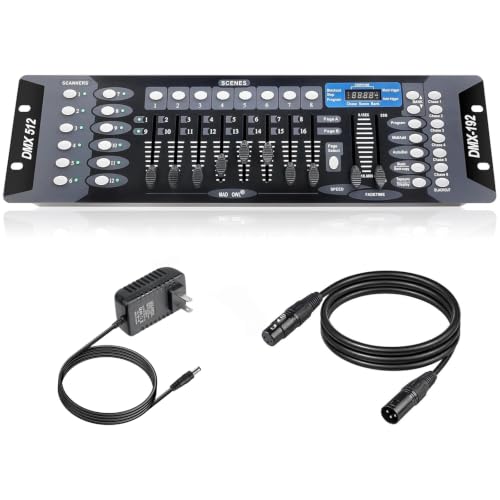
- 192 channels for up to 12 fixtures
- 23 banks of programmable scenes
- Six chases with 240 scene steps
Best For: Small stages, clubs, and hands-on lighting operation
Best High-Capacity Console

- 384 channels for up to 24 fixtures
- MIDI and music-triggered lighting modes
- 30 scene banks and six programmable chases
Best For: Larger DJ, club, and stage lighting rigs
Flexible Scene Builder

- Controls up to 12 fixtures across 192 channels
- Stores up to 240 scenes for repeatable shows
- Voice control and three-pin compatibility
Best For: DJs and small event lighting setups
Rack-Ready Event Control
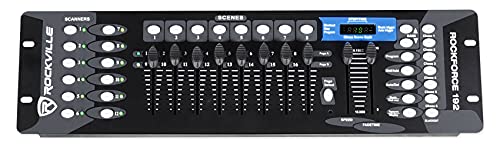
- Controls 192 channels across 12 scanners
- Offers scene banks and six programmable chases
- Adds microphone-based sound activation
Best For: DJs and rack-mounted event lighting systems
Wireless Event Flexibility

- Combines 2.4G wireless and wired XLR modes
- Provides 384 channels for up to 12 lights
- Supports MIDI, sound activation, and 240 scenes
Best For: Weddings, bars, DJs, and flexible indoor stages
Classic Scene Control – CHAUVET DJ Obey 70
The CHAUVET DJ Obey 70 is a practical choice among dmx controllers for events when you want organized scene and chase playback without relying on a computer. Its rack-mount design and 384 channels suit structured stage-lighting setups.
Best For: DJs, venues, and event operators programming multiple intelligent lights and repeatable shows.
Pros:
- Stores up to 240 scenes across 30 banks of eight.
- Controls up to 12 intelligent lights with up to 32 channels each.
- Supports six chases and programmable fade and speed times.
- Rack-mount construction and 384 DMX channels provide a tidy, capable setup.
Cons:
- It is a corded, rack-mount controller rather than a compact wireless option.
- Its listed 6.9-pound weight may be less convenient for highly mobile setups.
The Obey 70 stands out for event teams that value repeatable programming and substantial scene capacity. It is best suited to planned lighting rigs with several fixtures and dedicated control space.
Music-Synced Performance – SoundSwitch Control One
The SoundSwitch Control One brings hands-on control to dmx controllers for events, pairing tactile performance controls with SoundSwitch software. It is especially useful when lighting needs to respond to DJ sets, live audio, or changing stage conditions.
Best For: DJs and performers who want real-time control over music-synced lighting effects.
Pros:
- Provides two DMX universe inputs and outputs with a thru option.
- Offers a touch strip, encoders, and customizable RGB performance pads.
- Supports live audio BPM detection from external audio sources.
- Connects directly with compatible Engine DJ devices without a computer.
Cons:
- SoundSwitch software is required for its primary 1:1 control workflow.
- Some AlphaTheta PRO DJ LINK Bridge configurations require a laptop.
Control One is a strong fit when expressive, hands-on lighting adjustments matter as much as programmed playback. Its broad source compatibility makes it flexible, but buyers should account for the software and hardware requirements of their preferred setup.
Standalone Show Control – ADJ Wolfmix WMX1 MK2
The American DJ Wolfmix WMX1 MK2 is a compact standalone option among dmx controllers for events. Its backlit buttons and rotary encoders are designed for direct operation during performances, while four universes provide room for larger lighting systems.
Best For: Event operators who want computer-free, hands-on control of multi-universe DMX lighting.
Pros:
- Standalone controller with 37 backlit silicone buttons.
- Four rotary encoders provide direct parameter adjustment.
- Supports up to four universes and includes four output sockets.
- At 2.36 pounds, it is relatively portable for event work.
Cons:
- The supplied notes do not specify scene, chase, or fixture-storage capacity.
- Its control layout may require familiarization before live operation.
The WMX1 MK2 is appealing for mobile lighting teams that prefer dedicated hardware over a computer-based workflow. Its four-universe design offers considerable expansion potential in a small footprint.
Budget Scene Programming – DMX512 384CH DJ Controller
This DMX512 console is a straightforward choice among dmx controllers for events when scene banks and channel count are the priority. It offers 384-channel control, programmable scenes, and a compact console layout for bar, club, and live-show lighting.
Best For: Small venues and event setups that need programmable scenes across conventional DMX fixtures.
Pros:
- Provides 384 DMX channels for detailed fixture control.
- Includes 30 banks of eight programmable scenes.
- Supports DMX512 control and a 110–240Vac, 50–60Hz power supply.
- Compact structure includes side handles and an LED gooseneck light.
Cons:
- The supplied dimensions are inconsistent, so buyers should verify the physical size before installation.
- The notes do not specify the number of fixtures or chase capacity.
- Its listed 6-pound weight may be less convenient for frequent transport.
This controller offers a familiar, scene-oriented approach for operators who want substantial channel capacity without a computer-based description. Verify dimensions and fixture requirements before committing it to a permanent rack or mobile case.
Best App-Based Pick – MyDMX Go Wireless Controller
For event planners who want streamlined dmx controllers for events, the ADJ MyDMX Go combines tablet-based control with wireless connectivity and a broad fixture library. Its app-focused design avoids traditional programming while still offering manual displays, presets, and automatic effects.
Best For: Mobile event setups, DJs, and users who prefer tablet-based lighting control.
Pros:
- 256-channel control through an iPad or Android tablet
- Supports more than 15,000 fixtures
- Offers 50 user presets and 21 automatic effects
- Compact interface includes mounting brackets and supports two lighting universes
Cons:
- Requires a compatible tablet for app-based operation
- Advanced upgrades are available separately
The MyDMX Go is a practical choice when portability and quick setup matter more than hands-on fader control. Its zero-programming approach can help event operators create effects efficiently across varied lighting systems.
Best Straightforward Console – 192-Channel DMX Board
This 192-channel console is a conventional option for buyers comparing dmx controllers for events and wanting physical faders and buttons. It controls up to 12 fixtures with 16 channels or fewer and supports programmable scenes and chases for stage or DJ lighting.
Best For: Small stages, clubs, and performance venues that need hands-on console control.
Pros:
- 192 channels control up to 12 lighting fixtures
- Provides 23 banks of 8 programmable scenes
- Supports six programmable chases with up to 240 scene steps
- Includes a 6.6-foot DMX cable
Cons:
- Offers fewer channels than the 384-channel alternative
- Uses a corded, rack-mount console design rather than an app interface
Choose this controller if you prefer tactile adjustments and straightforward scene programming. It is well suited to smaller event lighting systems where 192 channels provide sufficient fixture coverage.
Best High-Capacity Console – RockForce 384 DMX Controller
The RockForce 384 is built for larger lighting rigs and is a strong contender among dmx controllers for events requiring more fixture capacity. It operates up to 24 intelligent lights, adds MIDI and music-triggered modes, and stores scenes and chases for repeatable shows.
Best For: DJs, clubs, and stages running multiple intelligent lights with physical control needs.
Pros:
- 384 channels support up to 24 fixtures with 16 channels each
- Stores 30 banks of 8 scenes and six programmable chases
- Includes MIDI control and a built-in microphone for music mode
- Metal housing, LED display, gooseneck lamp, and 110–240V power support
Cons:
- Larger and heavier than a compact app-based interface
- Provides six chases, which may limit users seeking more chase slots
With twice the channel capacity of a basic 192-channel board, the RockForce 384 makes sense for expanding event rigs. MIDI, music mode, manual override, and power-failure memory add flexibility for live operation.
Flexible Scene Builder – CO-Z 192 DMX Controller
The CO-Z 192 DMX controller is a practical starting point for DJs, event hosts, and small venues that need hands-on control over multiple fixtures. Its 192-channel layout supports up to 12 intelligent lights, while scene and chase storage helps you prepare repeatable lighting looks for events.
Best For: DJs, weddings, church gatherings, family events, and small stage setups using compatible DMX fixtures.
Pros:
- Controls up to 12 fixtures with up to 16 channels each.
- Supports up to 240 scenes for more complex show programming.
- Includes voice control and a layout designed for easier operation.
- Works with compatible three-pin DMX equipment, including fog machines and par lights.
Cons:
- Its 192-channel capacity may be limiting for larger, more fixture-heavy productions.
- Uses a corded electric power source and is not described as wireless.
For buyers comparing DMX controllers for events, this model emphasizes accessible controls and flexible scene storage rather than advanced networking features. The one-year warranty and upgraded controls add practical reassurance for regular event use.
Rack-Ready Event Control – Rockville ROCKFORCE 192
The Rockville ROCKFORCE 192 is a rack-style option for event operators who want dedicated control of lighting and fog effects. It manages 192 channels across 12 scanners and combines programmable scenes, chases, music triggering, and a straightforward LED interface.
Best For: DJs, event planners, concerts, parties, and theatrical productions using DMX-512 lighting or fog systems.
Pros:
- Controls 192 channels across 12 scanners with 16 channels each.
- Provides 23 banks of eight scenes and six chases of 240 scenes.
- Built-in microphone enables sound-activated lighting effects.
- Metal-and-plastic construction and a 3U rack format suit organized setups.
Cons:
- Its 192-channel capacity may not suit larger lighting systems.
- The 3U rack design is less compact than a small tabletop controller.
Among DMX controllers for events, the ROCKFORCE 192 is a sensible choice when repeatable programming and music-synced effects matter. Its physical layout is aimed at approachable operation, while the scene and chase banks provide room for prepared event sequences.
Wireless Event Flexibility – DMX512 384-Channel Controller
This 384-channel DMX512 controller stands out for event setups that need both wireless and traditional wired connections. It supports up to 12 intelligent lights, sound-activated and MIDI control, and programmable scene banks for weddings, bars, discos, and indoor stages.
Best For: DJs, wedding stages, bars, discos, churches, banquet halls, and live indoor events needing flexible fixture placement.
Pros:
- Provides 384 channels while supporting up to 12 intelligent lights.
- Offers 2.4G wireless transmission alongside three-pin XLR wired control.
- Includes sound-activated, automatic, manual, and MIDI control modes.
- Stores 30 banks and 240 preset static scenes with scene editing functions.
Cons:
- Wireless operation may require more setup planning than a fully wired system.
- The supplied details do not specify a warranty or fixture-brand compatibility list.
- It requires a 9V battery in addition to its event-control hardware.
For buyers seeking DMX controllers for events, the dual-mode connection is the main advantage: wireless transmission can simplify layouts, while XLR provides a conventional fallback. Its higher channel count and MIDI support also give growing event setups more control headroom.
How We Picked the Best Dmx Controllers for Events
We focused on controllers that suit common event-production needs, including DJ lighting, mobile entertainment, clubs, stages, school performances, and small-to-mid-sized venues. The comparison considers channel capacity, fixture support, scene and bank programming, playback controls, software or app integration, MIDI compatibility, wireless operation, portability, and rack-mount practicality.
Because event setups vary widely, no single console is ideal for everyone. A compact controller may be easier for a mobile DJ, while a standalone or software-connected system can offer more sophisticated automation for recurring productions.
Quick Comparison
- Best for traditional hands-on control: Look for physical faders, fixture buttons, scene memories, and straightforward DMX addressing.
- Best for software-based workflows: App- and computer-compatible controllers can simplify programming and offer visual control.
- Best for wireless setups: Dual-mode or wireless-capable systems can reduce cable runs, provided the venue has a dependable signal environment.
- Best for larger fixture counts: Controllers with 384 channels or more provide additional room for moving lights, pars, effects, and future expansion.
- Best for integrated show control: MIDI, sound activation, and dedicated playback features help coordinate lighting with music and other stage effects.
Key Buying Factors for Dmx Controllers for Events
Channel Capacity and Fixture Compatibility
Check the controller’s total DMX channels and how many fixtures or fixture profiles it can manage. A 192-channel unit may be sufficient for a small rig, while larger events benefit from 384 channels or more. Confirm that your lights use standard DMX512 and that the controller supports their channel layouts.
Programming and Playback
Consider how quickly you need to build scenes, chases, banks, and cues. Physical controls are useful for live adjustments, whereas app or computer-based systems may make complex programming easier. Sound activation and MIDI support are valuable when lighting must follow music or a broader show sequence.
Connectivity and Reliability
Inspect the DMX input and output configuration, cable requirements, wireless range, and power arrangement. Wired DMX remains a dependable choice for permanent or critical installations. Wireless operation adds flexibility but should be tested in the actual venue before a live event.
Portability and Operator Experience
Mobile users should prioritize manageable size, clear labeling, and fast setup. Fixed venues may prefer a rack-mount design or a more capable control surface. Beginners should favor intuitive programming, while experienced operators may value deeper fixture and cue customization.
Who Should Buy Which Dmx Controllers for Events?
Mobile DJs and small event operators should look for compact, easy-to-learn boards with scene memories and sound activation. Clubs and recurring venues may benefit from standalone controllers or app-based systems that support repeatable shows and quick changes. Bands and stage crews should consider MIDI, playback flexibility, and sufficient channel headroom. Production teams managing varied fixtures should prioritize larger channel capacity, robust programming options, and dependable wired connectivity.
Before buying, list every fixture, its DMX channel count, the number of scenes you need, and how the controller will be operated during a show. Matching those requirements to the controller’s workflow is more important than choosing the highest channel count alone.