Choosing among DMX controllers for beginners can be challenging when product listings use similar channel counts but offer very different layouts, programming features, and portability.
This roundup compares 10 accessible options, from compact consoles for a few fixtures to more capable controllers for DJs, parties, venues, and small stage productions.
Best 10 Dmx Controllers for Beginners Picks for 2026
Best Starter Board
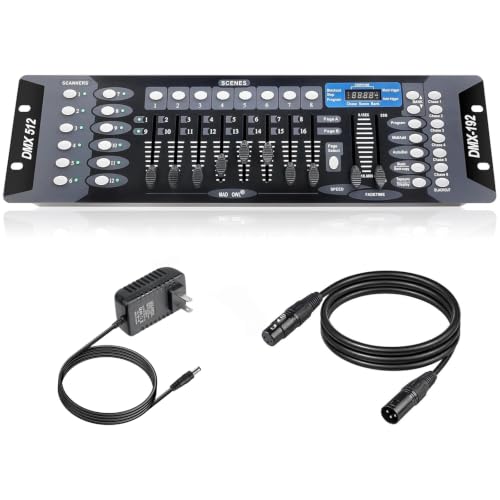
- Controls 12 fixtures with up to 16 channels each.
- Stores 23 banks, 240 scene steps, and six chases.
- Includes a 6.6-foot DMX cable.
Best For: Beginners managing small stage or DJ lighting setups
Best Feature Set

- Controls 192 DMX channels across 12 fixtures.
- Stores 240 scenes and supports six chase sets.
- Includes fog, strobe, MIDI, and reversible-slider controls.
Best For: Growing lighting systems with additional stage effects
Best High-Capacity Pick

- Provides 384 DMX channels for larger setups.
- Stores 30 banks of eight programmable scenes.
- Has side handles and an LED gooseneck light.
Best For: Beginners planning larger club, bar, or live-show systems
Best Compact Option

- Controls up to eight lights with up to 12 channels each.
- Provides 96 DMX channels.
- Supports six chases with up to 999 steps each.
Best For: Small beginner lighting rigs with straightforward chase programming
Best Budget Starter
Compact 14-Channel DMX Controller
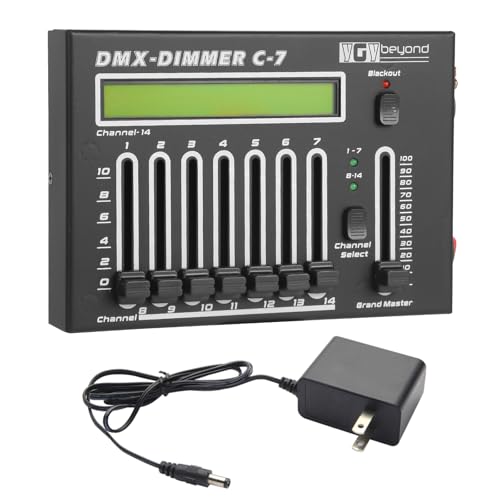
- Standard DMX512 support for common lighting fixtures
- Simple fader layout with LCD status display
- Grand Master and Blackout controls included
Best For: Beginners managing small parties and events
Best for DJ Software Integration

- Controls SoundSwitch lighting software directly
- Two DMX universes with installation-friendly Thru option
- Tactile pads, encoders, and touch strip for live changes
Best For: DJs using compatible Engine DJ or AlphaTheta systems
Best for Larger Fixture Setups

- Controls up to 12 fixtures with 16 channels each
- Stores up to 240 lighting scenes
- Includes voice control and organized operation sections
Best For: Amateurs expanding to multi-fixture lighting rigs
Versatile Scene Control

- Controls up to 24 fixtures with 16 channels each
- Stores scenes and programmable chases
- Adds MIDI and music-triggered control
Best For: Beginners with expanding DJ, club, or stage lighting rigs
Simple Compact Control

- Provides six sub-controls plus a master fader
- Compact aluminum body is travel-friendly
- Supports DMX512 devices up to 12 channels
Best For: Small lighting systems and basic manual dimming
Balanced Programming Value
TCFUNDY 192-Channel DMX Controller

- Controls up to 12 fixtures with 16 channels each
- Stores 240 scenes across programmable chases
- Offers manual and automatic control modes
Best For: Beginners building moderate-size party or stage lighting setups
Best Starter Board – 192-Channel DMX Controller
For shoppers comparing dmx controllers for beginners, this 192-channel board offers a practical introduction to fixture control. Its faders and buttons support real-time adjustments, while 23 banks, 240 programmable scene steps, and six chases provide room to learn and build custom light shows.
Best For: Beginners running small stage, club, or DJ lighting setups with up to 12 fixtures.
Pros:
- Controls up to 12 fixtures with up to 16 channels each.
- Stores 23 banks of eight scenes and six programmable chases.
- Includes a 6.6-foot DMX cable and uses straightforward faders and buttons.
Cons:
- Offers fewer channels and banks than the larger 384-channel option.
- Its rack-mount form and 22.44-inch width may be bulky for compact setups.
This is a sensible learning-focused controller if you want hands-on programming without immediately moving to a higher-capacity console.
Best Feature Set – CHAUVET DJ OBEY40 Controller
The CHAUVET DJ OBEY40 is a strong choice among dmx controllers for beginners who expect their setup to grow. It combines 192 channels with extensive scene storage, chase playback, fog and strobe controls, MIDI compatibility, and reversible sliders for flexible operation.
Best For: Beginners and newer operators building more complex lighting systems with fog or strobe effects.
Pros:
- Controls up to 12 fixtures with up to 16 channels each.
- Provides 30 banks of eight scenes and six chase sets.
- Adds fog and strobe controls, MIDI compatibility, and reversible sliders.
Cons:
- At 6.7 pounds, it is heavier than some compact controllers.
- Its expanded feature set may require more setup time for first-time users.
Choose the OBEY40 if you want beginner-accessible physical controls but also need organized programming and dedicated effect control for a more involved show.
Best High-Capacity Pick – 384-Channel DMX Controller
This 384-channel console gives beginners using dmx controllers for beginners plenty of capacity for future expansion. It supports 30 banks of eight programmable scenes and is designed for editing live-show lighting with smooth transitions across larger fixture arrangements.
Best For: New users who want substantial channel capacity for bar, club, live-show, or stage lighting.
Pros:
- Offers 384 DMX channels for broad fixture control.
- Provides 30 banks with eight programmable scenes each.
- Includes a compact structure, side handles, and an LED gooseneck light.
Cons:
- Its higher channel count may be more controller than a small beginner setup needs.
- The supplied notes do not specify a DMX cable or detailed fixture-channel limits.
If expansion matters more than minimal controls, this console provides considerable programming headroom while retaining practical features for live operation.
Best Compact Option – CHAUVET DJ OBEY 10
The CHAUVET DJ OBEY 10 keeps the controls focused for shoppers seeking dmx controllers for beginners. With 96 DMX channels, support for up to eight intelligent lights, and six chase sets with up to 999 steps each, it suits straightforward setups where a smaller fixture count is sufficient.
Best For: Beginners controlling a limited number of intelligent lights with programmable chase sequences.
Pros:
- Controls up to eight intelligent lights with up to 12 channels each.
- Offers 96 DMX channels in a compact controller format.
- Supports six chases with up to 999 steps each.
Cons:
- Controls fewer fixtures and channels than the other controllers in this roundup.
- Provides less stated scene-bank capacity than the 192- and 384-channel options.
This is the simplest fit when your lighting rig is modest and you prefer a focused controller rather than paying for capacity you may not use.
Best Budget Starter – Compact 14-Channel DMX Controller
For shoppers seeking DMX controllers for beginners, this compact 14-channel console offers a straightforward way to manage compatible stage, DJ, PAR, moving-head, and strobe lights. Its simple controls, LCD display, and low-power design suit small events and home practice.
Best For: Beginners running lighting for parties, weddings, KTV rooms, bars, and small performances.
Pros:
- Supports standard DMX512 and provides independent channel control.
- Seven faders per page switch between channels 1–7 and 8–14.
- Grand Master and one-press Blackout controls simplify overall brightness and emergency shutoff.
- Compact 1.83-pound body is easy to carry and store.
Cons:
- Its 14-channel layout is more limited than larger controllers for complex shows.
- Requires a compatible 9V–12V DC, 0.5A power adapter.
This is a practical entry-level option when portability and quick manual control matter more than extensive scene programming. The LCD status display and clearly arranged faders make it approachable for first-time users.
Best for DJ Software Integration – SoundSwitch Control One
Among DMX controllers for beginners, the SoundSwitch Control One is a strong choice for users who want hands-on lighting control alongside DJ software or compatible Engine DJ hardware. It combines tactile controls with software-based show customization.
Best For: DJs and performers building synchronized lighting shows with SoundSwitch, Engine DJ, or supported AlphaTheta setups.
Pros:
- Provides 1:1 control for SoundSwitch software with two DMX universes and a Thru option.
- Works plug-and-play with compatible Denon DJ and Numark Engine DJ devices without a computer.
- Touch strip, encoders, and RGB performance pads offer responsive live adjustments.
- Supports BPM detection from live audio, DAWs, and DJ software using supported inputs.
Cons:
- Many compatibility and advanced features depend on SoundSwitch software or supported DJ hardware.
- Rekordbox use through PRO DJ LINK Bridge requires a laptop running SoundSwitch.
The Control One is less of a standalone beginner console and more of a dedicated interface for software-driven lighting. It makes the most sense if your DJ setup already fits the supported ecosystem.
Best for Larger Fixture Setups – CO-Z 192-Channel DMX Console
For beginners who expect to expand beyond a few fixtures, this 192-channel console provides considerably more control than basic entry-level boards. It can manage up to 12 intelligent lights with up to 16 channels each and store up to 240 scenes.
Best For: Amateur DJs, small venues, churches, weddings, and users managing multiple intelligent lights and scenes.
Pros:
- Controls up to 12 fixtures with up to 16 channels each.
- Supports up to 240 scenes for more involved lighting shows.
- Organized sections cover fixture selection, scenes, channels, pages, timing, and functions.
- Includes voice control and a three-pin cable for compatible equipment such as fog machines.
Cons:
- The 3.9-pound, 19.1-inch-wide design is less portable than mini consoles.
- Its larger number of controls may require more learning time for complete beginners.
- The supplied notes specify 130-volt corded power, which may require attention to local power compatibility.
This CO-Z board is a better fit for beginners who want room to grow into multi-fixture setups. Its scene capacity and broad control layout are useful, though the larger console may be more than needed for a simple party rig.
Versatile Scene Control – Rockville ROCKFORCE 384
For beginners shopping for DMX controllers, the Rockville ROCKFORCE 384 offers room to grow without requiring computer software. Its 16 sliders, scene banks, programmable chases, MIDI support, and built-in microphone provide several ways to control a larger lighting setup.
Best For: Beginners managing multiple fixtures for DJ setups, clubs, stages, or programmed light shows.
Pros:
- Controls up to 24 intelligent lights with 16 channels each.
- Stores 30 banks of 8 scenes and 6 programmable chases.
- Includes MIDI, music-triggered modes, manual override, and power-failure memory.
- Metal housing, LED display, and included gooseneck lamp suit dark environments.
Cons:
- Its 20.71-inch width and 5.3-pound weight make it less portable than mini controllers.
- The larger feature set may take more time for a complete beginner to learn.
This is a strong choice if you want a hands-on controller with substantial scene capacity and support for a growing DMX rig. The universal 110–240V power supply also adds flexibility for different setups.
Simple Compact Control – MAD OWL 12-Channel DMX Dimmer
Among DMX controllers for beginners, the MAD OWL 12-channel unit is a straightforward option for small lighting systems. Six sub-control faders, one master fader, and a blackout button keep the control layout simple and portable.
Best For: Beginners controlling small DMX512 lighting setups with no more than 12 channels.
Pros:
- Simple layout with six sub-control faders and a main control fader.
- Compact aluminum design measures 7.09 by 3.94 by 1.38 inches.
- Uses a standard 3-pin XLR DMX output for connection to compatible equipment.
- Lightweight design is convenient for travel and quick installation.
Cons:
- It cannot be used with stage lighting equipment requiring more than 12 channels.
- It is a basic dimming controller rather than a scene- and chase-programming console.
This controller makes the most sense when your priority is uncomplicated manual dimming in a compact package. Check your fixtures’ channel requirements before buying to ensure they fit within the 12-channel limit.
Balanced Programming Value – TCFUNDY 192-Channel DMX Controller
The TCFUNDY 192-channel console is a practical middle ground for beginners who want programmable lighting control without stepping up to a larger 384-channel board. It combines fixture selection, scene programming, chase storage, manual faders, and automatic operation in a dedicated console.
Best For: Beginners running several party, DJ, wedding, church, or small stage fixtures.
Pros:
- Controls up to 12 intelligent lights with up to 16 channels each.
- Stores 30 banks of 8 scenes and 6 programmable chases containing 240 scenes.
- Includes manual channel control plus speed and fade-time sliders for auto mode.
- Supports compatible fixtures through a 3-pin XLR connection and includes a 3-pin cable.
Cons:
- Its 12-fixture capacity is lower than controllers designed for 24 fixtures.
- The console still requires learning its separate fixture, scene, channel, and function sections.
- The supplied notes do not specify software-update support.
This model is a sensible starting point if you want physical controls and programmable shows for a moderate-size rig. Its scene and chase capacity gives beginners useful automation while retaining hands-on fader control.
How We Picked the Best Dmx Controllers for Beginners
We focused on controls that are practical for first-time users: clearly labeled faders and buttons, straightforward fixture and scene programming, useful master and blackout controls, and compatibility with common DMX512 lighting fixtures. We also considered channel capacity, portability, MIDI or software support, included accessories, and whether each controller suits simple plug-and-play use or a more expandable setup.
A higher channel count is not automatically better. Beginners often benefit more from an intuitive layout and reliable basic controls than from features they will not use. The right choice depends on the number of fixtures, the complexity of the show, and whether you want hands-on hardware or computer-based control.
Quick Comparison
| What to Compare | Best For | Why It Matters |
|---|---|---|
| Channel count | Matching your fixture needs | Determines how many DMX channels you can control |
| Fixture capacity | Multi-light setups | Shows how many individual fixtures can be addressed |
| Scenes and banks | Automated looks | Lets you save and recall lighting states |
| Portability | Mobile DJs and parties | Smaller consoles are easier to transport and position |
| Software or MIDI support | Advanced workflows | Provides more control options as your system grows |
Key Buying Factors for Dmx Controllers for Beginners
Channel and Fixture Capacity
Count the DMX channels your lights require, then leave room for expansion. A fixture using 8 channels consumes more capacity than a basic dimmer, and pan, tilt, color, gobo, and effect controls can add up quickly. Controllers with 192 or 384 channels are common starting points, but fixture capacity and programming structure are equally important.
Programming and Scene Control
Look for direct-access faders, dedicated fixture buttons, programmable scenes, chases, banks, and a master dimmer. A blackout button is especially useful for quickly cutting the output between songs or during setup. Beginners should favor a layout they can understand without constantly consulting the manual.
Connections and Compatibility
Most traditional consoles use 3-pin DMX connections, although cable arrangements vary. Confirm the controller matches your fixtures and use proper DMX cables rather than ordinary microphone cables where possible. Check whether cables, adapters, or terminators are included before buying.
Portability and Future Growth
Compact mini consoles suit small parties and simple fixtures, while larger boards provide more hands-on control for stage or club systems. If you may add moving heads, fog machines, or several fixture groups, choose extra capacity and scene memory rather than buying only for today’s setup.
Who Should Buy Which Dmx Controllers for Beginners?
Choose a compact 14-channel or 12-channel controller if you operate a few simple fixtures and prioritize low cost, quick setup, and portability. A 192-channel board is a sensible middle ground for many beginner DJ rigs, party lights, and small venues. Consider a 384-channel model if you expect to control multiple fixtures, create more elaborate scenes, or add lighting over time.
Controllers with dedicated fog-machine support can suit mobile entertainers, while MIDI-capable hardware is more useful for users integrating lighting with music equipment. SoundSwitch Control One is better suited to buyers who want a software-centered or performance-oriented workflow and are comfortable learning a more specialized system.
Before ordering, list each fixture’s DMX mode and channel requirement, decide whether you need manual or automated control, and verify the console’s connectors. For most first-time users, the best DMX controller is the one that offers enough capacity without making basic lighting cues unnecessarily difficult to program.