Choosing the right DJ mixer for clubs means balancing channel flexibility, sound quality, workflow, connectivity, and booth-friendly durability. The ideal setup depends on whether you mix with decks, control software, or perform from a standalone system.
We selected 10 club-ready options across traditional mixers, four-channel controllers, motorized systems, and portable standalone units so you can match your gear to your performance style and venue needs.
Best 10 Dj Mixer for Clubs Picks for 2026
Flagship Open-Format Choice

- Four-channel club-style workflow
- Track Separation for live mashups
- Rekordbox, Serato, and DMX support
Best For: Serious hobbyists, mobile DJs, and open-format performers
Premium Standalone System
- Motorized 7.2-inch platters
- Standalone Engine DJ operation
- USB, streaming, Serato, and Stems support
Best For: Professional and open-format DJs wanting an all-in-one system
Accessible Club-Style Mixer

- Two-channel professional workflow
- Included rekordbox DVS unlock
- Magvel Fader and channel filters
Best For: Beginners learning club-style mixing at home
Scratch-Focused Serato Controller

- Motorized platters with adjustable torque
- Serato DJ Pro and Stems integration
- 29 FX and performance-oriented controls
Best For: Scratch and mobile DJs using Serato DJ Pro
Club-Ready Layout

- Four-channel layout inspired by club gear
- Full-size jog wheels and performance pads
- Supports rekordbox and Serato DJ Pro
Best For: DJs building club-style skills with creative software control
Portable Standalone Power
- Battery-powered, laptop-free Engine DJ operation
- Wi-Fi streaming and extensive onboard effects
- Balanced outputs plus booth, AUX, and mic connections
Best For: Mobile DJs needing standalone performance and flexible connectivity
Motorized Performance Control

- Seven-inch motorized high-torque platters
- MAG FOUR crossfader and adjustable faders
- Serato stems, DVS, and extensive effects
Best For: Scratch and performance DJs seeking tactile, durable control
Club-Ready Standalone Power
- Four-deck standalone control without a laptop
- Wi-Fi, Bluetooth, USB, and SD media access
- XLR main and booth outputs for flexible setups
Best For: Laptop-free club, mobile, and streaming DJs
Practical Two-Deck Control
Hercules DJControl Inpulse 500

- Two-deck control for Serato and DJUCED
- Large jog wheels and 16 RGB performance pads
- Fold-out feet help protect against spills
Best For: Learning DJs and smaller performance setups
Beginner-Friendly Streaming Choice
- Simple two-channel layout for learning
- Smart Fader assists with blending tracks
- Portable and compatible with computers and mobile devices
Best For: Beginners, home practice, and livestreaming
Flagship Open-Format Choice – Pioneer DJ DDJ-FLX10
For DJs seeking a club-ready workflow without buying separate decks and a mixer, the Pioneer DJ DDJ-FLX10 is a powerful dj mixer for clubs alternative. Its four-channel layout, pro-style effects, and rekordbox and Serato DJ Pro support make it suitable for serious home practice, mobile work, and booth-style setups.
Best For: Serious hobbyists, mobile DJs, and open-format performers who want a future-proof controller.
Pros:
- Four-channel layout mirrors a professional CDJ and DJM workflow.
- Track Separation enables live vocal, drum, and instrument mashups.
- Large jog wheels include multicolor displays for waveforms, artwork, and playing parts.
- Supports rekordbox, Serato DJ Pro, and DMX lighting control.
Cons:
- At 14.8 pounds, it is less compact than a basic two-channel controller.
- Its advanced feature set may be more than beginners need.
The DDJ-FLX10 is a strong choice when club familiarity and creative flexibility matter more than minimal size. Track Separation and lighting output add performance options, while the four-channel design supports more complex sets.
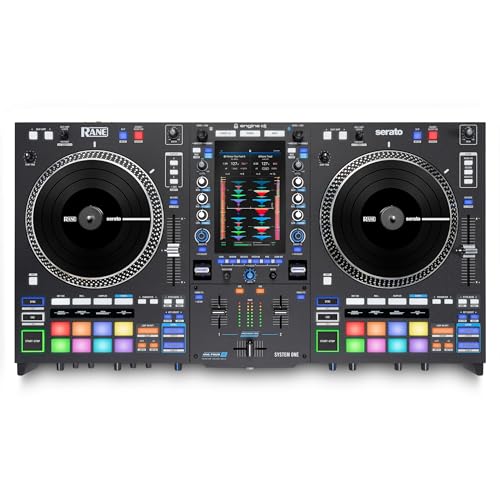
Premium Standalone System – RANE SYSTEM ONE
The RANE SYSTEM ONE is a high-end dj mixer for clubs setup for performers who want motorized platters, standalone operation, and broad media flexibility. Engine DJ OS allows laptop-free mixing, while USB, SD, internal storage, streaming, and Serato DJ Pro integration support varied performance workflows.
Best For: Professional and open-format DJs who want standalone mixing, motorized platters, and extensive creative tools.
Pros:
- Motorized 7.2-inch aluminum platters provide a turntable-style feel.
- Supports USB, SD, internal storage, streaming services, Serato DJ Pro, and djay PRO.
- Standalone Stems, Stem FX, and on-device rendering expand live remixing options.
- Includes extensive FX, touchscreen browsing, professional outputs, and SoundSwitch lighting support.
Cons:
- Its 29.4-pound weight and large footprint make transport more demanding.
- The extensive feature set may require a longer learning curve.
With motorized platters, a touchscreen, standalone Stems, and professional I/O, the SYSTEM ONE is built for ambitious performances. It is especially compelling for DJs who want one system to cover club sets, events, and laptop-free shows.
Accessible Club-Style Mixer – Pioneer DJ DJM-250MK2
The Pioneer DJ DJM-250MK2 is a straightforward dj mixer for clubs practice and home separates setups. Its two-channel arrangement follows a familiar professional-booth workflow, while the dedicated filters, Magvel Fader, and rekordbox DVS unlock make it a practical entry point.
Best For: Beginners and home DJs learning club-style beatmatching with turntables or media players.
Pros:
- Two-channel layout teaches a standard club-mixer workflow.
- Free rekordbox DVS unlock supports mixing digital files with turntables or media players.
- Dedicated Sound Color FX Filter controls add hands-on tone shaping.
- Magvel Fader is designed for smooth blending and light scratching.
Cons:
- Two channels provide less room for layered sets than four-channel options.
- It focuses on essential mixing rather than extensive onboard effects.
The DJM-250MK2 keeps the learning path clear without removing important club-style controls. Choose it if you want a compact, no-fuss mixer for building a separates system and developing core mixing technique.
Scratch-Focused Serato Controller – RANE ONE MKII
The RANE ONE MKII combines a two-channel mixer section with motorized platters and Serato DJ Pro for a hands-on dj mixer for clubs experience. Adjustable platter torque, plunger start/stop buttons, Stems integration, and dedicated effects suit scratch routines, open-format sets, and mobile performance.
Best For: Scratch and mobile DJs who want motorized turntable control with an integrated Serato workflow.
Pros:
- Motorized 7.2-inch platters offer adjustable torque and an authentic turntable feel.
- Serato DJ Pro integration includes Stems performance capabilities.
- Provides 29 internal FX, channel effects, and software FX access.
- Secondary pad buttons and tension-adjustable channel faders support detailed performance control.
Cons:
- Its two-channel design is less suited to complex multi-deck mixing.
- Motorized platters add performance value but can make the controller less minimal for simple sets.
The ONE MKII is a focused choice for DJs who prioritize tactile platter control, scratching, and Serato features. Its white finish, integrated mixer, and pro I/O also make it a practical centerpiece for home studios, clubs, and mobile gigs.
Club-Ready Layout – AlphaTheta DDJ-GRV6
The AlphaTheta DDJ-GRV6 is a strong dj mixer for clubs stepping stone for DJs who want a familiar, performance-focused layout without immediately moving to a full booth setup. Its four-channel, CDJ-3000- and DJM-A9-inspired design supports rekordbox and Serato DJ Pro while adding Groove Circuit and Stems FX tools for live remixing.
Best For: DJs practicing club-style workflows, live remixes, and expressive hands-on control at home or in smaller performance setups.
Pros:
- Club-standard-inspired layout helps build transferable muscle memory.
- Full-size jog wheels and eight pads per side support scratching and performance control.
- Works with both rekordbox and Serato DJ Pro out of the box.
- Groove Circuit and Serato Stems FX add creative remixing options.
Cons:
- Requires a laptop or compatible device for its software-based workflow.
- Its large 28-inch width may be less convenient for compact workspaces.
The DDJ-GRV6 is a practical choice when club familiarity matters most. Choose it for a software-based setup that emphasizes layout, jog-wheel control, and creative performance features.
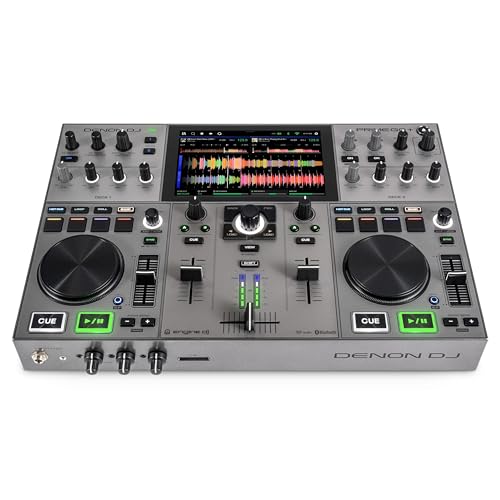
Portable Standalone Power – Denon DJ PRIME GO+
The Denon DJ PRIME GO+ brings dj mixer for clubs capabilities into a compact, battery-powered standalone controller. Engine DJ OS enables laptop-free performances, while built-in Wi-Fi, streaming access, extensive effects, and professional balanced outputs make it adaptable for mobile gigs and smaller club environments.
Best For: Mobile DJs and performers who need standalone operation, wireless music access, battery power, and flexible professional connections.
Pros:
- Runs laptop-free on a rechargeable battery with Engine DJ OS.
- Built-in Wi-Fi supports access to more than 100 million tracks across supported services.
- Offers balanced XLR main outputs, booth outputs, RCA, AUX, and two microphone inputs.
- Includes extensive main, sweep, fader echo, and Touch FX options.
Cons:
- Its compact controls may offer less physical workspace than larger four-channel units.
- Standalone stems require pre-rendering with Engine DJ Desktop.
- Streaming access depends on supported services and connectivity.
The PRIME GO+ is the most flexible choice here for DJs who value portability and independence from a laptop. Its battery operation and broad connection set make it especially useful for mobile performances and compact club rigs.
Motorized Performance Control – RANE PERFORMER
The RANE PERFORMER is a performance-focused dj mixer for clubs built around four channels, motorized high-torque platters, and a robust metal chassis. With Serato DJ Pro integration, DVS support, adjustable-tension faders, extensive effects, and professional outputs, it targets DJs who want tactile control and advanced live manipulation.
Best For: Turntablists, scratch DJs, and performance-oriented users who want motorized platters, detailed stem controls, and durable club-style connections.
Pros:
- Seven-inch motorized aluminum platters provide tactile, vinyl-like control.
- Adjustable-tension volume faders and MAG FOUR crossfader support precise mixing and scratching.
- Includes Serato stem modes, DVS support, and extensive customizable effects.
- Solid metal construction and multiple XLR, TRS, RCA, and headphone connections suit demanding setups.
Cons:
- At 28.2 pounds, it is substantially less portable than compact controllers.
- Requires a corded power source and a computer-based Serato workflow.
- Its advanced feature set may be more than casual DJs need.
The RANE PERFORMER is the specialist option for DJs who prioritize physical expression over portability. Its motorized platters, premium fader system, and sturdy connections make it well suited to scratch-heavy sets and demanding performance work.
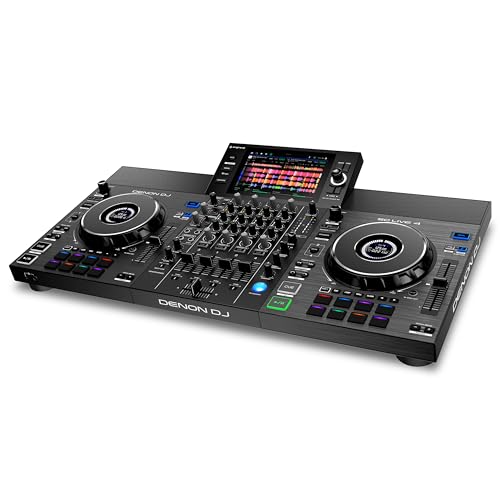
Club-Ready Standalone Power – Denon DJ SC LIVE 4
The Denon DJ SC LIVE 4 is a strong choice for a dj mixer for clubs when you want four-deck control without depending on a laptop. Its Engine DJ operating system, 7-inch touchscreen, wireless streaming, and extensive professional outputs suit mobile performers, streaming setups, and club DJs.
Best For: DJs who want laptop-free four-deck performances with flexible streaming and club connectivity.
Pros:
- Four-deck control with a 3-band EQ and support for Serato DJ Pro and VirtualDJ.
- Wi-Fi streaming, Bluetooth audio input, two USB ports, and an SD card slot.
- XLR main output, RCA main outputs, booth output, and two microphone inputs.
- Built-in speakers and a 7-inch touchscreen add portability and convenience.
Cons:
- Its 28.3-inch width and 13.6-pound weight make it less compact than basic two-deck controllers.
- The built-in speakers may be more useful for practice and monitoring than large club sound systems.
Choose the SC LIVE 4 if flexible media access and standalone operation matter more than a minimal footprint. It offers the broadest club-oriented connectivity and deck control of these three options.
Practical Two-Deck Control – Hercules DJControl Inpulse 500
The Hercules DJControl Inpulse 500 is a practical dj mixer for clubs and learning setups that need two-deck control, a built-in audio interface, and direct hardware input mixing. Its large jog wheels, RGB pads, and raised fold-out feet make it approachable for practice and small performance spaces.
Best For: New and intermediate DJs who want a sturdy two-deck controller for Serato or DJUCED.
Pros:
- Built-in audio interface and hardware input mixer for audio inputs.
- Large touch-sensitive jog wheels support scratching and hands-on control.
- Sixteen backlit RGB pads provide hot cue, loop, and performance control.
- Retractable feet lift the controller above surfaces and help protect it from spills.
Cons:
- Two-deck operation offers less expansion than a four-deck controller.
- USB connectivity may be less flexible for larger club systems than controllers with dedicated XLR and booth outputs.
The Inpulse 500 is a sensible choice when hands-on mixing and beginner-friendly features are priorities. It is better suited to smaller setups and developing DJs than demanding multi-deck club rigs.
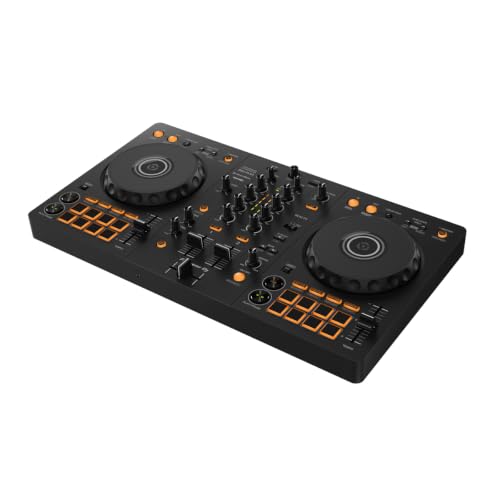
Beginner-Friendly Streaming Choice – Pioneer DJ DDJ-FLX4
The Pioneer DJ DDJ-FLX4 is a compact dj mixer for clubs, practice spaces, and livestreaming setups built around a simple two-channel layout. Smart Fader can assist with volume, bass, and BPM adjustments, while its compatibility with Rekordbox, Serato DJ Pro, and mobile platforms supports an easy upgrade path.
Best For: Beginners and casual performers who want portable two-deck control with streaming and mobile compatibility.
Pros:
- User-friendly layout based on Pioneer DJ professional gear.
- Smart Fader helps blend tracks without advanced beatmatching skills.
- Sixteen performance pads support hot cues, pad effects, beat jump, and sampling.
- Works with PC, Mac, iPhone, iPad, and Android devices and includes a built-in sound card.
Cons:
- Two-channel control is less suitable for complex club sets requiring more decks.
- Its lightweight, portable design may provide fewer dedicated connections than larger club-focused controllers.
The DDJ-FLX4 stands out for accessibility and portability rather than maximum club-system flexibility. Pick it for learning, home practice, or livestreaming when a straightforward workflow is more important than expanded deck control.
How We Picked the Best Dj Mixer for Clubs
We evaluated these products by focusing on the features that matter most in club environments: channel count, input and output connectivity, performance controls, software or standalone capability, portability, and room to grow. We also considered how easily each option fits common booth setups, including powered speakers, monitors, headphones, microphones, media players, turntables, and external effects.
Because a controller and a traditional mixer serve different purposes, this list includes both categories. A controller may offer built-in decks, pads, displays, and software integration, while a standalone mixer is often a better choice for combining media players or turntables. The best pick is the one that matches your existing equipment and preferred workflow.
Quick Comparison
| Best For | Recommended Type | Why It Stands Out |
|---|---|---|
| Professional four-deck sets | Four-channel controller | More room for layered mixes, stems, and live transitions |
| Traditional club booths | Standalone mixer | Integrates naturally with media players and external sources |
| Motorized performance | Motorized controller | Provides turntable-style tactile control |
| Mobile or compact gigs | Portable standalone controller | Reduces dependence on a laptop and large setup |
| New DJs and smaller systems | Two-channel controller | Simpler layout, lower cost, and easier learning curve |
Key Buying Factors for a Dj Mixer for Clubs
Channel Count and Expansion
Two channels are enough for basic transitions, but four channels offer greater flexibility for layered mixes, acapellas, external players, microphones, and live effects. If you expect your setup to grow, buying four-channel gear now can prevent an early upgrade.
Inputs, Outputs, and Booth Compatibility
Check for the connections your venue requires, such as balanced master outputs, booth outputs, microphone inputs, phono inputs, and line inputs. Professional outputs are especially valuable for long cable runs and installed sound systems. Confirm that the unit can connect to your monitors and headphones without adapters.
Software Versus Standalone Operation
Controllers typically depend on Serato, rekordbox, or another DJ platform, while standalone systems can play music directly from supported storage or streaming services. Software setups may provide deeper library management, whereas standalone gear can make the booth cleaner and more reliable when you want fewer devices.
Performance Controls and Displays
Large jog wheels, responsive faders, beat pads, screens, stem separation, looping, and effects can significantly change your workflow. Prioritize controls you will actually use rather than paying for features that add complexity without improving your set.
Who Should Buy Which Dj Mixer for Clubs?
Choose a four-channel controller if you perform complex sets, use stems, or want space for multiple decks. A motorized model is best for DJs who value vinyl-style tactile feedback and scratching. Pick a traditional two-channel mixer when you already own media players or turntables and need a central mixing hub.
Standalone units suit performers who want dependable, laptop-free operation, while compact two-channel controllers are ideal for beginners, home practice, mobile DJs, and smaller venues. Before buying, verify software support, firmware requirements, dimensions, power needs, and the venue’s input and output connections.