The best camera external recorders with HDMI input can extend a camera’s recording time, improve workflow flexibility, and provide cleaner files for editing, streaming, or archiving. The right choice depends on whether you need a compact field recorder, a USB capture device, or a professional deck.
We compared these 10 options by resolution support, recording and passthrough features, connectivity, ease of use, and suitability for different camera setups.
Best 10 Camera External Recorders with Hdmi Input Picks for 2026
Best Standalone 4K Recorder

- Standalone recording to USB or TF card
- 4K24/30 recording with 4K60 passthrough
- H.264/H.265 and pause/resume support
Best For: Simple PC-free 4K capture from HDMI sources
Best Professional Monitor-Recorder

- 5.2-inch, 1500-nit touchscreen monitor
- 4K60 I/O and 8K30 ProRes RAW recording
- CFexpress, Wi-Fi, timecode, and NDI support
Best For: Professional camera and field-production workflows
Best Multi-Camera Capture Card

- Four HDMI inputs with loop-out monitoring
- UVC plug-and-play across major platforms
- 4K60 capture and 100W PD support
Best For: Multi-camera streaming, events, and software production
Best Broadcast Deck
Blackmagic HyperDeck Studio HD Mini
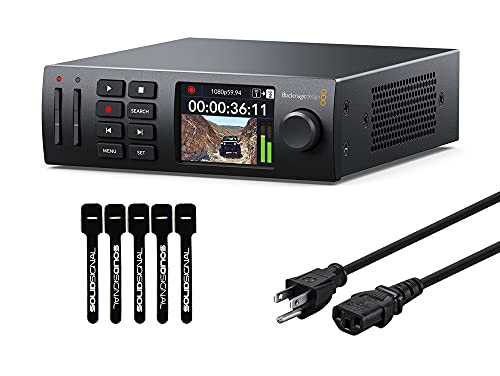
- Records H.264, ProRes, and DNxHD
- SD/HD recording up to 1080p60
- 3G-SDI input with HDMI output and USB webcam mode
Best For: Compact SDI-based studio and broadcast recording
Best Budget Capture Card
4K HDMI Capture Card with Loop-Out

- 4K 60Hz HDMI input with up to 1080p 60fps capture
- HDMI loop-out for low-latency monitoring
- Plug-and-play with mic input and broad software support
Best For: Affordable camera streaming and recording setups
Best Professional Deck

- HDMI 2.0 plus 12G-SDI input and output connections
- Records to SD cards or dual 2.5-inch SSDs
- Supports ProRes, DNxHD, uncompressed, and H.264/H.265
Best For: Professional studio and broadcast recording workflows
Best Portable Option
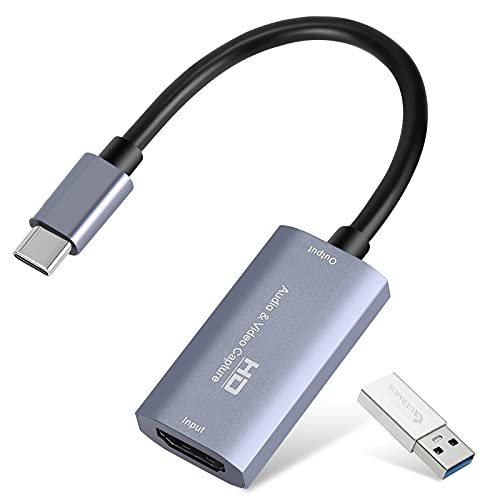
- Up to 4K 30Hz input and 1080p 60fps capture
- Compact, plug-and-play design with no external power
- USB-A and USB-C compatibility for mobile setups
Best For: Portable camera streaming and computer capture
Best with Extra Features
ZowieREC 4K HDMI Video Recorder

- Standalone recording up to 4K at 30fps
- 4K pass-through with 1080p60 recording
- TF card and USB storage options
Best For: PC-free 4K recording from cameras, consoles, and HDMI devices
Best Dual-Input Recorder
UR500 4K60 HDMI Video Recorder

- Two HDMI inputs support sources up to 4K60
- Built-in 7-inch preview display
- PIP, POP, PMP, USB, and SD support
Best For: Multi-source capture and portable HDMI monitoring
Best Versatile Converter
ClonerAlliance Box Pro 1080p Recorder
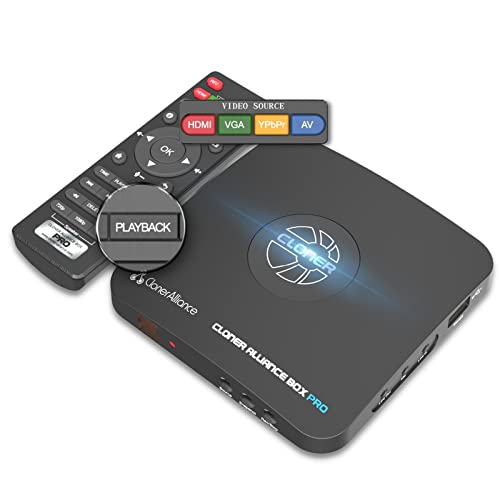
- HDMI, RCA, component, composite, and VGA inputs
- Standalone 1080p60 recording and playback
- Pass-through and scheduled recording included
Best For: Digitizing analog video alongside recording HDMI sources
Best Standalone 4K Recorder – UHD Pro 4K HDMI DVR
For shoppers comparing camera external recorders with HDMI input, the UHD Pro is a practical standalone option for capturing 4K video without a computer. It records to USB storage or a TF card, supports H.264 and H.265, and provides 4K60 passthrough for low-disruption monitoring.
Best For: Users who want standalone 4K recording, simple operation, and flexible support for cameras, camcorders, DSLRs, and other HDMI sources.
Pros:
- Records UHD video at up to 4K30, including a cinematic 4K24 mode.
- Supports H.264 and H.265 codecs, selectable resolutions, and bitrates up to 50 Mbps.
- 4K60 HDMI passthrough, pause/resume recording, scheduling, and audio-only recording add flexibility.
- Works with multiple file systems and includes Windows trimming and conversion software.
Cons:
- Windows-only editing software; Mac is not supported.
- HDCP-protected sources, Dolby audio, HDR, and smart TVs/TV antennas are not supported as recording sources.
- USB storage or a TF card is required for recording.
This is a strong fit when ease of use and direct recording matter more than advanced on-camera monitoring. Its compatibility limitations should be checked before purchase, particularly for protected or HDR sources.
Best Professional Monitor-Recorder – Atomos Ninja TX
Among camera external recorders with HDMI input, the Atomos Ninja TX combines a bright touchscreen monitor with professional recording and production features. Its HDMI 2.0 input/output, CFexpress Type B recording, and support for several codecs make it suited to demanding camera workflows.
Best For: Video professionals who need on-camera monitoring, high-quality recording, wireless workflows, and advanced production connectivity.
Pros:
- Bright 1500-nit 5.2-inch touchscreen for monitoring in challenging viewing conditions.
- Records to CFexpress Type B and supports Apple ProRes, Avid DNx, and H.265/H.264.
- Provides HDMI 2.0 and locking 12G-SDI connectivity, with 4K60 I/O and 8K30 ProRes RAW recording.
- Integrated Wi-Fi, timecode synchronization, uploading, NDI, and cross conversion support professional workflows.
Cons:
- CFexpress Type B media is required for recording.
- Its professional feature set may be more than casual users need.
- The supplied specifications list a one-year manufacturer warranty, with registration extension details noted separately.
The Ninja TX is best viewed as a production monitor and recorder rather than a basic capture device. It offers a deeper feature set for filmmakers and crews, provided the added workflow complexity and media requirements fit the project.
Best Multi-Camera Capture Card – 4-Channel 4K60 HDMI Capture
If you need camera external recorders with HDMI input for streaming or multi-camera production, this four-channel capture card is designed for computer-based workflows. It accepts up to four HDMI sources, presents them as independent UVC camera feeds, and includes loop-out ports for real-time monitoring.
Best For: Streamers, event producers, conference teams, and creators building a multi-angle setup with OBS, vMix, Zoom, or similar software.
Pros:
- Four HDMI inputs and four HDMI loop-outs support multi-camera capture and zero-latency monitoring.
- USB 3.2 Gen 2 Type-C UVC/UAC connectivity is plug-and-play with Windows, macOS, and Android.
- Supports 4K60 MJPEG capture, 1080p60 NV12, and multiple output formats for quality or smoothness.
- Includes 100W PD input, 5V/2A accessory power output, and a dedicated line-audio input for HDMI input 1.
Cons:
- It is a computer-connected capture card, not a standalone recorder.
- Its four-channel 4K60 mode uses MJPEG, while the listed 4K30 YUV444 mode has a different format profile.
- Audio input is dedicated to HDMI input 1.
This model makes the most sense for live production where several HDMI cameras must be managed in software. It is less suitable if your priority is recording directly to removable media without a computer.
Best Broadcast Deck – Blackmagic HyperDeck Studio HD Mini
For buyers seeking camera external recorders with HDMI input in a compact broadcast-style deck, the Blackmagic HyperDeck Studio HD Mini offers SD/HD recording with familiar front-panel controls. It records to SD/UHS-II cards or external USB disks and supports H.264, ProRes, and DNxHD workflows.
Best For: Broadcast, studio, and live-production users who need a compact deck with professional codecs, timecode, reference connections, and USB webcam functionality.
Pros:
- Records H.264, ProRes, or DNxHD to SD/UHS-II cards or external USB disks.
- Supports SD and HD formats up to 1080p60 with 3G-SDI input/output and HDMI output.
- Includes timecode and reference generators, front-panel transport controls, and a color display.
- USB webcam functionality works with video software such as Zoom, Teams, Skype, OBS, and XSplit.
Cons:
- The listed HDMI connection is an output; the primary video input is 3G-SDI rather than HDMI.
- It is limited to SD/HD recording up to 1080p60, not 4K capture.
- Recording media or an external USB disk is not indicated as included.
This is a capable compact deck for SDI-centered production environments. Despite its HDMI connectivity, shoppers specifically needing HDMI input should note that the supplied specifications identify HDMI as an output and BNC 3G-SDI as the video input.
Best Budget Capture Card – 4K HDMI Capture Card with Loop-Out
For shoppers seeking camera external recorders with hdmi input, this compact VIXLW capture card offers a practical USB-based setup for recording, streaming, and previewing camera footage. It accepts up to 4K 60Hz HDMI input, captures up to 1080p at 60 fps, and includes HDMI loop-out for low-latency monitoring.
Best For: Camera owners, streamers, and gamers who need an affordable capture device with loop-out and microphone input.
Pros:
- Supports 4K 60Hz HDMI input and up to 1080p 60fps capture.
- HDMI loop-out enables lag-free viewing while capturing.
- Plug-and-play design works with Windows, macOS, Linux, OBS, and common streaming platforms.
- Includes a 3.5mm microphone input for external commentary.
Cons:
- It does not support 4K 120Hz or 144Hz input.
- USB output is limited to up to 2K at 30Hz with YUY2.
- The microphone input accepts a 3.5mm microphone headset and does not record party chat.
This is a versatile entry-level option for camera capture and live streaming, especially when HDMI pass-through matters. Its modest capture limits and short 60-day warranty make it less suitable for demanding professional production.
Best Professional Deck – HyperDeck Studio 4K Pro
Among camera external recorders with hdmi input, the Blackmagic Design HyperDeck Studio 4K Pro is the most production-focused choice. This 1 RU recorder combines HDMI 2.0 and 12G-SDI connectivity with recording to SD cards or SSDs and support for professional file formats.
Best For: Studio, broadcast, and advanced video-production workflows needing HDMI, SDI, timecode, and flexible media options.
Pros:
- Includes HDMI 2.0 input and extensive 12G-SDI connectivity.
- Records to SD cards, UHS-II cards, or two 2.5-inch SSD slots.
- Supports ProRes, DNxHD, uncompressed video, and H.264/H.265 10-bit 4:2:2 recording.
- Provides timecode, reference, RS-422 control, built-in LCD, speaker, and jog wheel.
Cons:
- Its rack-style 1 RU design and professional I/O may be excessive for basic camera recording.
- Power cord is not included.
- Media storage must be supplied separately.
This is the strongest fit for serious HDMI recording and mixed-interface production environments. It offers substantially more connectivity and codec flexibility than USB capture cards, but its professional format and accessory requirements increase setup complexity.
Best Portable Option – USB 3.0 HDMI Capture Card
This compact USB 3.0 model is a straightforward choice for shoppers comparing camera external recorders with hdmi input for mobile streaming or computer-based recording. It accepts up to 4K 30Hz HDMI input and sends up to 1080p 60fps or 2K 30Hz video to compatible capture software.
Best For: Portable camera capture, online meetings, live streaming, and users who need USB-A and USB-C connection flexibility.
Pros:
- Captures up to 1080p at 60fps or 2K at 30Hz.
- Small, lightweight aluminum design is convenient for travel and outdoor streaming.
- Plug-and-play operation requires no additional driver or external power supply.
- Compatible with Windows, macOS, Linux, Android, OBS, Zoom, VLC, and major streaming platforms.
Cons:
- It is for capture software use and cannot directly cast to a monitor or TV.
- It has one-way HDMI-to-USB-C transmission and no stated HDMI loop-out.
- Using USB 2.0 instead of USB 3.0 can limit bandwidth and resolution.
This capture card suits users who value portability and simple computer recording over standalone operation. Make sure the host device recognizes a USB 3.0 connection, and plan to use capture software for recording or preview.
Best with Extra Features – ZowieREC 4K HDMI Video Recorder
The ZowieREC is a practical choice among camera external recorders with HDMI input when you want standalone 4K recording without a computer. It records to TF cards or USB storage, supports HDMI pass-through, and includes pause, resume, and scheduled recording functions.
Best For: DSLR, camcorder, gaming, and conference recording where 4K pass-through and PC-free operation are priorities.
Pros:
- Records up to 4K at 30fps without a PC.
- Supports 4Kp60 input and low-latency pass-through, with 1080p60 recording.
- Offers TF card and USB storage, plus scheduling and pause/resume controls.
Cons:
- Does not support protected or copyrighted HDMI sources.
- An AV-to-HDMI adapter is not included.
Choose this model if you want a compact, premium-cased recorder with flexible storage and strong 4K monitoring capabilities. Keep in mind that its recording output is limited to 1080p60 when using supported 4K input modes.
Best Dual-Input Recorder – UR500 4K60 HDMI Video Recorder
The UR500 stands out among camera external recorders with HDMI input for two-source workflows. It accepts two HDMI inputs up to 4K60, includes a built-in 7-inch preview screen, and supports PIP, POP, and PMP layouts for monitoring or combining sources.
Best For: Multi-camera setups, presentations, gaming, and portable production requiring source switching or multi-view monitoring.
Pros:
- Provides two HDMI inputs with support for sources up to 4K60.
- Built-in 7-inch screen simplifies previewing and playback.
- Supports USB, SD, PIP/POP/PMP layouts, and Windows, Mac, and Linux workflows.
Cons:
- Records and outputs at up to 1080p60 rather than 4K.
- Battery operation requires a separately purchased compatible battery.
- Protected or copyrighted HDMI sources are not supported.
This is the more capable option when two HDMI sources and on-device monitoring matter more than 4K recording output. Its flexible power options also make it useful for field use, provided you supply a compatible battery if needed.
Best Versatile Converter – ClonerAlliance Box Pro 1080p Recorder
The ClonerAlliance Box Pro is a flexible pick among camera external recorders with HDMI input, especially if you also need to digitize older video equipment. It records 1080p at 60fps without a PC and accepts HDMI, RCA, composite, component, and VGA sources.
Best For: Archiving VHS and other analog footage, recording cameras and consoles, and capturing HDMI sources to USB storage.
Pros:
- Supports HDMI and multiple analog inputs, including RCA, component, and VGA.
- Records and plays back MP4 files without requiring a PC.
- Includes pass-through, scheduled recording, and broad storage-format support.
Cons:
- Maximum capture resolution is 1080p at 60fps.
- Included editing and conversion software supports Windows but not Mac.
- HDCP-protected content is not supported.
Choose the Box Pro when input flexibility is more important than 4K resolution. Its analog conversion features make it particularly useful for mixed collections of modern HDMI devices and legacy video sources.
How We Picked the Best Camera External Recorders with Hdmi Input
We focused on the features that matter most in real-world camera workflows: HDMI compatibility, supported resolution and frame rates, recording quality, passthrough performance, audio options, storage or computer connectivity, and setup complexity. We also considered whether each model is designed for field use, desktop production, live streaming, or legacy-video conversion.
Because “external recorder” can describe several device types, this roundup includes standalone HDMI recorders, monitor-recorders, professional broadcast decks, and USB capture cards. Check the product specifications carefully before buying, since HDMI input does not automatically mean that a device records internally or supports every camera signal.
Quick Comparison
| Best for | Look for | Typical advantage |
|---|---|---|
| Portable camera recording | Standalone operation, compact design, storage support | Less dependence on a computer |
| Monitoring and field production | Built-in display, camera-to-cloud tools, reliable passthrough | Better framing and workflow control |
| Streaming and video calls | UVC support, USB 3.x, plug-and-play drivers | Simple computer integration |
| Multi-camera production | Multiple HDMI inputs, switching, PIP, or multiview | More flexible live production |
| Professional playback and archiving | Broadcast I/O, SSD or deck-based media, format support | Consistent studio operation |
Key Buying Factors for Camera External Recorders with Hdmi Input
Resolution, Frame Rate, and Signal Compatibility
Confirm the recorder accepts your camera’s exact HDMI output, including 4K versus 1080p, frame rate, color format, and whether the signal is clean HDMI. A 4K passthrough feature may not mean that the unit records 4K, so separate those specifications.
Recording Method and Codec
Standalone models may record to an internal drive, removable storage, or another connected medium. H.264 is widely compatible, while H.265 can reduce file sizes but may require more demanding editing hardware. Professional codecs and media formats can preserve more quality but usually cost more and create larger files.
Passthrough, Monitoring, and Latency
HDMI loop-through is useful when you need to record while sending the same signal to a monitor, switcher, or display. For gaming, live events, and camera monitoring, low latency is especially important. A built-in screen can also reduce the need for separate field equipment.
Audio and Power
Look for the audio inputs you actually use, such as HDMI embedded audio, 3.5mm, or professional line-level connections. For field recording, assess battery or USB power options, heat management, cable strain, and whether the recorder can run continuously for the length of your shoot.
Computer Connectivity and Software
USB capture cards are convenient for streaming and recording directly into a computer, but they depend on compatible software and sufficient USB bandwidth. USB 3.x, UVC support, and a reliable driver-free setup can make a major difference.
Who Should Buy Which Camera External Recorders with Hdmi Input?
Choose a compact standalone recorder if you film interviews, events, tutorials, or long sessions and want to avoid tying the camera to a computer. A monitor-recorder is better for creators who need a larger preview, on-set tools, or a more structured field workflow.
Streaming creators and remote presenters should prioritize a UVC USB capture card with dependable 1080p60 or 4K support. Multi-camera operators should consider a model with two or more HDMI inputs, loop outputs, and picture-in-picture or multiview functions. Studios, broadcasters, and editors with demanding playback or archiving needs will usually benefit most from a professional deck with robust media and I/O support.
Before ordering, verify the camera’s HDMI output, required cable type, HDCP restrictions, storage format, power supply, and intended recording resolution. Those checks will help ensure your selected recorder fits the complete workflow rather than only matching a headline specification.