The right equalizer can make a live rig easier to control, helping reduce feedback, shape troublesome frequencies, and create a clearer, more balanced mix. The best choice depends on your system size, channel needs, rack space, and how much hands-on control you want.
We’ve gathered 10 audio equalizers for live sound, ranging from compact graphic EQs to advanced feedback-management processors. Use the guide below to narrow the options by application, features, and setup priorities.
Best 10 Audio Equalizers for Live Sound Picks for 2026
Flexible 31-Band Control

- 31-band stereo graphic EQ
- FBQ feedback detection
- Subwoofer output with adjustable crossover
Best For: Detailed live sound shaping and system setup
Compact Feedback Control

- Dual 15-band graphic EQ
- FBQ feedback detection
- Low-cut filter and subwoofer output
Best For: Straightforward live sound EQ and feedback management
Protected System Tuning

- 31-band stereo graphic EQ
- Pink-noise room-tuning generator
- Limiters with gain-reduction meters
Best For: Venue tuning and protected live sound operation
Reliable Dual-Channel EQ

- Dual 15-band constant-Q EQ
- Selectable 6 or 12 dB boost/cut
- TRS and XLR connectivity
Best For: Conventional dual-channel live sound equalization
Automatic Feedback Control

- Ultra-fast feedback detection
- 40 FBQ filters with parametric EQ
- Single-shot mode locks filters
Best For: Live systems needing automatic feedback suppression
Dual Graphic Control
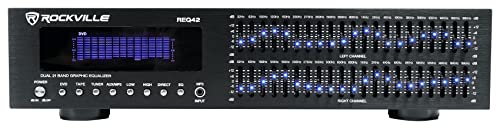
- Two 21-band graphic EQs
- 20 Hz–20 kHz frequency coverage
- LED sliders and dual VU meters
Best For: DJs and live setups wanting hands-on visual EQ
EQ, Limiting, and Noise Reduction
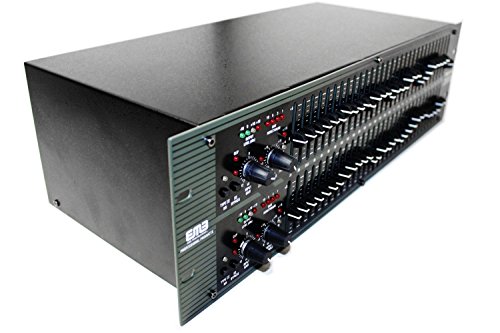
- Combines graphic EQ and limiter
- Includes Type 3 NR noise reduction
- Rackmount design for audio systems
Best For: Live and playback systems needing multi-function processing
Compact Live Control

- Nine graphic EQ bands
- FBQ Feedback Detection
- Compact plastic enclosure
Best For: Small live rigs and space-conscious setups
Detailed Dual-Channel Shaping

- 31 bands per channel
- Low-cut noise filtering
- XLR and TRS connectivity
Best For: Detailed live-system tuning and installations
Flexible Rackmount Low-End Control

- 15 bands per channel
- Adjustable low-cut control
- Dedicated bass output
Best For: Rack-mounted live systems needing low-frequency flexibility
Flexible 31-Band Control – Behringer FBQ3102HD
For live sound setups that need detailed tonal shaping, the Behringer ULTRAGRAPH PRO FBQ3102HD provides 31-band stereo graphic equalization, plus filters for removing unwanted low and high frequencies. Its FBQ system helps identify problematic frequencies during setup or performance.
Best For: Stereo live sound systems needing detailed EQ control, feedback detection, and subwoofer integration.
Pros:
- 31-band stereo graphic equalization for precise adjustments
- FBQ feedback detection can reveal critical frequencies and function as an audio analyzer
- Dedicated mono subwoofer output with adjustable crossover frequency
- Additional sweepable high- and low-cut filters help remove rumble and hiss
Cons:
- Rack-format controls may be more than needed for simple systems
- The supplied specifications list USB hardware connectivity alongside an analog signal format, so verify connection requirements before purchase
The FBQ3102HD is a versatile choice when you want extensive stereo EQ control and dedicated filtering in one rack unit. Its feedback-detection and subwoofer features make it particularly useful for more involved live sound rigs.
Compact Feedback Control – Behringer FBQ1502HD
The Behringer FBQ1502HD is a practical option for audio equalizers for live sound when a 15-band format meets your needs. Its FBQ feedback-detection system highlights troublesome frequencies, while the low-cut filter helps reduce unwanted floor rumble.
Best For: Live sound users who want straightforward 15-band EQ control with feedback detection and low-frequency filtering.
Pros:
- Dual 15-band HD graphic equalizer configuration
- FBQ system identifies annoying feedback frequencies and can serve as an analyzer
- Dedicated mono subwoofer output with adjustable crossover frequency
- Low-cut filter helps remove unwanted floor rumble
Cons:
- Offers fewer bands than a 31-band equalizer
- Its supplied specifications include inconsistent signal and hardware-interface descriptions, so confirm compatibility with your system
The FBQ1502HD balances useful live-sound features with a less extensive band count. It is a sensible fit when feedback control and basic system cleanup matter more than highly granular frequency shaping.
Protected System Tuning – Behringer FBQ6200HD
For live sound engineers who want both detailed EQ and system-protection features, the Behringer ULTRAGRAPH PRO FBQ6200HD combines 31-band stereo graphic equalization with FBQ feedback detection, pink-noise test signals, and channel limiters.
Best For: Live sound systems that need room tuning, feedback identification, and protection against overload or distortion.
Pros:
- 31-band stereo graphic equalizer supports detailed tonal adjustment
- Pink-noise generator provides test signals for adapting a system to room acoustics
- FBQ feedback detection reveals critical frequencies and can work as an analyzer
- Dedicated limiters with gain-reduction meters help protect against overload and distortion
Cons:
- More feature-rich than necessary for basic EQ-only applications
- The supplied specifications list a digital signal format and XLR connector, so confirm the intended signal path
The FBQ6200HD stands out when equalization is only part of the job. Its pink-noise generator and limiters make it especially useful for tuning a venue and managing system levels with greater control.
Reliable Dual-Channel EQ – dbx 215s Dual 15-Band EQ
The dbx 215s is a dual-channel 15-band equalizer suited to live sound systems that need familiar rackmount EQ controls. It offers selectable 6 or 12 dB boost/cut ranges, bypass switches, level monitoring, and both TRS and XLR connections.
Best For: Stereo or dual-channel live sound setups requiring conventional 15-band EQ and flexible input/output connections.
Pros:
- Dual 15-band, 1/3-octave constant-Q frequency bands
- Selectable 6 or 12 dB boost/cut ranges provide control over adjustment depth
- Front-panel bypass switch and 12 dB input-gain range
- Four-segment LED output meters plus TRS and XLR inputs and outputs
Cons:
- Provides fewer bands than 31-band equalizers
- The supplied notes do not list an integrated feedback-detection system
- Its 4.8-pound weight may matter in highly portable rigs
The dbx 215s is a straightforward choice for users who value dual-channel operation, standard 1/3-octave bands, and broad connector compatibility. It is best suited to systems where hands-on EQ control is more important than automated feedback tools.
Automatic Feedback Control – Behringer FBQ2496
For audio equalizers for live sound, the Behringer FBQ2496 is designed for fast, largely automatic feedback management. Its parametric EQ and feedback-detection modes make it practical when quick intervention matters during performances or events.
Best For: Live sound setups that need automatic feedback suppression and flexible parametric filtering.
Pros:
- Ultra-fast feedback detection and response.
- Offers 40 FBQ filters and 96 kHz audio performance.
- Single-shot mode locks detected feedback filters until manually reset.
- Includes a Panic button and a set-and-forget default setting.
Cons:
- Its 19-inch rack format may be more equipment than smaller systems need.
- Focused on feedback suppression and parametric EQ rather than simple graphic slider control.
The FBQ2496 is a strong choice when maintaining stability is the priority. Automatic modes reduce the need for constant manual adjustment, while the available filtering supports more deliberate tonal control.
Dual Graphic Control – Rockville REQ42-B
The Rockville REQ42-B provides two 21-band graphic equalizers for hands-on frequency shaping across the 20 Hz–20 kHz range. For audio equalizers for live sound, its visual controls and rack-ready design suit DJs, events, and organized PA setups.
Best For: DJs, home studios, events, and mobile setups that prefer dual graphic EQ control with visual level monitoring.
Pros:
- Dual 21-band graphic equalizers cover a wide frequency range.
- Blue LED sliders, a multicolor LED display, and dual VU meters aid monitoring.
- Standard 19-inch rack-mountable design includes removable brackets.
- Provides RCA stereo input, record output, and a 3.5 mm MP3/iPod input.
Cons:
- Connectivity is centered on RCA rather than XLR or 1/4-inch connections.
- Its 6.5-pound chassis may not be ideal where minimum weight is essential.
The REQ42-B is a straightforward option for users who want visible, manual EQ adjustments. Its dual-channel layout and monitoring displays make it especially useful when quick front-panel changes are part of the workflow.
EQ, Limiting, and Noise Reduction – EMB Professional EB831EQ
The EMB Professional EB831EQ combines graphic equalization with limiter processing and Type 3 NR noise reduction. Among audio equalizers for live sound, it is suited to systems where tonal shaping, peak management, and cleaner signal presentation are needed in one rackmount processor.
Best For: DJs, clubs, studios, stages, and home systems needing EQ plus limiting and noise-reduction processing.
Pros:
- Combines graphic EQ and limiter functionality.
- Type 3 NR processing is designed to help reduce audible background noise.
- Limiter processing helps control excessive signal peaks.
- Rackmount format integrates with mixers, amplifiers, and PA components.
Cons:
- At 13.67 pounds, it is heavier than some rack processors.
- Its broader processing feature set may be more than users seeking only basic EQ require.
The EB831EQ makes sense when an installation needs more than frequency adjustment alone. Its combination of EQ, peak control, and noise reduction can help organize a demanding signal chain for live or playback use.
Compact Live Control – Behringer FBQ800 V2
For shoppers seeking audio equalizers for live sound in a compact format, the Behringer FBQ800 V2 provides nine graphic bands in a small enclosure. Its FBQ Feedback Detection feature is intended to help identify feedback during studio or live use.
Best For: Space-conscious live rigs, small setups, and users who want straightforward graphic EQ control.
Pros:
- Ultra-compact design measuring 15.24 x 6.73 x 4.02 inches.
- Provides nine graphic EQ bands for basic tonal shaping.
- Includes FBQ Feedback Detection for studio and live applications.
Cons:
- Offers fewer bands than the 15-band and 31-band alternatives.
- Plastic construction may be less suited to especially demanding touring environments.
The FBQ800 V2 is a practical choice when portability and simple feedback-oriented control matter more than extensive frequency-by-frequency adjustment.
Detailed Dual-Channel Shaping – EQ-231 31-Band Stereo EQ
This 31-band stereo equalizer is built for buyers who want extensive control from audio equalizers for live sound. Dual channels, selectable low-cut filtering, balanced XLR connections, and level-monitoring LED ladders make it suitable for live applications, installations, and studio use.
Best For: Professional live systems and installations that need detailed stereo EQ adjustment and flexible connectivity.
Pros:
- Provides 31 adjustable bands per channel with a stated range of ±12 dB.
- Low-cut switch helps attenuate wind noise, floor rumble, and electrical hum.
- Includes XLR balanced and 1/4-inch TRS unbalanced inputs and outputs.
- Four-segment LED ladders provide visual gain and output-level feedback.
Cons:
- Its 18.9-inch width and 6.69-pound weight require more installation space than compact EQs.
- The extensive 31-band layout may be more control than basic setups require.
Choose the EQ-231 when precise, dual-channel shaping and connection flexibility are priorities, particularly in a rack-based live or installed system.
Flexible Rackmount Low-End Control – EQX-215S 15-Band Stereo EQ
The EQX-215S combines 15-band-per-channel graphic control with rack-friendly construction, making it a flexible option among audio equalizers for live sound. A variable low-cut control and dedicated bass output add useful low-frequency management for live events, studios, and installations.
Best For: Rack-mounted live systems that need stereo EQ, adjustable low-cut filtering, and dedicated bass-output control.
Pros:
- Offers 15 adjustable bands per channel with a stated ±12 dB range.
- Variable low-cut control helps target unwanted low-end noise.
- Includes a dedicated bass output with adjustable frequency.
- Supports XLR and 1/4-inch TRS connections in a 1U rack-mount form factor.
Cons:
- Provides fewer EQ bands per channel than the 31-band EQ-231.
- The dedicated bass-output features may be unnecessary for simpler systems.
The EQX-215S is a strong middle-ground option for users who want more shaping than a compact nine-band unit, plus rack integration and extra low-frequency routing.
How We Picked the Best Audio Equalizers for Live Sound
We selected these models based on the features that matter most in practical PA and installation work: frequency-band resolution, channel configuration, feedback-management tools, signal quality, connectivity, rack compatibility, and ease of operation. We also considered the different needs of musicians, DJs, venues, houses of worship, rehearsal spaces, and fixed sound systems.
Graphic equalizers remain popular because their sliders provide an immediate visual reference. Parametric and automatic feedback processors can offer more precise control, but they may require more setup knowledge. The right format is the one that matches your workflow rather than simply offering the most controls.
Quick Comparison
- Best for detailed stereo tuning: 31-band dual-channel graphic equalizers.
- Best for compact racks: 9-band and 15-band designs with straightforward controls.
- Best for feedback management: Automatic feedback destroyer and filter-based processors.
- Best for flexible channel use: Dual-channel units that can operate in stereo or independent-channel configurations.
- Best for budget-conscious systems: Basic graphic EQs with balanced inputs and outputs.
Key Buying Factors for Audio Equalizers for Live Sound
Band Count and Control Range
A 31-band EQ provides finer adjustment across the audible spectrum and is useful for ringing out microphones or tuning a PA. A 15-band model is simpler and faster to operate, while compact 9-band units suit small systems or auxiliary duties. Check the center frequencies and boost/cut range, not just the band count.
Graphic, Parametric, or Automatic Control
Graphic EQs are easy to understand and effective for broad tonal shaping. Parametric EQ offers more precise frequency, bandwidth, and gain adjustment. Automatic feedback processors can identify and suppress problem frequencies, but they should complement—not replace—careful microphone placement, gain staging, and speaker positioning.
Inputs, Outputs, and System Layout
Confirm whether the unit uses balanced XLR, TRS, or unbalanced connections, and check its operating level. Stereo systems typically benefit from dual channels, while mono monitor or vocal chains may need only one. Subwoofer outputs, bypass switches, limiters, and noise-reduction features can be useful depending on the installation.
Reliability and Rack Fit
For touring or frequent performance use, look for sturdy construction, clear metering, secure sliders, and standard rack compatibility. Leave adequate ventilation space and verify the unit’s depth before planning the rack. A simple, dependable EQ is often preferable to a feature-heavy processor that is difficult to troubleshoot during a show.
Who Should Buy Which Audio Equalizers for Live Sound?
Live bands and sound engineers will generally benefit from a 31-band stereo graphic EQ for detailed room and monitor tuning. Small venues, DJs, and home audio users may prefer a 15-band or compact 9-band model that delivers essential control without consuming much rack space. Installations prone to microphone feedback should consider an automatic feedback processor, while still addressing acoustic and gain-structure problems at their source. Budget-focused buyers should prioritize balanced connections, usable band spacing, and dependable bypass operation over extra processing features.