Choosing among 4K wireless video receivers can be difficult because headline range and resolution do not tell the whole story. Compatibility, latency, wireless bands, output options, and reliability matter just as much for real-world production.
We selected 10 systems spanning affordable HDMI extenders and professional SDI/HDMI kits, so you can match your workflow, display setup, and budget without paying for features you will not use.
Best 10 4K Wireless Video Receivers Picks for 2026
Best Multi-Receiver Pick

- 4K30 dual-band transmission
- Up to 1,300 feet and 60ms latency
- Supports up to four receivers
Best For: Film crews and multi-user monitoring
Best Plug-and-Play Value

- 4K decode with 1080p60 output
- 360-foot open-space range
- Supports up to eight transmitters
Best For: Presentations, classrooms, and home theaters
Best for SDI Workflows

- 4K30 HDMI transmission
- HDMI and SDI input/output
- Supports professional decimal-point frame rates
Best For: Broadcast and SDI-equipped production crews
Best for Multi-Transmitter Setups

- 400-foot stated range
- 4K decode with 1080p60 output
- Supports up to 12 transmitters
Best For: Multi-source offices, classrooms, and events
Best Long-Range 4K Workflow

- 4K30 HDMI and 1080p SDI/HDMI support
- Up to 1,312-foot stated range
- Monitoring for up to five destinations
Best For: Production crews needing long-range mobile and receiver monitoring
Best Low-Latency HDMI System

- 4Kp30 10-bit HDR over HDMI
- Less than 0.01 seconds of stated latency
- 6GHz transmission with up to 750-foot range
Best For: HDMI camera and AV workflows requiring near-zero-delay monitoring
Best 4K60 Range and Connectivity

- 4K60 HDMI with 1080p HDMI/3G-SDI support
- Tri-band 2.4GHz, 5GHz, and 6GHz operation
- Stated range of at least 8,202 feet
Best For: Professional productions needing 4K60 and advanced app monitoring
Long-Range Flexible Pick
JM300PRO 4K Wireless Video Kit
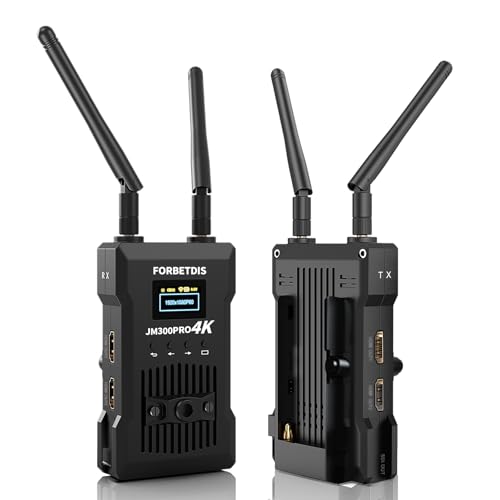
- 4K/30 transmission with stated 0.06-second latency
- Supports one transmitter to up to four receivers
- USB-C, DC, and NP-F battery power options
Best For: Multi-screen events, streaming, and home entertainment
Production-Ready Pick
Hollyland Pyro S 4K HDMI/SDI System

- HDMI and SDI integration with 4K/30 support
- Claimed 1,300-foot range and 50ms latency
- Advanced app monitoring and up to four receivers
Best For: Film sets, live events, and professional monitoring
Simple Home Theater Pick

- Pre-paired setup with no apps or drivers
- 4K/30 video with synchronized audio
- Dual HDMI output and up to four receivers
Best For: Home theaters, presentations, and everyday HDMI extension
Best Multi-Receiver Pick – Hollyland Pyro H
For production teams comparing 4k wireless video receivers, the Hollyland Pyro H stands out with 4K30 transmission, dual-band operation, smart channel scanning, and support for up to four receivers. Its HDMI connectivity and UVC streaming also make it flexible for monitoring and live broadcasts.
Best For: Film crews, live-streaming teams, and multi-user monitoring setups.
Pros:
- Transmits up to 4K30 with 2.4GHz and 5GHz dual-band support.
- Offers a claimed 1,300-foot range and 60ms latency.
- Supports up to four receivers, Hollyview app monitoring, HDMI loopout, and UVC streaming.
Cons:
- The listed range is based on line-of-sight conditions.
- This kit includes one transmitter and one receiver, so additional receivers may be needed for larger teams.
The Pyro H is a strong choice when collaborative monitoring and connectivity options matter as much as image quality. Smart channel scanning and UVC support add practical value for demanding shoots and streaming workflows.
Best Plug-and-Play Value – 4K Decode Wireless HDMI Kit
This wireless HDMI kit is a practical option among 4k wireless video receivers for offices, classrooms, events, and home entertainment. It decodes 4K input while outputting 1080p at 60Hz, connects without Wi-Fi or apps, and includes an LED display for status checks.
Best For: Presentations, classrooms, home theaters, and general HDMI device extension.
Pros:
- Supports 4K decoding with 1080p at 60Hz output.
- Offers up to 360 feet in open spaces and uses 2.4GHz plus 5.8GHz dual-band transmission.
- Supports mirrored or extended displays and up to eight transmitters per receiver.
Cons:
- It does not provide 4K output; output is limited to 1080p at 60Hz.
- Walls and other obstacles can reduce transmission distance and speed.
With automatic pairing, no required software, and support for multiple transmitters, this kit is geared toward convenient everyday use. It is better suited to 1080p displays than to a true 4K-output workflow.
Best for SDI Workflows – Hollyland Mars 4K
For buyers seeking 4k wireless video receivers for professional production, the Hollyland Mars 4K combines 4K HDMI transmission with SDI input/output support. Decimal-point SDI frame rates, an LCD screen, multiple monitoring options, and flexible power choices make it suited to more advanced video setups.
Best For: Broadcast-style production, camera crews, directors, and SDI-equipped monitoring systems.
Pros:
- Supports up to 4K30 over HDMI and HD formats over HDMI or SDI.
- Provides SDI output for 23.98, 29.97, and 59.94 fps workflows.
- Supports up to four app monitoring devices and offers HDMI plus SDI connectivity.
Cons:
- Its stated 450-foot range is based on interference-free laboratory conditions.
- It is more specialized than HDMI-only kits and may be unnecessary for basic home use.
- QC/PD charging is not supported.
The Mars 4K is the most production-oriented option here for users who need SDI compatibility and broadcast-style frame-rate support. Its shorter stated range than the Pyro H is balanced by more specialized professional interfaces.
Best for Multi-Transmitter Setups – 400FT Wireless HDMI System
This compact wireless HDMI system is a useful choice among 4k wireless video receivers when you need simple setup and flexible source switching. It supports 4K decoding with 1080p60 output, dual-band transmission, mirrored or extended displays, and as many as 12 transmitters paired with one receiver.
Best For: Offices, classrooms, events, gamers, and setups with multiple HDMI sources.
Pros:
- Provides up to 400 feet of stated range with 5.8GHz and 2.4GHz dual-band support.
- Pairs automatically in under three seconds without Wi-Fi, apps, or software.
- Supports up to 12 transmitters per receiver and up to five sets simultaneously.
Cons:
- 4K is decoded, but the output is limited to 1080p at 60Hz.
- Actual range can vary depending on walls and other obstacles.
The system’s main advantage is scalability: one receiver can handle numerous transmitters, making it convenient for shared displays and rotating sources. Choose it for ease of use and multi-source flexibility rather than native 4K output.
Best Long-Range 4K Workflow – CineView SE 4K
The Accsoon CineView SE 4K is a practical choice among 4k wireless video receivers for crews needing HDMI and SDI support, long-range monitoring, and flexible device connections. It handles 4K up to 30p through HDMI, 1080p through HDMI or 3G-SDI, and can send a feed to up to five destinations when compatible wireless and wired connections are used.
Best For: Filmmakers and production teams needing long-distance monitoring, camera-control support, and mobile app viewing.
Pros:
- Supports 4K input and output up to 30p via HDMI, plus 1080p through 3G-SDI.
- Offers a stated range of up to 1,312 feet and latency as low as 50ms at 1080p.
- Supports up to four wireless connections plus one wired USB-C connection.
- Includes camera-control functions for select Sony and Canon cameras.
Cons:
- 4K latency is listed at approximately 0.1 seconds.
- USB-C video output is for supported mobile monitoring, not UVC computer capture.
- Mac and PC computers are not supported for the listed monitoring connections.
This system is well suited to organized shoots where range, multi-device monitoring, and camera control matter more than computer-based capture. Confirm camera and mobile-device compatibility before purchase.
Best Low-Latency HDMI System – Teradek Ace 750
The Teradek Ace 750 stands out among 4k wireless video receivers for users who want a straightforward HDMI-only transmitter and receiver set. It delivers up to 4Kp30 10-bit HDR, uses the 6GHz band with automatic channel selection, and is paired out of the box for quick setup.
Best For: Camera operators and AV users who prioritize near-zero-delay HDMI monitoring and simple installation.
Pros:
- Supports up to 4Kp30 10-bit HDR video over HDMI.
- Provides less than 0.01 seconds of stated latency.
- Offers a stated range of up to 750 feet with 6GHz transmission.
- Includes AC and D-Tap power options for studio or on-camera use.
Cons:
- Connectivity is HDMI rather than HDMI plus SDI.
- 4K frame-rate support is limited to 30p.
- A second AC adapter for additional studio or AV setups is sold separately.
Choose the Ace 750 when low delay and plug-and-play operation are central requirements. Its HDMI-only design makes it less flexible for workflows built around SDI equipment.
Best 4K60 Range and Connectivity – CineView Master 4K
The Accsoon CineView Master 4K is a high-capability option among 4k wireless video receivers, combining HDMI and 3G-SDI connectivity with 4K60 transmission. Its tri-band design, extended stated range, and app-based production tools make it suitable for demanding shoots and live events.
Best For: Professional crews, sports broadcasters, event teams, and filmmakers needing 4K60, long-distance transmission, and advanced mobile monitoring.
Pros:
- Supports HDMI video up to 4K60 and 1080p through HDMI or 3G-SDI.
- Uses 2.4GHz, 5GHz, and 6GHz tri-band transmission for signal flexibility.
- Offers a stated range of at least 8,202 feet in unobstructed conditions.
- Accsoon SEE adds recording, live streaming, focus peaking, waveforms, and false color.
Cons:
- The longest range and latency figures are measured in unobstructed, interference-free conditions.
- Listed latency is under 25ms at 1080p60 and under 35ms at 4K60, excluding camera latency.
- Wired USB-C monitoring is specified for compatible iOS devices rather than general computer capture.
The Master 4K is the strongest fit here for teams that need 4K60 and broad monitoring options. Its advanced features are most valuable when a production can take advantage of compatible receivers, mobile devices, and app tools.
Long-Range Flexible Pick – JM300PRO 4K Wireless Video Kit
If you need 4k wireless video receivers for multi-screen viewing, the JM300PRO combines 4K/30 transmission, a claimed 1,000-foot open-range distance, and flexible power options. It supports one transmitter with up to four receivers, though adding receivers can reduce range.
Best For: Weddings, conferences, live streaming, and home entertainment setups that need multiple displays or mobile monitoring.
Pros:
- Supports up to 4K/30 video with a stated 0.06-second latency.
- One transmitter can connect to as many as four receivers.
- Supports USB-C, 9–16V DC, and compatible NP-F battery power inputs.
- Offers Android and iOS app monitoring for up to four phones or tablets.
Cons:
- The claimed 1,000-foot range applies to open conditions and may decrease with additional receivers.
- NP-F batteries are not included.
- A 0.06-second delay may still matter for real-time gaming.
The JM300PRO stands out for installation flexibility and multi-receiver expansion. Choose it when broad compatibility and several viewing points matter more than specialized production features.
Production-Ready Pick – Hollyland Pyro S 4K HDMI/SDI System
Among 4k wireless video receivers, the Hollyland Pyro S is the most production-focused option here. It supports HDMI and SDI workflows, 4K/30 video, a claimed 1,300-foot range, and automatic dual-band hopping for more adaptable monitoring on set.
Best For: Film production, live events, ENG/EFP work, and crews that need HDMI/SDI connectivity with advanced monitoring tools.
Pros:
- Supports 4K/30 video over HDMI and multiple frame rates through SDI.
- Uses Auto Dual-Band Hopping and Smart Channel Scan for signal management.
- Supports one transmitter with up to four receivers.
- Includes app tools such as waveform, vectorscope, zebra, and anamorphic de-squeeze.
Cons:
- The stated 1,300-foot range and 50ms latency depend on operating conditions.
- Its HDMI/SDI feature set may be more than a basic home setup requires.
- The supplied configuration is listed as one transmitter and one receiver.
The Pyro S is the strongest fit for professional video environments where connection options and monitoring tools are priorities. It is less compelling if you only need a simple HDMI link between a laptop and TV.
Simple Home Theater Pick – Vrriis WL095P 4K HDMI Kit
The Vrriis WL095P is a straightforward choice for 4k wireless video receivers when you want a pre-paired HDMI connection without installing apps or drivers. It supports UHD 4K/30 video, dual HDMI output on the receiver, and expansion to as many as four receivers.
Best For: Home theaters, presentations, and streaming video from a DSLR, PC, or laptop to a TV or monitor.
Pros:
- Pre-paired plug-and-play setup with no apps or drivers required.
- Supports UHD 4K/30 video and synchronized audio using H.265 encoding.
- Claims up to 1,150 feet of open-field transmission range.
- Receiver includes dual HDMI outputs and supports up to four receivers overall.
Cons:
- Walls, metal, brick, and glass can significantly reduce signal coverage.
- The stated 0.1-second latency may not suit latency-sensitive gaming.
- Adding receivers can shorten the wireless transmission distance.
The WL095P prioritizes easy setup and flexible display distribution. It is a practical pick for everyday HDMI extension, especially when dual receiver outputs or a simple pre-paired installation are useful.
How We Picked These 4K Wireless Video Receivers
We compared the listed systems by supported video formats, claimed wireless range, latency, connection types, and production-oriented features. Priority went to products that clearly identify HDMI or SDI compatibility, 4K support, 1080p high-frame-rate output, and practical setup details. We also considered receiver capacity, loop-out support, frequency-band design, camera control, HDR, and monitoring flexibility.
Range figures are best-case estimates and can change substantially with walls, interference, antenna placement, and local wireless congestion. Treat them as useful comparisons rather than guarantees.
Quick Comparison
| Best For | Look For |
|---|---|
| Budget home or office use | Plug-and-play HDMI, 1080p60 output, and a clear status display |
| Camera monitoring | Low latency, compact transmitters, and dependable HDMI connectivity |
| Professional production | SDI and HDMI, timecode or camera control, stronger interference management, and multiple receivers |
| Long-distance installations | Published range, line-of-sight placement, and stable dual- or tri-band operation |
Key Buying Factors for 4K Wireless Video Receivers
Resolution, Frame Rate, and HDR
Many systems advertise 4K input or decoding while outputting 1080p at 60Hz. That can be ideal for directors’ monitors and wireless preview screens, but it is not the same as a complete 4K60 path. Check whether the specification means input, transmission, decoding, or output. If HDR or 10-bit video matters, confirm that every device in the chain supports it.
Latency and Reliability
Low latency is essential for camera operators, live switching, and interactive presentations. A 25–60ms claim is generally more useful for monitoring than a basic extender with approximately 100ms delay. For critical events, prioritize stable performance and interference resistance over maximum advertised distance.
HDMI, SDI, and Receiver Capacity
HDMI suits mirrorless cameras, laptops, televisions, and consumer displays. SDI is more appropriate for cinema cameras, broadcast equipment, and long wired runs. If several people need to monitor one camera, verify the supported number of receivers and whether each receiver offers loop-out or another usable output.
Wireless Bands, Power, and Setup
Dual-band or tri-band systems may handle congestion better, but performance still depends on the environment. Check connector types, power requirements, battery options, mounting hardware, and whether the kit needs a line of sight. LED displays and plug-and-play pairing are especially helpful for temporary installations.
Who Should Buy Which 4K Wireless Video Receivers?
Choose an affordable HDMI extender for presentations, home entertainment, classroom use, or occasional streaming. A compact low-latency HDMI system is a better fit for mirrorless-camera monitoring and small productions. Buyers working with cinema or broadcast cameras should favor an SDI/HDMI model with stronger format support and professional control features. For multi-camera crews, large venues, or demanding wireless monitoring, prioritize tri-band operation, multiple receiver support, robust range, and the lowest practical latency rather than selecting solely by price.