Dehydrating your own meals can reduce pack weight, control ingredients, and make trail food more affordable. The best food dehydrator for backpacking should dry evenly without adding unnecessary complexity to meal prep.
We compared 10 countertop dehydrators across capacity, power, temperature control, tray design, and ease of use to help you choose a practical model for fruit, vegetables, jerky, and lightweight backpacking meals.
Best 10 Food Dehydrator for Backpacking Picks for 2026
Best Large-Batch Pick
Cosori 6-Tray Stainless Steel Dehydrator

- 6 stainless steel trays with 6.5 sq. ft. of drying space
- 600W rear airflow system for even drying
- 95–165°F control and 48-hour timer
Best For: High-volume backpacking meal prep at home
Best Budget-Friendly Prepper
Hamilton Beach Digital Dehydrator

- Five BPA-free trays provide 4.2 sq. ft. of space
- 100–160°F controls with a 48-hour auto-shutoff timer
- Eight-pound design with dishwasher-safe trays and lid
Best For: Occasional, affordable backpacking food preparation
Best Premium Stainless-Steel Option
Magic Mill Pro 7-Tray Dehydrator

- Seven full-size stainless steel trays and stainless interior
- 600W rear-fan system for even drying
- 95–176°F one-degree control with 48-hour timer
Best For: Frequent, high-volume trail-food preparation
Best Compact Choice
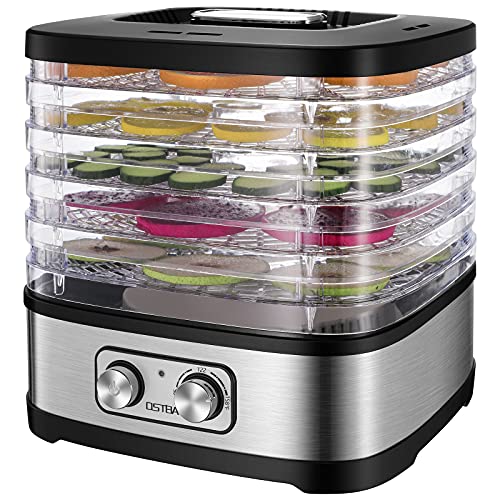
- Compact 4.1-pound body for easy cupboard storage
- Five BPA-free trays with two adjustable stacking heights
- 95–158°F control and 360-degree airflow
Best For: Small-batch trail snacks in space-limited kitchens
Quiet Compact Pick

- 4.9-pound compact design
- 95–165°F control and 48-hour timer
- Quiet operation below 47 dB
Best For: Lightweight, smaller-batch trail-food preparation
High-Capacity Batch Pick

- Eight stainless steel trays
- 650 watts for larger batches
- 95–167°F range with 48-hour timer
Best For: Preparing bulk trail food before extended trips
Stainless-Steel Control Pick
Cosori 5-Tray Stainless Dehydrator
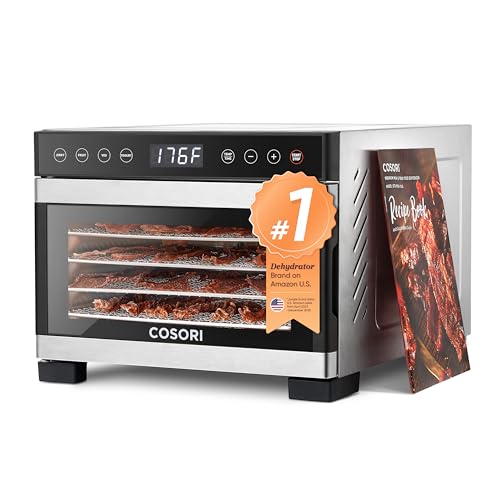
- 3.1 square feet of drying space
- Stainless steel trays and horizontal airflow
- 95–176°F control with four presets
Best For: Durability-focused trail-food preparation at home
High-Capacity Pick

- 10 extra-large stainless steel trays
- 95°F–167°F control with 48-hour timer
- Rear fan, safety shut-off, and dishwasher-safe trays
Best For: Batch meal prep before extended backpacking trips
Compact Budget Option
Elite Gourmet 4-Tray Dehydrator

- Four removable dishwasher-safe trays
- 95°F–158°F range and 24-hour timer
- Compact design with transparent trays
Best For: Small-batch trail-food preparation at home
Space-Saving Prep Pick
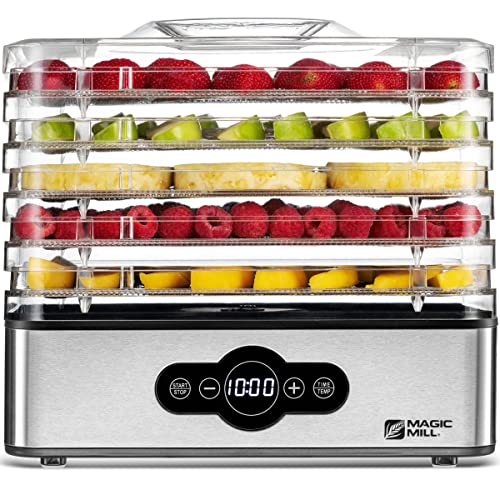
- Five adjustable stainless steel trays
- 95°F–167°F range with 48-hour timer
- Compact design for varied ingredient sizes
Best For: Personal or small-group backpacking meal prep
Best Large-Batch Pick – Cosori 6-Tray Stainless Steel Dehydrator
If you want a food dehydrator for backpacking meal prep and larger batches, the Cosori offers generous capacity, horizontal airflow, and precise digital controls. Its six stainless steel trays provide 6.5 square feet of drying space, though its 18.1-pound weight makes it better suited to home preparation than carrying on the trail.
Best For: Backpackers who prepare substantial quantities of meals, fruit, vegetables, or jerky at home before a trip.
Pros:
- Six stainless steel trays provide 6.5 square feet of drying space.
- 600-watt power and rear-mounted airflow support faster, even drying without tray rotation.
- Quiet operation below 48 dB, a 48-hour timer, and temperature control from 95°F to 165°F.
- Includes a mesh screen, fruit roll sheet, dishwasher-safe trays, and a 50-recipe cookbook.
Cons:
- At 18.1 pounds, it is not a practical unit to carry in a backpack.
- The large rectangular body requires considerable storage space.
The Cosori is a strong choice when your priority is consistent, high-volume meal preparation. It is most useful as a home base for making lightweight backpacking food rather than as portable camp equipment.
Best Budget-Friendly Prepper – Hamilton Beach Digital Dehydrator
The Hamilton Beach is a practical food dehydrator for backpacking if you need a straightforward machine for making fruit, vegetables, herbs, or jerky without a premium price or oversized footprint. Its five stackable trays offer 4.2 square feet of space, while the digital timer and auto-shutoff simplify unattended drying.
Best For: Budget-conscious backpackers who want an easy-to-store dehydrator for occasional meal and snack preparation.
Pros:
- Five BPA-free stackable trays provide up to 4.2 square feet of drying space.
- Adjustable 100°F–160°F temperature range handles a variety of foods.
- Digital timer runs up to 48 hours and shuts the unit off automatically.
- Includes a mesh screen and fruit leather sheet; trays and lid are dishwasher-safe.
Cons:
- Its 500-watt base-mounted heater may be less convenient than a rear-airflow design because the product does not specify that tray rotation is unnecessary.
- The plastic construction is less substantial than stainless steel alternatives.
- It has a narrower temperature range than some competing models.
With a compact eight-pound design and accessible controls, this Hamilton Beach model is a sensible entry point for homemade trail food. It offers useful capacity without taking over a pantry or requiring complicated settings.
Best Premium Stainless-Steel Option – Magic Mill Pro 7-Tray Dehydrator
For serious food dehydrator for backpacking prep, the Magic Mill Pro combines a full stainless steel build with seven full-size trays and a rear-fan drying system. It is designed for repeated batch use, with precise one-degree controls, a 48-hour timer, and a keep-warm mode for finished food.
Best For: Frequent backpacking meal planners who value durable construction, large capacity, and highly adjustable drying settings.
Pros:
- Full stainless steel construction includes the exterior, interior, and seven trays.
- 600-watt rear fan and heat system are designed for even drying without tray rotation.
- Temperature adjusts from 95°F to 176°F in one-degree increments.
- Includes a 48-hour timer, auto-shutoff, overheat protection, 24-hour keep-warm mode, mesh screens, and a fruit roll tray.
Cons:
- The full-size design is better for home batch preparation than backpack transport.
- Its premium stainless steel construction may be more than occasional users need.
- The supplied notes do not list the unit’s exact weight in pounds, only approximately 7.26 kilograms.
The Magic Mill Pro is the most feature-rich option here for repeat dehydrating sessions. Its capacity and durable materials make it especially appealing when you prepare many trail meals or snacks throughout the year.
Best Compact Choice – OSTBA 5-Tray Food Dehydrator
The OSTBA is a compact food dehydrator for backpacking cooks who want to make small batches of lightweight snacks and ingredients without sacrificing basic flexibility. Its five BPA-free trays, 360-degree airflow, simple knob control, and 4.1-pound weight make it easy to store between trips.
Best For: Backpackers with limited kitchen storage who prepare modest batches of fruit, vegetables, herbs, or jerky.
Pros:
- Compact 4.1-pound design fits easily in a cupboard.
- Five BPA-free trays can be stacked at two adjustable heights for different food sizes.
- 95°F–158°F temperature control and 360-degree airflow support varied drying tasks.
- Dishwasher-safe trays, a transparent cover, low-noise operation, and a recipe book add convenience.
Cons:
- The 240-watt motor is less powerful than the 500W and 600W models in this roundup.
- Manual knob controls are less precise than digital controls.
- The compact five-tray capacity is better for smaller batches than large-scale meal prep.
The OSTBA stands out when storage space and low weight matter most. It is a straightforward, economical tool for producing trail snacks and ingredients in smaller quantities.
Quiet Compact Pick – Adjustable Cosori Dehydrator
If you need a food dehydrator for backpacking meal prep, the Cosori offers a relatively lightweight 4.9-pound design with five trays, precise controls, and a compact footprint. Its 95–165°F range and long timer support jerky, fruit, herbs, vegetables, and other trail-food ingredients.
Best For: Backpackers who want a quiet, expandable dehydrator for preparing smaller batches of trail snacks and meals.
Pros:
- Lightweight 4.9-pound construction is easier to store and transport than the larger stainless-steel options.
- Adjustable temperature from 95–165°F in 1°F increments and a timer up to 48 hours.
- Operates below 47 dB, making overnight use less disruptive.
- Five BPA-free trays can be expanded to seven with optional trays.
Cons:
- Its five-tray capacity is smaller than the eight-tray PSIIDAN.
- The maximum temperature is lower than the stainless-steel Cosori’s 176°F setting.
- The trays and body use polypropylene rather than stainless steel.
This is a practical choice when storage space, low weight, and quiet operation matter most. The expandable tray system also gives you room to increase capacity later without starting with a larger appliance.
High-Capacity Batch Pick – PSIIDAN 8-Tray Dehydrator
For batch-focused backpacking preparation, the PSIIDAN food dehydrator provides eight stainless steel trays and 650 watts of power. It combines a 95–167°F temperature range with a timer lasting from 30 minutes to 48 hours, making it suitable for preparing larger quantities of jerky, fruit, herbs, and vegetables.
Best For: Backpackers and households preparing large batches of dehydrated food before extended trips.
Pros:
- Eight stainless steel trays provide more loading capacity for bulk meal preparation.
- Temperature adjusts up to 167°F, with timing from 30 minutes to 48 hours.
- Includes a mesh tray, drip tray, recipe book, and manual.
- Interior lighting lets you monitor food without opening the door and losing heat.
Cons:
- Its larger eight-tray format may be less convenient for limited storage.
- The supplied notes do not list the unit’s weight or dimensions, making packability harder to assess.
- It uses more power than the 350-watt compact Cosori.
The PSIIDAN stands out when throughput matters more than minimizing countertop space or energy use. Its stainless steel trays and included accessories make it well equipped for preparing multiple backpacking ingredients in one cycle.
Stainless-Steel Control Pick – Cosori 5-Tray Stainless Dehydrator
This Cosori is a strong food dehydrator for backpacking preparation when durable food-contact materials and precise temperature control are priorities. Five stainless steel trays provide 3.1 square feet of drying space, while horizontal airflow, four presets, and a 95–176°F range support consistent results for jerky, fruit, vegetables, and other trail foods.
Best For: Backpackers who want stainless steel trays, higher heat capability, and guided presets in a countertop-sized unit.
Pros:
- Five stainless steel trays provide 3.1 square feet of drying space with no plastic contact with food.
- Temperature adjusts from 95–176°F in 1°F increments, with a timer up to 48 hours.
- Four presets cover jerky, fruit, vegetables, and yogurt while remaining adjustable.
- Rear horizontal airflow is designed to distribute heat evenly across the trays.
Cons:
- At 10.8 pounds, it is substantially heavier than the 4.9-pound compact Cosori.
- It has five trays, offering less capacity than the eight-tray PSIIDAN.
- The 480-watt design uses more power than the smaller 350-watt Cosori.
This model is best suited to home preparation of backpacking food rather than carrying the dehydrator itself. Its stainless steel construction, higher maximum temperature, and horizontal airflow make it the durability-focused choice among these options.
High-Capacity Pick – Magic Mill 10-Tray Dehydrator
For a food dehydrator for backpacking meal prep, the Magic Mill offers substantial batch capacity and precise controls. Its 10 stainless steel trays, 48-hour timer, and adjustable 95°F–167°F range suit users preparing jerky, fruit, vegetables, or other shelf-stable foods at home before a trip.
Best For: Batch meal prep and serious home users who need generous tray capacity.
Pros:
- Ten extra-large stainless steel trays provide ample drying space.
- Rear-mounted fan and Precision Airflow circulation are designed for even drying without manual tray rotation.
- Temperature control, a 48-hour timer, and a keep-warm function offer flexible operation.
- Dishwasher-safe trays, automatic shut-off, and overheat protection simplify use and cleanup.
Cons:
- At 20.5 pounds and 18 inches deep, it is not a portable backpacking appliance.
- Its 700-watt, 120-volt design is intended for home use and requires advance meal preparation.
This is a strong choice when backpacking food is prepared in larger batches before departure. Its capacity and controls are impressive, but its size and home-oriented power requirements make it better for a kitchen than for carrying into the backcountry.
Compact Budget Option – Elite Gourmet 4-Tray Dehydrator
The Elite Gourmet is a straightforward food dehydrator for backpacking preparation when you want a smaller countertop unit. Its four trays, adjustable 95°F–158°F temperature range, and up-to-24-hour timer cover common tasks such as drying fruit, herbs, vegetables, and jerky ingredients.
Best For: Occasional home drying and smaller trail-food batches.
Pros:
- Compact 11.5-by-10-by-8-inch footprint is easier to accommodate than larger dehydrators.
- Adjustable temperature and timer settings support different foods.
- Horizontal airflow and a bottom-mounted fan are designed to distribute heat evenly.
- Removable trays and lid are dishwasher safe, and transparent trays let you monitor progress.
Cons:
- Four trays provide less capacity than larger models.
- The 24-hour maximum timer may be limiting for longer drying cycles.
- It is a 120-volt indoor appliance and should not be used outdoors.
For backpackers who dehydrate modest quantities at home, this model keeps the process simple and relatively compact. Its smaller capacity and shorter timer make it less suitable for preparing food for a large group or extended trip.
Space-Saving Prep Pick – Magic Mill 5-Tray Dehydrator
This compact Magic Mill is a practical food dehydrator for backpacking cooks who want adjustable capacity without a large appliance. Five stackable stainless steel trays, expandable tray height, and a 48-hour timer make it suitable for preparing jerky, fruit, vegetables, and other backpacking foods in manageable batches.
Best For: Backpackers seeking a compact home dehydrator with flexible tray spacing.
Pros:
- Five stainless steel trays offer more room than a basic small-batch unit.
- Tray height adjusts from 0.6 to 1.1 inches for thicker ingredients.
- Temperature settings from 95°F to 167°F and a 48-hour timer provide useful flexibility.
- Detachable trays can be washed by hand or in a dishwasher.
Cons:
- The 240-watt motor has less power than the larger 700-watt model.
- Its 8.5-by-11.8-by-11-inch size is compact for storage but still not designed for backpack carry.
- The supplied details list a 110-volt electrical design, so it requires powered preparation at home.
This model balances capacity and footprint well for preparing personal or small-group backpacking meals. Adjustable tray spacing is especially useful for varied ingredients, while the compact design is easier to store than a full-size dehydrator.
How We Picked the Best Food Dehydrator for Backpacking
We focused on features that matter when preparing trail food: consistent airflow, useful temperature ranges, practical capacity, straightforward controls, and cleanup-friendly tray materials. Stainless steel trays can offer durability and simplify long-term use, while BPA-free plastic trays may keep weight and cost lower.
Because these are generally countertop appliances rather than field equipment, we also considered how easily each model fits into a home meal-prep routine. A good choice should let you dry multiple ingredients efficiently without requiring constant tray rotation or complicated settings.
Quick Comparison
| Priority | Look For | Best For |
|---|---|---|
| Large batch prep | 7–10 trays and strong airflow | Families, group trips, and frequent dehydrating |
| Compact use | 5 trays and a smaller footprint | Occasional backpacking meal prep |
| Convenience | Digital controls and an automatic timer | Hands-off drying |
| Durability | Stainless steel trays and housing components | Regular, long-term use |
| Lower energy use | Lower-wattage heating system | Smaller batches and budget-conscious users |
Key Buying Factors for a Food Dehydrator for Backpacking
Capacity and Footprint
More trays let you prepare complete meals or several ingredients at once, but larger machines take up more counter and storage space. For occasional trips, five trays may be enough. Frequent hikers or groups may benefit from seven to ten trays.
Temperature and Airflow
Adjustable temperature control is important because fruits, vegetables, herbs, and meats dry best under different conditions. Rear-mounted fans generally help distribute heat more evenly than basic stackable designs. For jerky, confirm that the model reaches an appropriate temperature and follow safe meat-handling guidance.
Trays and Cleanup
Stainless steel trays are durable and resist staining, while plastic trays can be lighter and easier to replace. Check whether trays are dishwasher-safe, whether mesh inserts are included, and how easily the interior can be wiped clean after sticky foods.
Controls, Timer, and Power
A digital timer helps prevent over-drying when you cannot monitor the machine. Higher wattage may shorten drying time or support larger loads, but it can also increase energy use. Choose power and capacity together rather than assuming the highest wattage is automatically best.
Who Should Buy Which Food Dehydrator for Backpacking?
Choose a compact five-tray model if you prepare occasional snacks or solo backpacking meals and want easier storage. Choose a larger seven- to ten-tray dehydrator if you batch-cook meals, dry ingredients for several people, or want to process a full harvest efficiently.
Prioritize digital controls and a timer for overnight drying or repeatable recipes. Prioritize stainless steel trays if durability and frequent cleanup matter most. If your main goal is lightweight trail food, remember that the dehydrator stays at home: compare finished food quality, usable capacity, and operating convenience more heavily than the appliance’s own weight.