The best bike trainers with power meter support make indoor cycling more measurable, helping you track effort, follow structured workouts, and compare performance over time. This roundup includes direct-drive smart trainers, a connected indoor bike, and pedal-based power meters that can add power data to compatible setups.
We compare accuracy-focused features, resistance range, gradient simulation, connectivity, ride feel, and setup requirements so you can choose the right option for serious training, everyday fitness, or immersive virtual riding.
Best 10 Bike Trainers with Power Meter Picks for 2026
Premium Direct-Drive Pick
Garmin TacX NEO 2T Smart Trainer

- 2,200-watt load capacity
- ANT+ and Bluetooth connectivity
- Includes multiple axle adapters
Best For: Connected indoor training with broad compatibility
Single-Sided Pedal Pick
Favero Assioma Uno Power Meter Pedal

- Left-pedal power sensor
- Bluetooth and ANT+ connectivity
- Built-in cadence sensor and gyroscope
Best For: Road cyclists wanting portable power measurement
High-Output Value Trainer
ThinkRider X2Max Smart Bike Trainer

- 2,000-watt power output
- Simulates gradients up to 18%
- ANT+ and BLE connectivity
Best For: Software-controlled indoor climbing workouts
Dual-Sided Accuracy Pick
Favero Assioma Duo Power Meter

- Dual-sided power measurement
- Stated ±1% accuracy with temperature compensation
- At least 50 hours of rechargeable use
Best For: Transferable power data across indoor and outdoor rides
Self-Powered Performance
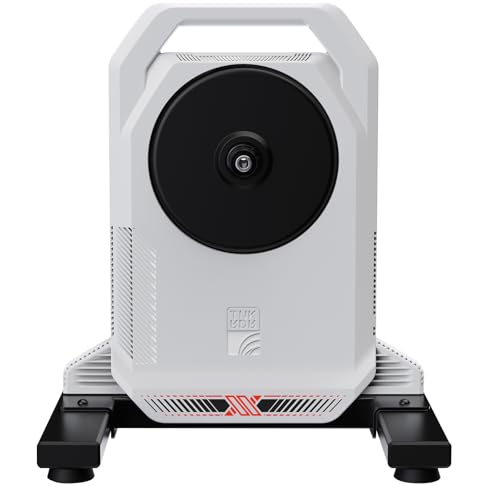
- ±1% claimed accuracy with direct motor drive
- 2,500W output and 25% gradient simulation
- Self-powered operation plus ANT+ and Bluetooth
Best For: High-power indoor training and virtual climbing
Versatile Connected Training

- ANT+ and Bluetooth power, speed, and cadence data
- Up to 2,300W and 24% slope simulation
- Includes quick-release and 12x142mm adapters
Best For: Multi-device training with road or mountain bikes
Complete Indoor Ride Experience

- ±1% claimed accuracy and 2,500W maximum power
- Physical grade changes with downhill simulation
- Virtual shifting, Wi-Fi, and major app compatibility
Best For: Dedicated, immersive indoor cycling setups
Best Premium Pick
Garmin TacX NEO 3M Smart Trainer

- Motion plates provide adjustable multidirectional movement.
- Simulates surfaces and gradients up to 25%.
- Power, speed, and cadence accuracy within 1%.
Best For: Premium indoor realism and immersive training
Best Value Direct-Drive Pick

- Offers 2,200 watts and 15% grade simulation.
- Includes ERG mode and Bluetooth/ANT+ connectivity.
- Belt-driven design supports smooth, quieter training.
Best For: Structured workouts and app-based indoor riding
Best Quiet High-Power Pick
CYCPLUS T2H Smart Bike Trainer

- Delivers 2,200 watts with 85 N·m of torque.
- Provides ±1% power accuracy and 20% gradient simulation.
- Noise-reduction design targets operation under 55 dB.
Best For: Quiet, high-power indoor training
Premium Direct-Drive Pick – Garmin TacX NEO 2T Smart Trainer
The Garmin TacX NEO 2T is a strong choice for cyclists comparing bike trainers with power meter functionality. Its magnetic resistance system supports loads up to 2,200 watts, while ANT+ and Bluetooth connectivity make it compatible with iOS, Android, macOS, and Windows devices.
Best For: Riders wanting a high-capacity, connected indoor trainer with broad device compatibility.
Pros:
- Supports up to 2,200 watts of load.
- ANT+ and Bluetooth connectivity work across major operating systems.
- Includes a front wheel block, power cable, skewer, and multiple axle adapters.
Cons:
- At 47.4 pounds, it is relatively heavy to move.
- A cassette is not listed among the included components.
The NEO 2T stands out for its substantial power capacity and included fitment hardware. It is a practical premium option for structured indoor training, provided its weight and cassette requirements fit your setup.
Single-Sided Pedal Pick – Favero Assioma Uno Power Meter Pedal
Favero Assioma Uno Power Meter Pedal | Why We Like The Favero Assioma UNO Pedal
Check Price On AmazonThe Favero Assioma Uno is a pedal-based option for cyclists seeking bike trainers with power meter support or a portable way to measure training output. Its left pedal sensor connects through Bluetooth and ANT+, and it includes cadence sensing and a gyroscope.
Best For: Road cyclists who want a compact, pedal-based power sensor with common wireless connections.
Pros:
- Uses Bluetooth and ANT+ for compatibility with cycling devices.
- Includes an inbuilt cadence sensor and gyroscope.
- Reports ±1% angular-velocity accuracy.
Cons:
- Measures power through a left-pedal sensor rather than dual-sided sensing.
- Designed for road bikes, limiting its stated bike-type range.
The Assioma Uno is not a trainer itself, but it can add power data to a compatible indoor riding setup. Its single-sided design keeps the feature set focused for road cyclists who prioritize straightforward power measurement.
High-Output Value Trainer – ThinkRider X2Max Smart Bike Trainer
The ThinkRider X2Max is a smart electromagnetic trainer for riders comparing bike trainers with power meter capability at a 2,000-watt output level. It supports ANT+ and BLE, simulates gradients up to 18%, and is designed to work with software such as Zwift.
Best For: Indoor cyclists who want software-controlled resistance, high output, and a trainer rated for steep virtual climbs.
Pros:
- Provides up to 2,000 watts with stated ±2% power-meter error.
- Simulates gradients up to 18% through variable resistance.
- Supports ANT+ and BLE and is rated at about 58 dB at 30 km/h.
Cons:
- Cassette is not included.
- Its listed power-meter error is wider than ±1%.
- Only a one-year warranty is specified.
The X2Max combines a strong output rating with modern wireless protocols and virtual-gradient simulation. It is appealing for Zwift-style training, although buyers should budget for a cassette and consider whether its stated accuracy meets their needs.
Dual-Sided Accuracy Pick – Favero Assioma Duo Power Meter
The Favero Assioma Duo is a dual-sided pedal power meter for cyclists building a precise indoor training setup around bike trainers with power meter data. It connects to bike computers, cycling GPS units, and smartphones through Bluetooth and ANT+, with automatic temperature compensation and stated ±1% accuracy.
Best For: Road cyclists seeking dual-sided, transferable power measurement with rechargeable batteries.
Pros:
- Dual-sided pedal-based power measurement.
- Automatic temperature compensation supports consistent readings from -10°C to 60°C.
- Rechargeable batteries provide at least 50 hours per charge.
- Includes cleats, charging hardware, and installation accessories.
Cons:
- Designed for road bikes and clipless pedal setups.
- Requires periodic charging.
- Uses Look Keo-compatible cleats and may require a cleat change for other systems.
The Assioma Duo is a flexible way to bring power measurement from one bike to another because it installs like a normal pedal. Its dual-sided design, wireless compatibility, and temperature compensation make it especially suitable for riders who want consistent data across indoor and outdoor training.
Self-Powered Performance – ThinkRider XXPRO
The ThinkRider XXPRO is a direct-drive option for cyclists comparing bike trainers with power meter functionality. It combines claimed ±1% data accuracy with up to 2,500 watts of power, 25% gradient simulation, and support for ANT+, Bluetooth, bike GPS, PC, and Zwift connections.
Best For: Riders who want high-power indoor training with self-power generation and downhill simulation.
Pros:
- Direct motor drive with claimed ±1% data accuracy and no calibration required.
- Can generate its own electricity, while also supporting plug-in operation.
- Simulates uphill and downhill gradients, with up to 2,500W and a 25% slope.
- Supports Bluetooth, ANT+, bike GPS, PC, and Zwift connections.
Cons:
- Its 242-pound load capacity is lower than some competing options.
- The supplied details list a one-year warranty.
With strong power and slope specifications, the XXPRO is suited to demanding virtual routes and structured sessions. Its self-powered design may also simplify setup where outlet access is inconvenient.
Versatile Connected Training – Elite Justo Direct Drive
The Elite Justo is a direct-drive smart trainer for shoppers evaluating bike trainers with power meter support. It offers ANT+ and Bluetooth connectivity, power data transmission, up to 2,300 watts at 40 km/h, and 24% slope simulation across a broad range of devices and training platforms.
Best For: Road and mountain-bike riders who want wide device compatibility and substantial climbing simulation.
Pros:
- Transmits power, speed, and cadence through ANT+ and Bluetooth.
- Supports control from smartphones, tablets, bike computers, sports watches, Windows, and Mac.
- Simulates gradients up to 24% and reaches up to 2,300W at 40 km/h.
- Includes quick-release and 12x142mm thru-axle adapters.
Cons:
- Shimano 9/10/11/12-speed road cassettes are compatible, but other cassette options are sold separately.
- At 46.7 pounds, it is a relatively substantial trainer to move.
The Justo stands out for connectivity and compatibility rather than the highest stated power ceiling. Its included adapters and two-year manufacturer warranty add practical value for riders building a flexible indoor setup.
Complete Indoor Ride Experience – Wahoo KICKR BIKE PRO
The Wahoo KICKR BIKE PRO is a complete indoor cycling setup for riders considering bike trainers with power meter capabilities. Its integrated motor and precision flywheel provide claimed ±1% power accuracy, while virtual shifting, physical grade changes, downhill simulation, Wi-Fi, and broad app compatibility support immersive training.
Best For: Serious cyclists seeking a dedicated indoor bike with integrated controls and realistic gradient changes.
Pros:
- Offers up to 2,500W and claimed ±1% power accuracy.
- Combines integrated downhill simulation with physical grade changes.
- Provides virtual shifting, custom gear mapping, and integrated shifter controls.
- Supports Wi-Fi, major training apps, KICKR Direct Connect, and automatic firmware updates.
Cons:
- Its 42 kg weight and large 47-by-37-by-29-inch dimensions require dedicated space.
- The supplied details list a one-year manufacturer warranty.
- As a complete indoor bike, it is less portable than a conventional trainer.
The KICKR BIKE PRO is designed for riders who prioritize a dedicated, realistic training environment over portability. Its power specifications, physical grade adjustment, and integrated controls make it a feature-rich choice for frequent indoor use.
Best Premium Pick – Garmin TacX NEO 3M Smart Trainer
Garmin TacX NEO 3M Smart Trainer, Multidirectional Movement, Realistic Ride Fee
Check Price On AmazonFor riders comparing bike trainers with power meter capability, the Garmin TacX NEO 3M stands out with power, speed, and cadence tracking rated within 1% accuracy across a broad range of outputs. Its integrated motion plates, realistic surface simulation, and broad app compatibility make it a feature-rich option for immersive indoor training.
Best For: Riders who want premium realism, multidirectional movement, and advanced virtual training features.
Pros:
- Built-in motion plates can be toggled on or off for a more natural riding feel.
- Simulates road surfaces, descents, and inclines up to a 25% gradient.
- Measures power, speed, and cadence with improved accuracy within 1%.
- Includes a pre-installed 11-speed cassette and requires no calibration out of the box.
Cons:
- Premium features depend on compatible apps, and some Tacx content requires a subscription.
- Its advanced feature set may be more than casual riders need.
The NEO 3M is a strong choice when realistic movement and detailed ride simulation matter as much as accurate power data. Its 2,200-watt capacity and stable design also suit demanding intervals and sprints.
Best Value Direct-Drive Pick – COOSPO T10 Smart Bike Trainer
The COOSPO T10 is a practical choice among bike trainers with power meter functionality, offering power measurement rated at ±2% accuracy, automatic ERG control, and up to 2,200 watts of resistance. Its belt-driven direct-drive design is built for smooth, quieter home workouts and supports major training platforms.
Best For: Riders seeking a capable direct-drive trainer for structured workouts and virtual cycling without premium pricing features.
Pros:
- Belt-driven direct drive is designed for smooth power transfer and reduced operating noise.
- Provides up to 2,200 watts and simulates gradients up to 15%.
- Supports automatic ERG mode for target-power interval training.
- Offers Bluetooth FTMS and ANT+ FE-C connectivity with popular cycling apps.
Cons:
- Cassette is not included.
- SRAM XDR requires a separately sold freehub body, and Micro Spline is not directly compatible.
- Power accuracy is rated at ±2%, less precise than some premium alternatives.
The T10 balances useful smart-trainer features with straightforward connectivity and stable construction. Check your frame and cassette compatibility before ordering, then use the COOSPO Tools app for calibration and firmware updates.
Best Quiet High-Power Pick – CYCPLUS T2H Smart Bike Trainer
The CYCPLUS T2H combines a brushless motor, 2,200 watts of peak power, and power meter accuracy rated at ±1%, making it a compelling option for riders comparing bike trainers with power meter support. It also offers dual BLE/ANT+ connectivity, automatic gradient matching up to 20%, and a noise-reduction design rated under 55 dB.
Best For: Home cyclists who prioritize quiet operation, high power, and realistic gradient simulation.
Pros:
- Brushless motor delivers up to 2,200 watts and 85 N·m of maximum torque.
- Power accuracy is maintained at ±1%.
- Simulates gradients up to 20% and syncs resistance with supported riding software.
- Triple-layer noise reduction is designed for operation under 55 dB.
Cons:
- Cassette is not included.
- Virtual shifting requires the separately sold CYCPLUS BC2 Shifter.
- Virtual shifting is not compatible with ERG mode.
The T2H is well suited to powerful indoor sessions where low noise and accurate data are priorities. Its shifting add-on requirements should be considered before choosing it for a virtual-shifting setup.
How We Picked the Best Bike Trainers with Power Meter
We focused on products that provide usable power data through an integrated power measurement system or a compatible pedal-based meter. We also considered smart resistance control, maximum simulated gradient, peak resistance, wireless protocols, drivetrain compatibility, noise, portability, and the platforms each product can connect to.
Because these products are not identical, the list includes both complete smart trainers and power-meter pedals. A direct-drive trainer replaces the rear wheel and controls resistance through apps, while power-meter pedals measure your effort on a conventional bike and can work indoors or outdoors.
Quick Comparison
| Best For | What to Look For |
|---|---|
| Immersive smart training | High resistance, realistic gradient simulation, and responsive app control |
| Power data on multiple bikes | Pedal-based measurement with ANT+ and Bluetooth compatibility |
| Quiet home workouts | Direct drive, a belt-driven transmission, and reliable cadence and power reporting |
| Advanced training setups | Accurate power measurement, broad connectivity, and stable ERG-mode performance |
Key Buying Factors for Bike Trainers with Power Meter
Power Accuracy and Measurement Type
Check the stated accuracy and whether power is measured at the trainer, crank, or pedals. Trainer-based measurement is convenient for a dedicated indoor setup, while pedal meters are easier to move between bikes and may provide left-right or dual-sided data. Remember that drivetrain losses and measurement location can produce different readings between devices.
Resistance and Gradient Simulation
Higher wattage and gradient ratings matter most for powerful riders, steep virtual climbs, and sprint workouts. For casual riding, smooth resistance changes and dependable ERG mode may be more important than the highest headline number.
Connectivity and Compatibility
ANT+ and Bluetooth support improves compatibility with cycling computers, phones, tablets, and training platforms. Verify cassette or freehub requirements, axle standards, pedal threads, and whether your preferred app can control the trainer rather than merely record data.
Ride Feel, Noise, and Space
Direct-drive trainers are generally stable and quieter than wheel-on designs, but they still require a suitable floor and adequate ventilation. Multidirectional movement can add realism, while a complete indoor bike may be simpler if you do not want to mount and remove your road bike.
Who Should Buy Which Bike Trainers with Power Meter?
Choose a premium direct-drive model such as the Garmin TacX NEO series, Elite Justo, ThinkRider XXPRO, or CYCPLUS T2H if you want immersive virtual riding, strong climbing simulation, and structured workouts. The ThinkRider X2Max is a practical choice for riders who want substantial resistance and broad wireless connectivity at a potentially lower cost.
Choose the Wahoo KICKR Bike PRO if you want a dedicated indoor cycling station with adjustable fit and no need to use your outdoor bicycle. Select Favero Assioma Uno for a simpler single-sided pedal-based upgrade, or Assioma Duo when left-right measurement and bike-to-bike flexibility matter most. The COOSPO T10 is worth considering for a straightforward belt-driven direct-drive setup with connected training features.