Camera sliders with 360-degree rotation make it easier to combine smooth linear movement with controlled pans, or to fine-tune a macro composition without repositioning the entire setup. The best option depends on your camera weight, shooting style, travel needs, and whether you want manual or motorized movement.
We’ve gathered ten options ranging from compact macro rails and phone-friendly dollies to long motorized sliders and heavy-duty rotating platforms. Use the guide below to narrow the list by stability, control, compatibility, and value.
Best 10 Camera Sliders with 360 Degree Rotation Picks for 2026
Best Portable Pick
NEEWER CS1M 16-Inch Carbon Fiber Slider

- 360° ball head with 90° tilt
- Adjustable legs and quiet four-bearing rail
- Phone and action-camera accessories included
Best For: Portable outdoor shooting with lightweight cameras, phones, and action cameras
Best Automated Pro Option
iFootage Shark Nano II 34-Inch Motorized Slider

- Eight-point programmable motion paths
- AI tracking and vibration stabilization
- Quiet motor with touchscreen and app control
Best For: Advanced cinematic, product, interview, and time-lapse motion control
Best Heavy-Duty Rotating Rig
Glide Gear REVO 50 360° Platform

- 360° rotating platform for immersive angles
- Adjustable 14.5–27-inch extension arm
- Ball head and phone mount included
Best For: Controlled rotating shots, commercials, music videos, and sturdy installations
Best Value Motorized Slider
GVM 31-Inch Carbon Fiber Dolly Rail

- Motorized horizontal, tracking, and 120° panorama modes
- Time-lapse with programmable endpoints
- Remote, battery, ball head, and cables included
Best For: Automated tracking, time-lapse, and 120° panoramic camera movement
Best Pro Motorized Pick

- 360° unlimited pan with dual-axis motorized control
- 7kg horizontal payload and 17-inch travel
- Touchscreen, app control, AI tracking, and DJI compatibility
Best For: Professional filmmakers and advanced motion-control setups
Best Macro Precision Pick
NiSi NM-200S Macro Focusing Rail

- 1mm adjustment per rotation with 180mm travel
- 360° rotating clamp for flexible camera orientation
- Arca-Swiss-compatible mounting and quick positioning
Best For: Macro photographers and focus-stacking workflows
Best Compact Pick

- 360° pan rotation with DJI Pocket integration
- Compatible with smartphones and action cameras
- 1.9-pound body with seven-hour battery life
Best For: Travel creators, vloggers, and lightweight camera setups
Best Macro Rail
NEEWER 4-Axis 360° Focusing Rail

- Four-axis positioning for close-ups
- Dual 100mm lead-screw sliders
- Supports cameras up to 5.5lb
Best For: Precise macro photography and time-lapse framing
Best Compact Dolly
NEEWER SD001 360° Camera Dolly

- Linear or circular wheel movement
- 360° ball-head rotation and 90° tilt
- Lightweight 220g tabletop design
Best For: Portable product, phone, and action-camera shots
Best Adjustable Spinner
Portable 360° Rotating Camera Slider
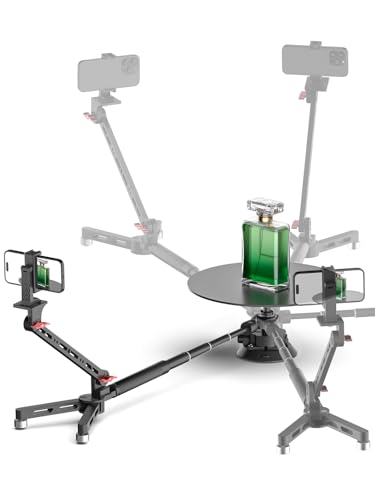
- Full 360-degree rotating movement
- Adjusts from 21.25 to 43.3 inches
- Suction base with phone holder and ball head
Best For: Creative rotating shots and on-location video setups
Best Portable Pick – NEEWER CS1M 16-Inch Carbon Fiber Slider
For creators seeking camera sliders with 360 degree rotation, the NEEWER CS1M offers a compact manual setup with a 360° ball head, adjustable legs, and broad camera, phone, and action-camera compatibility. Its 16-inch carbon-fiber rail is designed for smooth, quiet movement and easy transport.
Best For: Portable outdoor shooting, smartphones, action cameras, and lightweight DSLR or mirrorless setups.
Pros:
- 360° ball-head rotation with 90° tilt adjustment
- Adjustable legs help level the slider on uneven terrain
- Quiet four-bearing movement and tripod-mounting options
- Includes phone clamp, action-camera mount, and carrying bag
Cons:
- Payload is limited to 4.4 pounds horizontally and 2.2 pounds for tilted or vertical use
- The 16-inch rail provides less travel than longer sliders
- Manual operation lacks motorized time-lapse control
The CS1M is a practical choice when portability and mounting flexibility matter more than long travel or automated motion. Check your camera weight carefully, especially for angled or vertical shots.
Best Automated Pro Option – iFootage Shark Nano II 34-Inch Motorized Slider
The iFootage Shark Nano II is built for advanced automated camera movement, including 360° rotary-axis shots. Its touchscreen and app support multi-point paths, while AI subject tracking, stabilization, and DJI gimbal integration expand its usefulness for cinematic and repeatable motion.
Best For: Professional product videos, interviews, time-lapses, panoramas, and complex multi-axis camera moves.
Pros:
- Supports up to eight customizable motion points
- AI face and object tracking helps keep subjects centered
- Quiet brushless motor with real-time micro-vibration cancellation
- Built-in IPS touchscreen and USB-C PD 3.0 charging
Cons:
- Its advanced controls may be more than casual users need
- DJI gimbal multi-axis operation uses the included custom RS Adapter
- Battery grip flexibility requires a separately identified accessory
Choose the Nano II when precise, repeatable automation is the priority. It is especially compelling for productions that need tracking, programmed paths, or long shooting sessions, provided the setup’s compatibility and power requirements fit your workflow.
Best Heavy-Duty Rotating Rig – Glide Gear REVO 50 360° Platform
The Glide Gear REVO 50 takes a different approach to camera sliders with 360 degree rotation: it is a rotating platform rig with an adjustable arm rather than a conventional rail slider. Its aluminum construction, ball head, and phone mount support flexible camera positioning for immersive and dynamic shots.
Best For: Rotating platform shots, music videos, commercials, and setups requiring a substantial support base.
Pros:
- 360° rotating platform captures footage from varied angles
- Adjustable extension ranges from 14.5 to 27 inches
- Includes a ball head and cell-phone mount
- Stool is rated for up to 40 pounds of support
Cons:
- The camera payload is listed as up to 5 pounds, despite the heavier stool capacity
- At 20 pounds, it is substantially less portable than compact sliders
- It is a rotating platform rig, not a conventional motorized rail slider
The REVO 50 makes sense for controlled rotating shots where a sturdy base and adjustable reach are more important than lightweight travel. Distinguish its 5-pound camera limit from the 40-pound stool capacity before choosing it for a heavy setup.
Best Value Motorized Slider – GVM 31-Inch Carbon Fiber Dolly Rail
The GVM motorized slider provides automated camera movement with horizontal, tracking, and 120° panoramic shooting modes. Its carbon-fiber rail, remote controller, time-lapse menu, and multiple mounting points make it a versatile alternative for creators comparing camera sliders with 360 degree rotation, though its listed panoramic range is 120° rather than a full 360°.
Best For: Automated tracking shots, time-lapse photography, and 120° panoramic movement with compatible cameras.
Pros:
- 31-inch carbon-fiber rail with a silent stepper motor
- Supports horizontal, tracking, and 120° panoramic shooting
- Video and time-lapse modes include set-point and auto-round-trip functions
- Includes remote, NP battery, ball head, cables, charger, and accessories
Cons:
- It does not provide a full 360° panoramic rotation according to the supplied specifications
- Listed weight is 10 pounds, making it less convenient for travel
- Operation depends on the included shutter-release cables for supported cameras
The GVM is a well-equipped option for creators who want motorized movement and time-lapse features without stepping up to a more advanced multi-axis system. Its 120° panorama mode should be sufficient for many scenes, but it is not a full-rotation solution.
Best Pro Motorized Pick – IFOOTAGE Shark Nano II 660
For filmmakers seeking camera sliders with 360 degree rotation, the IFOOTAGE Shark Nano II 660 combines unlimited pan movement with motorized slider travel and dual-axis control. Its 17-inch range, 7kg horizontal payload, app control, and DJI gimbal compatibility make it suited to advanced, repeatable camera movements.
Best For: Professional filmmaking, live streaming, interviews, time-lapse work, and heavier camera setups.
Pros:
- Offers 360° unlimited pan movement with dual-axis motorized control.
- Supports up to 7kg horizontally and provides a 17-inch sliding range.
- Includes touchscreen and smartphone-app control with up to eight waypoints.
- Brushless motor operates below 20dB and supports AI dynamic tracking.
Cons:
- DJI gimbal integration requires a compatible adapter and the gimbal is sold separately.
- Its advanced controls and professional payload may be more than casual users need.
The Nano II 660 is the strongest choice here for creators who need precise, quiet, programmable motion and a robust payload. It is particularly compelling when 360° panning and synchronized DJI gimbal movement are central to the shot.
Best Macro Precision Pick – NiSi NM-200S Macro Focusing Rail
The NiSi NM-200S is a manual macro focusing rail for photographers who want camera sliders with 360 degree rotation in a compact precision setup. Its 1mm-per-rotation adjustment, 180mm travel, and rotating clamp help refine focus and camera orientation without removing the rail mount.
Best For: Macro photography, close-up focus stacking, and tripod-based precision adjustments.
Pros:
- Provides precise 1mm movement per rotation across a 180mm adjustment range.
- 360° rotating clamp makes it easy to change camera orientation.
- Arca-Swiss-style compatibility and multiple screw holes support flexible mounting.
- Quick-position button allows faster large adjustments between shots.
Cons:
- This is a manual focusing rail rather than a motorized slider.
- Its design is aimed at macro precision, not long cinematic camera moves.
Choose the NM-200S when controlled macro positioning matters more than automated movement. The rotating clamp and fine adjustment system are practical advantages for close-up work, especially when paired with a compatible tripod setup.
Best Compact Pick – iFootage Shark Slider PICO
The iFootage Shark Slider PICO is a lightweight option for creators comparing camera sliders with 360 degree rotation for phones, action cameras, and compact DJI devices. It adds 360° pan rotation, programmable shot points, several shooting modes, and up to seven hours of battery life in a portable 1.9-pound design.
Best For: Vloggers, mobile filmmakers, travel creators, and owners of DJI Pocket or action cameras.
Pros:
- Supports 360° pan rotation and direct DJI Pocket 3/4 integration.
- Works with DJI Pocket devices, action cameras, and smartphones.
- Offers Video, Time-Lapse, Stop Motion, Panorama, and Multi-Target modes.
- Provides up to seven hours of operation with 30W PD 3.0 charging.
Cons:
- Its 2.4-pound payload is intended for lighter cameras and devices.
- The 15.8-inch slider is less suited to larger professional camera rigs.
The PICO is a practical travel-friendly choice when portability and device compatibility are priorities. Its quiet motor, wireless phone features, and direct DJI Pocket integration make it especially useful for solo creators producing repeatable moving shots.
Best Macro Rail – NEEWER 4-Axis 360° Focusing Rail
If you need camera sliders with 360 degree rotation for close-up work, the NEEWER GM-MP3 focuses on controlled, repeatable positioning rather than long tracking moves. Its dual lead-screw sliders provide four-way adjustment, while the rotating top section helps refine composition for macro photography, close-ups, and time-lapse videos.
Best For: Macro photographers and videographers who need precise four-axis camera positioning.
Pros:
- Dual 100mm sliders provide up to 200mm of combined movement.
- Supports left, right, forward, and backward adjustments with a rotating top section.
- Aluminum alloy construction weighs 745g and supports cameras up to 5.5lb.
- Includes an Arca-type quick release plate and 3/8-inch tripod compatibility.
Cons:
- Designed for macro and precise framing, not extended cinematic slider travel.
- Requires the positioning lock to be pushed down for stabilization.
The GM-MP3 is a specialized choice for photographers who value fine control and stable composition. Its compact, sturdy design makes it practical for studio or outdoor close-up setups, though its short travel limits its usefulness for wide camera moves.
Best Compact Dolly – NEEWER SD001 360° Camera Dolly
The NEEWER SD001 is a portable option for camera sliders with 360 degree rotation, combining straight-line dolly movement with circular panning. Adjustable wheels, a rotating ball head, and a phone clamp make it suitable for tabletop shots, product footage, and compact mobile-video setups.
Best For: Creators who want a lightweight tabletop dolly for cameras, phones, and action cameras.
Pros:
- Wheels adjust to create linear or circular movement.
- Soft rubber wheel rings support smooth, quieter operation.
- Ball head rotates 360° and tilts 90° for flexible framing.
- Compact 220g aluminum alloy design includes a rotatable phone clamp with cold shoe.
Cons:
- Not suitable for telephoto lenses.
- Action-camera adapter is sold separately.
- Its small tabletop format is less suited to larger, full-size camera rigs.
For portable shooting, the SD001 offers more movement options than a basic mini dolly while remaining easy to pack. It is especially practical for social content and product clips, provided your camera setup stays within the compact format.
Best Adjustable Spinner – Portable 360° Rotating Camera Slider
This portable spinner is a flexible pick among camera sliders with 360 degree rotation, using a suction-cup base and dual-bearing system for fluid repositioning. Its adjustable 21.25- to 43.3-inch range gives creators more control over the distance and perspective of rotating shots.
Best For: On-location filming, music videos, commercials, and rotating phone or camera presentations.
Pros:
- Provides full 360-degree rotation for footage from multiple angles.
- Adjustable length extends from 21.25 to 43.3 inches.
- Suction-cup base and multiple interfaces support flexible mounting.
- Includes a phone holder and camera ball head for additional adjustment.
Cons:
- At 6 pounds, it is less lightweight than a compact tabletop dolly.
- The supplied details list cellphone compatibility, so camera compatibility should be checked before purchase.
- Suction-cup mounting may require a suitable smooth surface for setup.
The Olylogic spinner stands out when you need a longer, adjustable rotating setup rather than a small tabletop tool. Its combination of suction mounting, extension range, and fluid slide-to-shoot operation suits creative commercial-style footage, but its heavier build may matter for frequent travel.
How We Picked the Best Camera Sliders with 360 Degree Rotation
We selected models that offer either an integrated 360-degree rotating mechanism or a practical rotating platform, clamp, or head that expands camera movement beyond a simple straight track. The lineup covers manual and motorized designs, compact macro rails, phone-compatible systems, and larger sliders intended for DSLR or mirrorless cameras.
Our main criteria were movement control, load capacity, track length, mounting flexibility, portability, and the type of footage each slider can realistically produce. Motorized models are especially useful for repeatable tracking shots and time-lapse sequences, while manual rails can be faster to set up and easier to carry.
Quick Comparison
- Best for long motorized moves: IFOOTAGE Shark Nano II 34-inch.
- Best for compact motorized shooting: iFootage Shark Slider PICO or Shark Nano II 660.
- Best for macro photography: NiSi NM-200S or the NEEWER four-axis macro rail.
- Best for heavier rigs: Glide Gear REVO 50.
- Best for simple, portable setups: NEEWER 16-inch, NEEWER SD001, or the portable spinner.
Key Buying Factors for Camera Sliders with 360-Degree Rotation
Rotation and Movement Control
Check whether the product rotates the camera itself, turns a platform around a central axis, or uses a rotating clamp for macro focusing. These designs are not interchangeable. A rotating platform suits orbiting or product shots, while a 360-degree clamp or focusing rail is better for precise close-up adjustments.
Camera and Accessory Compatibility
Confirm the mounting thread, quick-release standard, and included adapters before buying. Phone clamps and action-camera mounts are useful for lightweight content, but larger cameras may require a sturdier ball head or separate support. Also verify that the slider can accommodate your camera, lens, microphone, and cage together.
Load Capacity and Stability
Use the manufacturer’s stated payload as a starting point, not a target. A heavier camera benefits from a rigid rail, secure tripod support, and a wide, stable base. Lightweight systems are easier to travel with but may show more vibration during fast moves or when fully extended.
Manual Versus Motorized Operation
Manual sliders are straightforward and usually quicker for live repositioning. Motorized models provide consistent speed, programmable movement, and repeatable time-lapse sequences, but they add weight, batteries, setup time, and potential app or control-system considerations.
Size, Travel, and Setup
Longer rails create more movement but are less convenient to pack. For travel, tabletop product videos, and macro work, a compact slider may be the better choice. For interviews, cinematic tracking shots, or larger studio setups, prioritize rail length and support points.
Who Should Buy Which Camera Sliders with 360 Degree Rotation?
Choose a compact manual slider if you shoot products, tabletop videos, phones, or travel content and want a simple setup. Choose a macro rail if precise focus adjustment and rotational composition matter more than cinematic travel. Choose a motorized slider for time-lapse, repeatable product shots, or controlled camera moves. Choose a heavy-duty rotating platform if you use a larger DSLR or mirrorless rig and need stronger support for orbiting movements.
Before ordering, compare the complete working weight of your rig with the slider’s capacity, measure the available rail length, and confirm that the rotation mechanism matches the type of movement you want to create.