Choosing among video distribution amplifiers with HDMI is easier when you start with the signal path, not just the port count. The right model can send one source to multiple displays while preserving resolution, HDR compatibility, and reliable HDCP handshakes.
This roundup includes compact 1×2 amplifiers, larger 1×4 and 1×8 systems, and HDMI-over-CAT solutions for longer cable runs. Consider your display format, distance, control requirements, and future bandwidth needs before buying.
Best 10 Video Distribution Amplifiers with Hdmi Picks for 2026
Compact 4K Splitter
Monoprice Blackbird 1x2 HDMI Amplifier

- Splits one HDMI input to two displays
- Supports 4K@30Hz and 3D video
- Supports 48-bit Deep Color and HD audio
Best For: Two-display home entertainment setups
Long-Range 4K Distribution
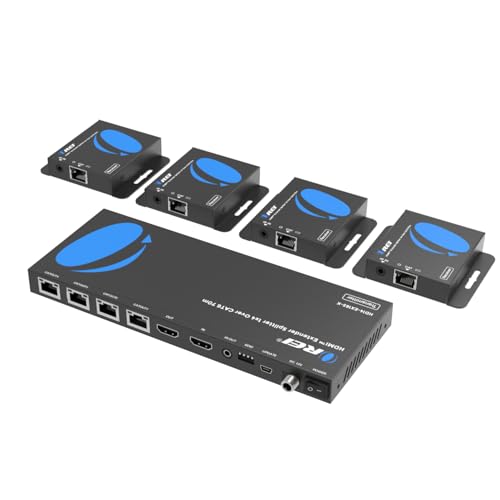
- Sends one source to four displays over Cat6
- Includes local HDMI loop output and IR passback
- Supports 4K@30Hz up to 165 feet
Best For: Commercial rooms and four-display installations
EDID-Managed 4K Distribution
Atlona Rondo 442 1x2 HDMI Distribution Amplifier

- Distributes one HDMI source to two displays
- Manages EDID communications
- Supports residential and commercial deployments
Best For: Two-display AV systems needing EDID management
Eight-Display CAT6 System

- Distributes one source to eight displays
- Supports 4K@30Hz up to 165 feet
- Includes eight receivers and power over LAN
Best For: Large venues and installations with eight displays
Compact Signal Booster
Kramer VM-2HXL 1:2 HDMI Distribution Amplifier

- One HDMI input with two outputs
- Reclocks and equalizes input signals
- Supports up to 2.25Gbps data transfer
Best For: Small two-display HDMI installations
4K60 Dual-Display Splitter
Alfatron ALF-SUK2 HDMI 2.0 Splitter
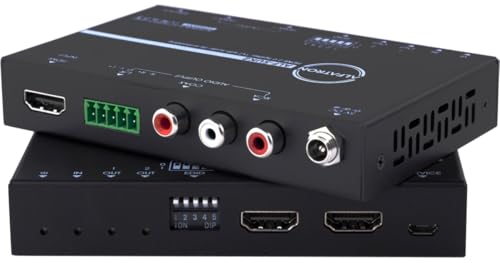
- Supports 4K60 with 4:4:4 chroma
- Handles HDR10 and HLG
- Includes HDCP 2.3 and smart EDID
Best For: Two-display 4K HDR mirroring
Eight-Display 4K Hub
KanexPro 1x8 HDMI Distribution Amplifier

- Feeds one source to up to eight displays
- Supports 4K UHD and 1080p at 60Hz
- Handles HDCP 2.2 and surround audio
Best For: Large multi-display HDMI installations
Best 8K Compact Splitter
1x2 HDMI 2.1b Distribution Amplifier
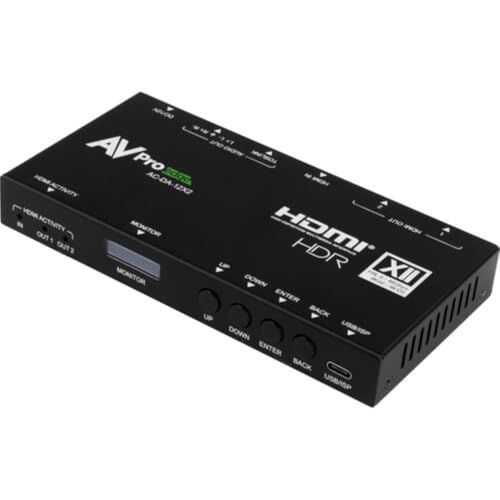
- Splits one HDMI source to two displays
- Supports up to 8K60 and 48 Gb/s
- Includes EDID management and digital audio support
Best For: Two-display 8K installations
Best Advanced Four-Output Model
AC-DA14-AUHD-GEN2 HDMI Distribution Amplifier

- Distributes one source to four displays
- Offers 48 Gbps bandwidth and HDMI 2.1b features
- Adds EDID blending and audio extraction
Best For: Demanding four-display installations
Best Compact Kramer Option
Kramer VM-2H2 HDMI Distribution Amplifier

- Compact 7.38-by-4.53-by-1-inch design
- Lightweight at 14.1 ounces
- Kramer-branded audio/video distribution unit
Best For: Compact HDMI installation planning
Compact 4K Splitter – Monoprice Blackbird 1×2 HDMI Amplifier
Monoprice Blackbird 4K 1x2 HDMI Amplifier Splitter - 48-bit Deep Color, 3D Video Support, Black
Check Price On AmazonFor buyers seeking video distribution amplifiers with HDMI for a simple two-display setup, the Monoprice Blackbird provides one HDMI input and two HDMI outputs. It supports 4K at 30Hz, 3D video, HDCP 1.4, and several multichannel audio formats.
Best For: Home entertainment systems that need to feed two HDMI displays from one source.
Pros:
- Splits one HDMI source to two displays.
- Supports 4K@30Hz, 1080p@120Hz, and 3D video.
- Handles 48-bit Deep Color and formats including Dolby TrueHD, DTS-HD, and 7.1-channel LPCM.
Cons:
- HDCP support is limited to version 1.4.
- 4K output is limited to 30Hz.
This is a straightforward choice when two outputs are sufficient and advanced 4K refresh rates are not required. Its broad audio and 3D support add flexibility for compatible home theater equipment.
Long-Range 4K Distribution – OREI 1×4 HDMI Extender
Among video distribution amplifiers with HDMI, the OREI 1×4 HDMI Extender is designed for larger spaces, sending one source to four displays over Cat6, Cat6a, or Cat7 cable. It also provides a local HDMI loop output, IR passback, and power over cable for the receivers.
Best For: Meeting rooms, bars, exhibitions, and video conference installations requiring four remote displays.
Pros:
- Distributes one HDMI source to four displays over network cable.
- Supports 4K@30Hz up to 165 feet and 1080p@60Hz.
- Includes IR remote control support, EDID, a local loop output, and receiver power over cable.
Cons:
- The listed highest resolution is 1920×1080@60Hz, despite 4K@30Hz support.
- Requires separate Cat6-family cables to connect the receivers.
With four receivers included and only one power adapter required, this kit is practical for distributed displays. Confirm the desired resolution and cable distance before installation, particularly for 4K deployments.
EDID-Managed 4K Distribution – Atlona Rondo 442 1×2 HDMI Distribution Amplifier
The Atlona Rondo 442 is a compact option for video distribution amplifiers with HDMI, delivering one HDMI source to two displays. Its EDID management helps coordinate supported audio formats and video resolutions in residential or commercial AV systems.
Best For: Installations using Blu-ray players, gaming consoles, computers, projectors, or televisions with two HDMI outputs.
Pros:
- Distributes an HDMI signal to two displays.
- Manages EDID communications for system compatibility.
- Designed for straightforward installation in commercial and residential applications.
Cons:
- The supplied notes do not specify maximum resolution or refresh rate.
- It provides only two HDMI outputs.
This model is a sensible fit when dependable HDMI distribution and EDID handling matter more than a large output count. Buyers needing specific 4K, HDR, or audio-format limits should verify the system specifications before purchase.
Eight-Display CAT6 System – OREI 4K 1×8 HDMI Extender
For high-output video distribution amplifiers with HDMI, the OREI 1×8 HDMI Extender sends one source to eight displays over Cat6, Cat6a, or Cat7 cable. It includes eight receivers, a local HDMI loop output, IR passback, and power over LAN.
Best For: Exhibitions, meeting rooms, bars, conferences, and other installations with up to eight remote displays.
Pros:
- Distributes one HDMI source to eight displays simultaneously.
- Supports 4K@30Hz up to 165 feet and 1080p@60Hz up to 230 feet.
- Includes eight receivers, IR accessories, EDID management, and receiver power over LAN.
Cons:
- The supplied notes list 1920×1080@60Hz and 2K@60Hz as supported resolutions, so 4K is limited to 30Hz.
- Requires Cat6-family cabling for the remote displays.
This kit is well suited to large, synchronized display layouts where eight endpoints justify a centralized transmitter. Its included receivers and plug-and-play design simplify deployment, while the loop output supports a nearby local screen.
Compact Signal Booster – Kramer VM-2HXL 1:2 HDMI Distribution Amplifier
The Kramer VM-2HXL is a practical choice among video distribution amplifiers with HDMI when you need to duplicate one HDMI source to two displays. It reclocks and equalizes incoming signals to help rebuild signal integrity, with a data transfer rate of up to 2.25Gbps.
Best For: Small installations needing one HDMI input distributed to two outputs.
Pros:
- Provides one HDMI input and two outputs.
- Reclocks and equalizes input signals.
- Rebuilds signal integrity for loss-less duplication.
- Compact 5 x 3 x 1-inch surface-mount design.
Cons:
- Limited to two output channels.
- Listed voltage is 5 volts, so installation should account for compatible power.
Choose the VM-2HXL if reliable two-display HDMI duplication and signal conditioning matter more than supporting a larger number of screens.
4K60 Dual-Display Splitter – Alfatron ALF-SUK2 HDMI 2.0 Splitter
The Alfatron ALF-SUK2 is one of the more capable video distribution amplifiers with HDMI for mirroring a source to two displays. Its HDMI 2.0 design supports UHD 4K60 with 4:4:4 chroma sampling, along with HDR10, HLG, and HDCP 2.3.
Best For: Dual-display setups that need 4K at 60Hz and HDR support.
Pros:
- Supports 4Kx2K at 60Hz with 4:4:4 chroma sampling.
- Handles 4K60 HDR10 and HLG.
- Supports HDCP 2.3 with backward compatibility.
- Includes smart EDID management.
Cons:
- Provides one input and two outputs, limiting expansion.
- Its listed connector type is HDMI, so it does not address non-HDMI source connections.
For a straightforward two-screen mirror, the ALF-SUK2 combines higher-bandwidth HDMI 2.0 support with the format compatibility needed for modern 4K HDR sources.
Eight-Display 4K Hub – KanexPro 1×8 HDMI Distribution Amplifier
The KanexPro HDSP184K is designed for larger installations that need to distribute one HDMI source to as many as eight displays. This video distribution amplifier with HDMI supports 4K UHD, Full HD 1080p, HDCP 2.2, and several lossless and surround-sound audio formats.
Best For: Commercial, classroom, or home installations feeding up to eight HDMI displays.
Pros:
- Distributes one HDMI source to up to eight displays.
- Supports 4K UHD and Full HD 1080p at 60Hz.
- HDCP 2.2 compliant.
- Supports Dolby Digital, DTS-HD, Dolby TrueHD, and HD lossless audio.
Cons:
- Larger and heavier than compact two-output splitters, at 2.4 pounds.
- Its eight-output capacity may be unnecessary for small setups.
- Includes a one-year warranty, which may be less coverage than some buyers prefer.
The HDSP184K is the strongest fit here when output count is the priority, offering broad 4K, HDCP, and audio-format support for multi-display distribution.
Best 8K Compact Splitter – 1×2 HDMI 2.1b Distribution Amplifier
If you need video distribution amplifiers with HDMI for a small setup, this 1×2 HDMI 2.1b model sends one HDMI source to two displays. It supports resolutions up to 8K60, 48 Gb/s video bandwidth, extended EDID management, and multichannel digital audio.
Best For: Home theaters, gaming setups, and compact installations needing two HDMI outputs with high-bandwidth support.
Pros:
- Supports resolutions up to 8K60.
- Provides 48 Gb/s video bandwidth.
- Includes extended EDID management and multichannel digital audio support.
- Includes a 12V power supply and mounting brackets.
Cons:
- Limited to two HDMI outputs.
- Requires a 12V DC power connection.
This is a focused option when two displays are enough and next-generation HDMI bandwidth matters. Its compact, surface-mount design and included mounting hardware also suit organized installations.
Best Advanced Four-Output Model – AC-DA14-AUHD-GEN2 HDMI Distribution Amplifier
Among video distribution amplifiers with HDMI, this 1×4 model is designed for installations that need one source routed to four displays. Its 48 Gbps bandwidth, custom EDID blending, extended four-block EDID support, and HDMI 2.1b gaming features make it suited to demanding display systems.
Best For: Multi-display home theaters, gaming-focused systems, and installations requiring flexible EDID handling.
Pros:
- Routes one HDMI input to four outputs.
- Provides 48 Gbps bandwidth with Fixed Rate Link 6.
- Supports custom EDID blending and extended four-block EDID.
- Extracts audio for up to 7.1 digital or two-channel analog output.
Cons:
- Requires a 12V DC power connection.
- Its advanced features may be unnecessary for simpler two-display setups.
This model stands out when a system needs four outputs and more sophisticated display compatibility management. Audio extraction adds flexibility for setups that separate display video from the audio system.
Best Compact Kramer Option – Kramer VM-2H2 HDMI Distribution Amplifier
For buyers comparing video distribution amplifiers with HDMI, the Kramer VM-2H2 is a compact audio/video distribution option with a 7.38-by-4.53-by-1-inch product footprint. The supplied information identifies it as a Kramer HDMI distribution amplifier and lists a package quantity of one.
Best For: Buyers seeking a compact Kramer-branded HDMI distribution amplifier for an audio/video installation.
Pros:
- Compact 7.38-by-4.53-by-1-inch product dimensions.
- Lightweight 14.1-ounce design.
- Comes as a single packaged unit.
Cons:
- The supplied specifications do not list supported resolutions or bandwidth.
- The supplied notes do not detail the number of HDMI inputs or outputs.
- Country of origin is listed as China.
The VM-2H2 may appeal to shoppers who prioritize a compact Kramer product, but its supplied specifications are less detailed than the newer models here. Verify the routing, resolution, and compatibility requirements before purchase.
How We Picked the Best Video Distribution Amplifiers with Hdmi
We compared these Video Distribution Amplifiers with Hdmi by looking at output count, supported HDMI bandwidth, maximum resolution and refresh rate, HDR and HDCP compatibility, EDID management, signal-extension options, and installation flexibility. We also considered whether each design suits a simple home setup, a conference room, classroom, retail display, or more demanding professional AV system.
Because distribution needs vary, the selection includes both straightforward splitters and models designed for longer runs or more advanced source-and-display combinations. Specifications such as 4K support can differ significantly: some units target 4K at 30Hz, while newer HDMI 2.0 and HDMI 2.1 models may support higher refresh rates and wider bandwidth.
Quick Comparison
For two nearby displays, a 1×2 amplifier is usually the simplest and most economical choice. A 1×4 or 1×8 model is better for classrooms, digital signage, and multi-screen entertainment systems. HDMI-over-CAT extenders are worth considering when ordinary HDMI cables cannot cover the required distance. Models with loop-through outputs can also make it easier to connect another display or downstream distribution device.
Check the individual specifications carefully before assuming that every output supports the same format. Resolution, refresh rate, HDR, audio format, and cable distance may change depending on the source, display, cable category, and whether all connected screens share compatible capabilities.
Key Buying Factors for Video Distribution Amplifiers with Hdmi
Resolution, Refresh Rate, and Bandwidth
Match the amplifier to your highest-priority source. 4K at 30Hz may be sufficient for presentations and many video applications, while gaming, sports, desktop use, and modern media devices often benefit from 4K at 60Hz or higher. HDMI 2.1-class equipment is more appropriate for 4K high-refresh or advanced console setups.
HDCP, HDR, and EDID Management
HDCP compatibility helps protected content pass correctly, while EDID management helps the source negotiate a usable format with multiple displays. This matters when displays have different resolutions or HDR capabilities. Look for selectable or automatic EDID modes if you are building a mixed-display system.
Output Count and Distance
Choose more outputs than you need if the system may expand, but avoid paying for unnecessary capacity. For short runs, standard HDMI is usually simpler. For longer distances, consider an extender that uses Cat 6 or Cat 7 cable, and verify its stated limits for both 4K and 1080p signals.
Installation and Control
Review power requirements, chassis size, mounting options, loop-out connections, IR support, and audio handling. A compact plug-and-play unit may be ideal for a home theater, whereas rack-friendly construction and reliable EDID controls are more valuable in commercial installations.
Who Should Buy Which Video Distribution Amplifiers with Hdmi?
Buy a basic 1×2 model for a source feeding two nearby TVs or projectors. Choose a 1×4 amplifier for meeting rooms, classrooms, or small commercial displays, and an 1×8 model when one source must serve many screens. Select an HDMI-over-CAT solution for long cable paths or centralized equipment racks. If you are purchasing for a gaming or high-refresh setup, prioritize HDMI 2.1 bandwidth; for business presentations, dependable switching, EDID behavior, and installation convenience may matter more than maximum specifications.