Choosing the right lighting controller can make a band’s live show easier to run, more consistent, and faster to set up. The best option depends on fixture count, programming needs, operator experience, and whether your setup is wired or wireless.
We’ve gathered 10 DMX controllers for bands spanning straightforward 192-channel boards, larger 384-channel consoles, wireless systems, app-based control, and compact dimming solutions.
Best 10 Dmx Controllers for Bands Picks for 2026
Best Proven Pick

- 384 DMX channels for detailed control
- Stores 240 scenes in 30 banks
- Six programmable chases with timing
Best For: Bands needing a rack-mountable console for programmed lighting
Best App-Based Option

- 256-channel tablet-based DMX control
- 15,000-plus fixture library
- 50 presets and 21 automatic effects
Best For: Bands wanting quick, tablet-based lighting control
Best High-Capacity Budget Pick

- 384 DMX channels for larger setups
- 30 banks with eight scenes each
- Includes handles and an LED gooseneck light
Best For: Bands needing extensive channels and programmable scene storage
Best Wireless Setup
JERRAY Wireless DMX Transmitter and Receivers

- Wireless 2.4G DMX512 connection
- Two receivers and seven group IDs
- Includes three power adapters
Best For: Bands needing quick, cable-free lighting connections
Best Full-Featured Console
CO-Z 192 DMX Stage Light Controller

- 192 channels for up to 12 fixtures
- Stores up to 240 scenes
- Voice control and dedicated faders
Best For: Bands running multiple intelligent lights and programmed scenes
Best Compact Controller

- Six sub-control faders plus master fader
- Compact aluminum travel-friendly design
- For fixtures using up to 12 channels
Best For: Small stages and bands needing simple manual control
Best All-Around Pick

- Controls up to 12 fixtures
- Sound-activated, auto, and manual modes
- Includes cable and 2-year warranty
Best For: Bands and mobile performers wanting simple, music-responsive lighting control
Best Flexible Setup
384-Channel Wireless DMX Controller

- 384 channels for up to 12 lights
- 2.4G wireless and wired DMX
- MIDI, sound, and scene controls
Best For: Bands needing wireless placement or MIDI-enabled lighting control
Best for Chase Programming
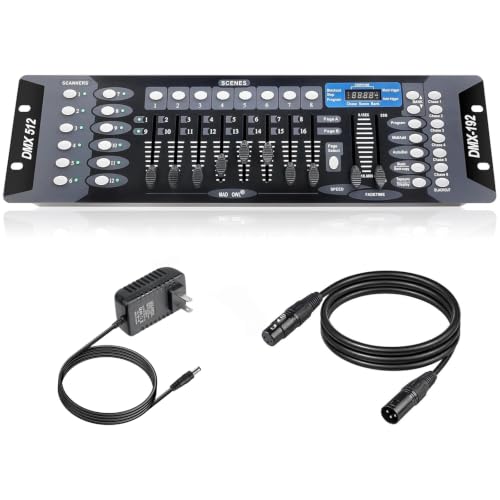
- Programs 240 steps across six chases
- 23 banks of eight scenes
- Includes a 6.6-foot DMX cable
Best For: Bands and venues creating custom wired lighting sequences
Best Proven Pick – CHAUVET DJ Obey 70
For bands seeking dependable dmx controllers for bands, the CHAUVET DJ Obey 70 offers substantial scene and chase capacity in a rack-mountable console. It controls up to 12 intelligent lights and provides 384 DMX channels for detailed stage setups.
Best For: Bands that want a proven, rack-mountable controller for programmed live-lighting scenes and chases.
Pros:
- Controls up to 12 intelligent lights with up to 32 channels each
- Stores up to 240 scenes across 30 banks
- Includes six programmable chases and per-step fade and speed timing
- Provides 384 DMX channels of control
Cons:
- Uses corded electric power and is specified for 230 volts
- At 6.9 pounds, it is less portable than compact interfaces
The Obey 70 is a strong choice when a band values hands-on programming capacity, physical controls, and rack installation over app-based operation.
Best Value Console – MINGJIE 192-Channel DMX Controller
The MINGJIE 192-channel console is a practical option among dmx controllers for bands, combining manual faders, programmed scenes, chases, and sound-activated operation. Its layout is divided into clearly labeled control sections for a more approachable workflow.
Best For: Bands, mobile DJs, and small event setups wanting flexible control with an included DMX cable.
Pros:
- Controls up to 192 DMX channels and 12 intelligent fixtures
- Stores 240 scenes in 30 banks and supports six chases
- Offers sound-activated and fully manual operation
- Includes a 4-foot 3-pin DMX cable and supports 100–240V input
Cons:
- Has fewer channels than 384-channel alternatives
- Its scene programming may be more involved than app-based control
With broad operating modes and a compact 3.09-pound alloy chassis, the MINGJIE provides a capable feature set for bands balancing control flexibility and portability.
Best App-Based Option – ADJ MyDMX Go
The ADJ MyDMX Go takes a different approach to dmx controllers for bands by using an iPad or Android tablet for wireless lighting control. Its fixture library, presets, and automatic effects can help bands create shows without programming every cue manually.
Best For: Bands that prefer tablet-based operation, quick setup, and automatic lighting effects.
Pros:
- Provides 256-channel DMX control through an iPad or Android tablet
- Offers a library of more than 15,000 fixtures
- Includes 50 user presets and 21 automatic effects
- Supports control over Wi-Fi and USB with a compact mounting design
Cons:
- Requires a compatible tablet for app-based operation
- Its plastic construction may feel less substantial than metal consoles
- Additional upgrades are available separately
MyDMX Go is especially appealing for bands that want fast visual control and minimal programming, provided a tablet-based workflow fits their live setup.
Best High-Capacity Budget Pick – DMX512 384CH DJ Controller
This 384-channel DMX512 console is designed for bands that need extensive fixture control and programmable scenes. It provides 30 banks of eight scenes, lightweight construction, side handles, and an LED gooseneck light for operation in stage environments.
Best For: Bands and live-show operators needing 384 channels and substantial scene programming capacity.
Pros:
- Provides 384 DMX channels for complex lighting setups
- Offers 30 banks with eight programmable scenes each
- Supports 110–240V AC input and uses DMX512 control
- Includes side handles and an LED gooseneck light
Cons:
- The supplied notes do not specify chase capacity or fixture-channel limits
- Its approximately 20.71-inch length may require dedicated transport space
This controller suits bands that prioritize channel capacity and scene storage. Its physical design also adds practical features for setup, transport, and low-light operation.
Best Wireless Setup – JERRAY Wireless DMX Transmitter and Receivers
For bands that need fast stage changes, this wireless DMX kit can reduce cable clutter between a lighting controller and compatible fixtures. It includes one transmitter, two receivers, power adapters, seven group IDs, and a stated range of up to 1,000 feet, making it a flexible option among dmx controllers for bands.
Best For: Bands, mobile performers, and event setups that prioritize wireless connections and quick installation.
Pros:
- Wireless 2.4G DMX512 transmission helps eliminate long XLR runs.
- Two receivers allow separate lighting fixtures or rigs to be connected.
- Seven independent group IDs and frequency hopping support multi-rig use.
- Power adapters are included for all three units.
Cons:
- It is not battery-powered and requires power adapters during operation.
- This is a wireless transmitter-and-receiver set rather than a standalone lighting console.
This kit is a strong fit when your band already has a DMX controller and wants a cleaner wireless link to its lights. Confirm that your fixtures and controller use compatible DMX connections before choosing it.
Best Full-Featured Console – CO-Z 192 DMX Stage Light Controller
The CO-Z 192 DMX controller is designed for bands running multiple intelligent fixtures and more involved scene changes. Its 192-channel layout can control up to 12 lights with up to 16 channels each, while supporting up to 240 scenes for programmed show control.
Best For: Bands and DJs managing several intelligent lights, programmed scenes, and varied stage effects.
Pros:
- Controls up to 12 intelligent lights with up to 16 channels per fixture.
- Supports up to 240 scenes for more complex performances.
- Dedicated controls include fixture selection, channel selection, speed, timing, and functions.
- Voice control is available for switching among lighting scenes.
Cons:
- The larger console may be more than needed for a small, simple lighting rig.
- It uses corded electric power, so it is not intended as a battery-powered controller.
Choose this model if your band wants hands-on access to numerous fixtures and preplanned scenes from one console. Its 19.1-inch width and 3.9-pound weight are worth considering when planning transport and booth space.
Best Compact Controller – MAD OWL 12-Channel DMX Dimmer
The MAD OWL 12-channel controller keeps lighting control simple for smaller stages and travel setups. Its six sub-control faders, one master fader, black-out function, and standard three-pin DMX output make it a practical entry-level choice among dmx controllers for bands.
Best For: Small bands and performers using DMX fixtures with no more than 12 channels.
Pros:
- Compact aluminum design is easy to transport and install.
- Six sub-control faders and a master fader provide direct manual control.
- Standard three-pin XLR DMX output supports straightforward connections.
- One-key black-out function is useful for quick stage changes.
Cons:
- It cannot control stage lighting equipment requiring more than 12 channels.
- It is a basic manual controller without the larger scene capacity of advanced consoles.
This is a sensible choice when portability and uncomplicated fader control matter more than extensive programming. Check each fixture’s channel requirements before buying, since the 12-channel limit is its key restriction.
Best All-Around Pick – 192-Channel DMX Controller
For bands seeking practical dmx controllers for bands, this 192-channel console offers straightforward control for up to 12 fixtures with 16 channels each. Its sound-activated mode can sync lighting to music when no dedicated lighting operator is available.
Best For: Bands, mobile DJs, churches, and small venues that want hands-on control plus automatic music syncing.
Pros:
- Controls up to 12 fixtures and stores up to 240 programmable scenes.
- Includes sound-activated, automatic, and manual scene modes.
- Organized controls, precision sliders, DMX cable, and power cord are included.
- Backed by a 2-year manufacturer warranty and lifetime technical support.
Cons:
- Uses a wired 3-pin XLR connection rather than wireless DMX.
- Its 192-channel capacity may be limiting for larger, more complex rigs.
This is a well-rounded option for performers who want accessible programming, music-responsive operation, and enough capacity for a typical band lighting setup.
Best Flexible Setup – 384-Channel Wireless DMX Controller
This 384-channel model stands out among dmx controllers for bands by combining wired 3-pin XLR operation with 2.4G wireless transmission. It also adds MIDI control, sound activation, and programmable scene storage for more adaptable live-show layouts.
Best For: Bands and stage operators who need wireless fixture placement, expanded channel capacity, or MIDI integration.
Pros:
- Provides 384 DMX channels for up to 12 intelligent lights.
- Supports both 2.4G wireless and traditional wired control.
- Offers sound-activated, auto, manual, and MIDI control functions.
- Stores 240 preset static scenes across 30 banks and includes one-key blackout.
Cons:
- Its broader feature set may require more setup than a basic controller.
- The supplied details do not specify included wireless receiver accessories.
Choose this console when flexibility matters most. Wireless and MIDI support can simplify evolving band setups, while the larger channel count leaves more room for detailed fixture programming.
Best for Chase Programming – 192-Channel DMX Board
For bands building repeatable lighting sequences, this 192-channel DMX board provides programmable banks, scenes, and chases in a rack-mountable metal housing. It supports up to 12 fixtures with 16 channels or fewer and includes a 6.6-foot DMX cable.
Best For: Performance venues and bands that prioritize custom chase effects and reliable wired connections.
Pros:
- Controls up to 12 lighting fixtures with 192 total channels.
- Offers 23 banks of eight programmable scenes.
- Supports 240-step scenes across six programmable chases.
- Includes a 2-meter/6.6-foot DMX cable and hands-on fader controls.
Cons:
- Does not list sound-activated or wireless operation in the supplied details.
- Provides less channel capacity than the 384-channel option.
This is a focused choice for users who prefer to preprogram lighting chases and make real-time adjustments from a physical board rather than rely on wireless or automated features.
How We Picked These Dmx Controllers for Bands
We compared these controllers by channel capacity, fixture and scene support, programming workflow, connectivity, portability, and suitability for live performance. We also considered how practical each unit is for rehearsals, small venues, club dates, and more complex touring rigs.
Specifications and terminology can vary between manufacturers, especially for low-cost DMX equipment. Before buying, confirm the exact channel layout, connector type, wireless compatibility, and included accessories for your fixtures.
Quick Comparison
- Simple manual control: 192-channel consoles are often the most approachable choice for basic PAR, wash, and static color setups.
- More programming capacity: 384-channel controllers provide additional room for fixtures, banks, scenes, and more involved shows.
- App-based operation: A tablet or phone-based system can reduce hardware bulk, but it depends on device compatibility and a reliable wireless network.
- Wireless DMX: Wireless transmitters and receivers can reduce cable runs, although they require careful attention to range, interference, and power.
- Small-stage dimming: Compact dimmer controllers make sense when the rig uses a limited number of conventional dimmable fixtures.
Key Buying Factors for Dmx Controllers for Bands
Channel and Fixture Capacity
Count the DMX channels your current fixtures use, then leave room for expansion. A controller that barely covers today’s rig may become limiting when you add moving heads, strobes, or additional LED fixtures.
Programming and Live Operation
Look for the controls your operator can use confidently during a song: faders, scene buttons, banks, chase controls, blackout, and speed adjustments. More features are not helpful if they slow down real-time changes.
Wired Versus Wireless Control
Wired DMX remains a dependable default for many bands. Wireless systems are useful when cable runs are difficult or stage layouts change frequently, but keep a wired backup plan for important performances.
Portability and Setup
Check the controller’s size, power requirements, connector layout, and included cables. A compact board may be preferable for a self-managed band, while a larger console can be worthwhile when a lighting operator travels with the production.
Fixture Compatibility
Confirm that your lights accept standard DMX512 and determine whether they need 3-pin or 5-pin connections, special addressing, or manufacturer-specific profiles. The controller and fixtures must share a workable channel map.
Who Should Buy Which Dmx Controllers for Bands?
Small bands and beginners should generally start with a straightforward 192-channel console that offers direct controls and simple scene programming. Expanding bands may benefit from a 384-channel model if they use multiple fixture types or want more programmed looks.
Mobile performers and DJs should consider wireless or app-based control when minimizing cable runs is a priority. Bands using compact, conventional lighting rigs may prefer a dedicated dimming controller. For frequent touring, prioritize rugged construction, familiar controls, reliable signal distribution, and easy backup procedures over maximum feature count.