The right DMX controller can turn a collection of lights into a coordinated show, but the best choice depends on your fixtures, programming needs, and venue.
We compare 10 DMX controllers ranging from straightforward 192-channel consoles to app-based, wireless, MIDI-enabled, and standalone systems for DJs, bands, clubs, and event production.
Best 10 Dmx Controllers Picks for 2026
Best Traditional DMX Board
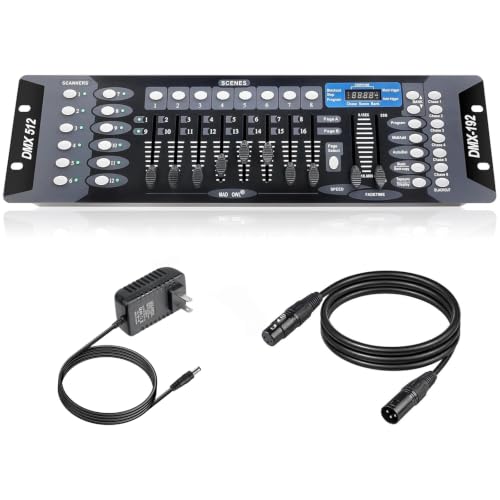
- Controls 12 fixtures with up to 16 channels each
- 23 banks and six programmable chases
- Includes a 6.6-foot DMX cable
Best For: Hands-on stage and DJ lighting control
Best App-Based Option
ADJ MyDMX Go Wireless Controller

- 256-channel tablet-based DMX control
- 15,000-plus fixture library
- 50 presets and 21 automatic effects
Best For: Quick, low-programming DJ and event setups
Best for Scene Programming

- 384 channels for intelligent lighting control
- Stores up to 240 scenes in 30 banks
- Six programmable chases with timing control
Best For: Detailed live-show scene and chase programming
Best for DJ Integration

- Two DMX universes with thru option
- Direct Engine DJ compatibility
- Tactile controls for live lighting effects
Best For: DJ performances using SoundSwitch and Engine DJ
Best Budget Pick
CO-Z 192-Channel DMX Controller

- Controls up to 12 intelligent lights
- Stores up to 240 scenes
- Includes voice control and three-pin support
Best For: Amateur users and small event lighting setups
Best Standalone System

- Standalone DMX lighting controller
- 37 backlit buttons and four encoders
- Supports up to four universes
Best For: Portable DJ and performance lighting rigs
Best High-Capacity Console
Rockville ROCKFORCE 384 DMX Controller

- Controls up to 24 intelligent lights
- 384 channels with scenes and chases
- Adds MIDI and music-triggered modes
Best For: Clubs, DJs, and larger stage lighting systems
Best for Creative Stage Programming

- 384 channels for detailed lighting control
- 30 banks of eight programmable scenes
- Compact design with LED gooseneck light
Best For: Clubs, bars, DJs, and live-stage programming
Best Wireless Flexibility
384-Channel Wireless DMX Controller

- 2.4G wireless and 3-pin wired modes
- Sound, MIDI, automatic, and manual control
- 30 banks and 240 programmable scenes
Best For: Weddings, bars, discos, and indoor stages
Best for Beginners

- Controls up to 12 fixtures and 192 channels
- 23 scene banks plus six programmable chases
- Beginner-friendly layout with manual sliders
Best For: Small gatherings and entry-level stage lighting
Best Traditional DMX Board – 192-Channel DMX Controller
This 192-channel DMX controller is a practical choice for users who want hands-on control of stage or DJ lighting. Its faders and buttons support real-time adjustments, while programmable banks and chases provide room to build repeatable light shows.
Best For: Stages, clubs, and performance venues using up to 12 compatible lighting fixtures.
Pros:
- Controls up to 12 fixtures with 16 channels or fewer.
- Offers 23 banks of eight programmable scenes.
- Stores 240-step scenes across six programmable chases.
- Includes a 6.6-foot DMX cable.
Cons:
- Its 192-channel layout is less suitable for fixtures requiring more extensive channel control.
- Uses a traditional hardware interface rather than app-based control.
Choose this model if you prefer dedicated faders and physical buttons for programming and live adjustments. Its rack-mount design and metal construction also suit permanent or semi-permanent installations.
Best App-Based Option – ADJ MyDMX Go Wireless Controller
The ADJ MyDMX Go takes a more streamlined approach to DMX controllers by using an iPad or Android tablet for operation. Its fixture library, automatic effects, and preset-driven workflow can help users create lighting displays without traditional programming.
Best For: DJs and event users who want app-based control with minimal programming.
Pros:
- Provides 256-channel control through an iPad or Android tablet.
- Works with a library of more than 15,000 fixtures.
- Includes 50 user presets and 21 automatic effects.
- Supports two lighting universes through 3-pin XLR and USB connections.
Cons:
- Requires a compatible tablet for app operation.
- Advanced upgrades are available separately.
This is a strong fit for users who prioritize quick setup and wireless operation over detailed manual programming. The included O-Clamp brackets also make it easier to mount the compact interface to truss.
Best for Scene Programming – Chauvet DJ Obey 70
The Chauvet DJ Obey 70 is a conventional DMX controller built for programming and recalling detailed lighting scenes. It combines 384 channels of control with dedicated banks, chases, and programmable fade and speed times.
Best For: Installations and live shows that need extensive scene and chase storage for multiple intelligent lights.
Pros:
- Controls up to 12 intelligent lights with up to 32 channels each.
- Provides 30 banks of eight scenes, or up to 240 scenes.
- Includes six chases containing up to 240 scenes.
- Allows fade and speed times to be programmed into each step.
Cons:
- Its 6.9-pound chassis is heavier than the compact app-based option in this roundup.
- Uses a dedicated hardware control surface rather than tablet control.
For users who want structured programming capacity, the Obey 70 offers a substantial scene-and-chase workflow. It is especially appropriate when fixtures use up to 32 channels and repeatable timing is important.
Best for DJ Integration – SoundSwitch Control One
The SoundSwitch Control One is designed for hands-on control alongside SoundSwitch software and compatible DJ hardware. Its tactile controls, dual DMX universes, and Engine DJ integration make it a specialized choice for synchronized music-and-light performance.
Best For: DJs and performers who want tactile, software-linked control over programmed or live lighting effects.
Pros:
- Provides one-to-one control for SoundSwitch software.
- Supports two DMX universes with input, output, and thru options.
- Works directly with compatible Denon DJ and Numark Engine DJ devices without a computer.
- Offers touch-strip, encoder, and RGB performance-pad control.
Cons:
- Some expanded compatibility modes require SoundSwitch software and a laptop.
- Its feature set is more specialized than that of a basic standalone DMX board.
This controller is best considered when lighting is part of a DJ performance workflow rather than a separate stage-control task. It supports live audio BPM detection and on-the-fly adjustment of color, brightness, strobe, moving heads, gobos, and other effects.
Best Budget Pick – CO-Z 192-Channel DMX Controller
The CO-Z 192 DMX controller is a practical starting point for DJs, small venues, and event setups that need straightforward control over multiple fixtures. Its 192 channels support up to 12 intelligent lights with as many as 16 channels each, while voice control and clearly divided operating sections help simplify show programming.
Best For: Amateur users, DJs, weddings, churches, family events, and small lighting rigs.
Pros:
- Controls up to 12 fixtures and stores up to 240 scenes.
- Supports compatible three-pin fixtures, including fog machines, strobes, pars, and beam lights.
- Organized controls include scene selection, channel sticks, display, speed/time controls, and function buttons.
- Upgraded buttons and precision control sticks are designed for reliable operation.
Cons:
- Its 192-channel capacity is lower than larger 384-channel controllers.
- The plastic construction may be less substantial than a metal-bodied console.
- Voice control and fixture compatibility depend on the connected setup.
This is a sensible choice among entry-level DMX controllers when you want useful scene capacity and accessible controls without moving to a larger, more advanced console.
Best Standalone System – American DJ WMX1 MK2 Wolfmix
The American DJ WMX1 MK2 is a compact standalone DMX lighting controller for users who want hands-on control without relying on a computer. It features 37 backlit silicone buttons, four rotary encoders, and four output sockets, making it suited to portable setups that need a dedicated control surface.
Best For: DJs, performers, and portable lighting setups that favor standalone operation and tactile controls.
Pros:
- Standalone design keeps operation centered on the controller itself.
- 37 backlit silicone buttons are useful in dim performance environments.
- Four rotary encoders provide additional hands-on adjustment.
- Supports up to four universes and includes four output sockets.
Cons:
- The supplied notes do not specify scene storage or fixture-channel capacity.
- Its feature set may require more familiarity than a basic controller.
- USB connectivity is listed, but the supplied details do not explain its specific functions.
Choose the WMX1 MK2 if portability, backlit controls, and multi-universe capability matter more to you than a traditional bank-and-slider console layout.
Best High-Capacity Console – Rockville ROCKFORCE 384 DMX Controller
The Rockville ROCKFORCE 384 is one of the more capable DMX controllers in this group, offering 384 channels for up to 24 intelligent lights with 16 channels each. It combines programmable scenes and chases with MIDI, music-triggered operation, manual override, and power-failure memory for more involved DJ, club, and stage shows.
Best For: DJs, clubs, and stage users managing larger fixture counts and programmable lighting sequences.
Pros:
- Controls up to 24 fixtures with 16 channels each.
- Stores 30 banks of eight scenes and six programmable chases, totaling up to 240 scenes.
- Built-in microphone enables music-triggered lighting modes, while MIDI adds external control options.
- Metal housing, LED display, gooseneck lamp, reversible channels, and power-failure memory support practical operation.
Cons:
- At 5.3 pounds, it is heavier than the compact American DJ controller.
- The larger control capacity may be more than small or occasional setups need.
- The supplied notes specify three-pin XLR connectivity, so fixture compatibility should be checked before purchase.
For users who need more channels, scene banks, and chase programming, the ROCKFORCE 384 offers a feature-rich traditional console design with useful automation and MIDI-oriented control.
Best for Creative Stage Programming – 384-Channel DMX Controller
This 384-channel DMX controller is built for lighting setups that need extensive scene programming. It provides 30 banks of eight programmable scenes, supports up to 24 fixtures, and includes an LED gooseneck light for easier operation during shows.
Best For: DJs, clubs, bars, and live-stage operators who want detailed wired DMX scene control.
Pros:
- 384 channels support detailed lighting adjustments.
- 30 banks with eight programmable scenes each provide substantial show-storage capacity.
- Compact, lightweight design includes side handles and an LED gooseneck light.
- Supports DMX512 control for coordinated stage lighting.
Cons:
- The notes do not indicate wireless operation, MIDI control, or sound activation.
- The control layout may be more than casual users need for small setups.
Choose this model if your priority is programming flexibility and a large channel count. Its scene-bank structure makes it a practical option for repeatable club or live-show lighting cues.
Best Wireless Flexibility – 384-Channel Wireless DMX Controller
This 384-channel DMX controller stands out among DMX controllers with its dual wired and 2.4G wireless modes. It also adds sound activation, MIDI control, and programmable scene storage, giving DJs and event operators several ways to manage indoor stage lighting.
Best For: Weddings, bars, discos, live houses, and indoor stages that benefit from wireless or wired control.
Pros:
- Supports both 2.4G wireless transmission and 3-pin XLR wired connections.
- Provides 384 channels and supports up to 12 intelligent lights.
- Includes sound-activated, automatic, manual, and MIDI control functions.
- Stores 30 banks and 240 preset static scenes with editing functions.
Cons:
- The controller requires a 9V battery according to the supplied details.
- Its feature set may take time for beginners to learn fully.
This is the most flexible choice of the three for changing venue layouts. Wireless operation can simplify installations, while wired DMX remains available when a conventional connection is preferred.
Best for Beginners – 192-Channel DMX Controller
This 192-channel DMX controller offers a straightforward entry point for users learning stage-light programming. It controls up to 12 fixtures with 16 channels each, provides 23 banks of eight programmable scenes, and includes six programmable chases with up to 240 scenes.
Best For: Beginners and small gatherings that need practical control for compatible 3-pin stage lighting equipment.
Pros:
- Simple layout includes fixture selection, scene controls, channel sliders, and an LED display.
- Controls up to 12 devices with 192 total channels.
- Offers programmable scenes, chases, automatic mode, and manual slider control.
- Includes a 3-pin cable for connecting compatible stage equipment.
Cons:
- Its 192-channel capacity is lower than the two 384-channel alternatives.
- The notes specify corded power and do not mention wireless operation.
- The supplied warranty information is inconsistent, listing both 360-day repair coverage and a 90-day manufacturer warranty.
For smaller lighting rigs and first-time users, this controller keeps the core programming functions accessible without the higher channel count of larger consoles. Confirm the warranty terms and fixture compatibility before purchase.
How We Picked the Best Dmx Controllers
We focused on the features that most affect real-world lighting control: channel capacity, fixture support, programming workflow, connectivity, portability, and ease of use. The lineup includes compact controllers for simple LED setups, traditional consoles for scene-based programming, and advanced systems for live performance or permanent installations.
We also considered whether each controller supports useful extras such as MIDI, sound activation, wireless DMX, app control, fixture presets, standalone operation, and multiple banks or scenes. Compatibility remains essential, so buyers should confirm that a controller’s DMX output, channel count, and fixture profiles match their lights.
Quick Comparison
- Best for simple setups: 192-channel controllers offer an affordable way to manage basic fixtures and preset scenes.
- Best for more fixtures: 384-channel models provide additional programming space for larger rigs.
- Best for app-based control: Wireless and tablet-focused systems can simplify setup and live adjustments.
- Best for live performers: Performance-oriented controllers prioritize hands-on control, fast cues, and reliable triggering.
- Best for advanced standalone use: Dedicated systems can automate complex shows without requiring a computer.
Key Buying Factors for Dmx Controllers
Channel and Fixture Capacity
Check both the controller’s total DMX channels and the number of fixtures it can address. A 192-channel unit may be sufficient for a few pars, moving lights, or effect fixtures, while larger productions may benefit from 384 channels or more.
Programming and Operation
Consider how you prefer to work. Physical faders suit manual adjustments and traditional scene programming, while software and app-based controllers may offer fixture libraries, visual editing, and easier updates. Make sure the interface is practical in a dark booth or during a live show.
Connectivity and Compatibility
Verify whether the controller uses standard 5-pin or 3-pin DMX connections, and check whether cables or adapters are included. Wireless DMX can reduce cable runs, but wired connections are often preferable where maximum stability matters. MIDI, USB, audio, and networking features can also influence compatibility with your existing setup.
Portability and Reliability
Mobile DJs should prioritize compact construction, straightforward setup, and secure controls. Installed or touring systems may justify a larger console if it provides stronger programming capability and better access to scenes and cues.
Who Should Buy Which Dmx Controllers?
Choose a 192-channel console if you need dependable control for a small party, home rig, or basic DJ lighting system. Move to a 384-channel model when you use more fixtures or want additional programming headroom.
App-based and wireless controllers suit users who value flexible placement and quick adjustments from a tablet or phone. Live performers and DJs who need immediate hands-on access should look for dedicated faders, playback controls, sound activation, or MIDI integration. For complex shows, recurring venues, or computer-free operation, a standalone controller with fixture management and advanced scene programming is usually the better long-term investment.