Choosing the right DI box can make a live setup quieter, cleaner, and easier to manage. For performers, engineers, and venue teams, the best models solve grounding issues, balance unbalanced signals, and keep instruments sounding consistent on stage.
This roundup focuses on practical DI boxes for live performance, with options for passive, active, stereo, and multi-channel use so you can match the box to your instrument, mixer, and power setup.
Best 10 Di Boxes for Live Performance Picks for 2026
Passive Stage Workhorse
Radial Pro DI Passive Direct Box

- Passive mono DI with custom transformer
- Rugged stainless steel I-beam build
- Made for guitars, bass, keyboards, and drums
Best For: Reliable single-channel stage instrument use
Stereo Playback DI
On-Stage DB2050 Active Stereo Multi-Media DI Box

- Stereo inputs: 1/4", 3.5 mm, and RCA
- Phantom powered, no batteries or adapters
- Has pad and ground lift switches
Best For: Stereo keyboards, PC audio, and playback rigs
Budget Noise Fix
Pyle Premium Direct Injection Audio Box

- Passive DI with impedance transformer
- Input attenuator for level control
- Helps cancel buzz and hum
Best For: Budget setups needing cleaner balanced output
Stereo Stage Control
Mackie MDB-2P Passive Stereo DI Box

- Dual 1/4-inch inputs for stereo rigs
- Passive design needs no power
- 15 dB pads and ground lift reduce noise
Best For: Stereo keyboards, DJs, and backing-track setups
Pro-Grade Active DI Pick
Radial Pro48 Compact Direct Box
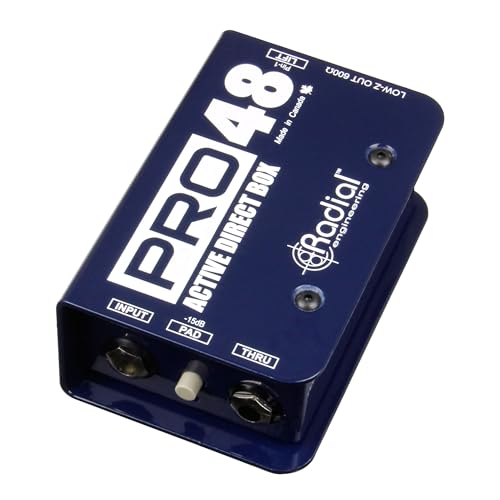
- Phantom-powered active DI for live stages
- -15 dB pad for passive guitars and basses
- Compact steel enclosure with balanced mono output
Best For: Bassists and guitarists needing a compact active DI with pad control
Flexible Phantom-or-Battery Choice
Klark Teknik DI 10A Active DI Box

- MIDAS transformer for high signal integrity
- Runs on phantom power or internal battery
- Automatic switchover if phantom fails
Best For: General live and multimedia use with backup power flexibility
Reliable Passive Stage DI
Livewire SPDI Passive Direct Box

- Passive DI that ignores phantom power
- Attenuation pad for input flexibility
- Lift and GND modes for grounding control
Best For: Simple live routing with passive instruments and ground control
Dual-Channel Active Utility
ART DualXDirect Dual Professional Active Direct Box

- Dual active channels for stereo or two-source use
- Phantom power or 9V battery operation
- Pad, low-pass filter, and phase controls
Best For: live performers needing a flexible dual-channel active DI
USB Monitoring DI
Radial USB-Pro 2-Channel Active Instrument Direct Box

- Stereo USB laptop DI with 24-bit/96k conversion
- Built-in headphone amp for monitoring
- Balanced lo-Z outputs for PA and mixer use
Best For: laptop performers and hybrid live rigs
Triple-Power Stereo Stage DI
Bolanle J22 Direct Active Stereo DI Box

- 48V phantom, 9V battery, or 5V USB power
- Dual-channel stereo with balanced XLR outputs
- Ground lift and polarity reversal for noise control
Best For: keyboard and synth players needing flexible power on stage
Passive Stage Workhorse – Radial Pro DI Passive Direct Box
If you want a dependable DI boxes for live performance option for stage instruments, the Radial Pro DI is built around a passive mono design with a custom transformer and rugged I-beam construction. It is a straightforward choice for feeding acoustic guitars, bass, keyboards, drum machines, and pro snake systems into a mixer or console.
Best For: Guitarists, bass players, keyboard rigs, and other live sources that need a tough passive DI.
Pros:
- Passive mono direct box with a custom transformer
- Rugged stainless steel I-beam construction for live use
- Works with acoustic guitars, bass, keyboards, drum machines, and snake systems
- XLR connectivity for balanced output to consoles
Cons:
- Mono only, so it is not built for stereo rigs
- No wireless or powered features
- Focused on instrument and live performance routing rather than multimedia inputs
For players who value simplicity and durability, this DI keeps the signal path basic and stage-ready. It is best suited to standard instrument sources that need reliable balancing without extra controls.
Stereo Playback DI – On-Stage DB2050 Active Stereo Multi-Media DI Box
The On-Stage DB2050 is a practical DI boxes for live performance pick when you need to connect stereo or multimedia sources directly to a mixer. With stereo 1/4″, 3.5 mm, and RCA inputs, plus isolated stereo XLR outs, it is aimed at cleanly routing playback and keyboard signals without extra batteries or adapters.
Best For: Stereo keyboards, PC audio, and multimedia playback rigs that need simple phantom-powered DI routing.
Pros:
- Stereo 1/4″, 3.5 mm, and RCA inputs for flexible source connection
- Isolated stereo XLR outs for cleaner mixer feeds
- Phantom powered, so no batteries or adapters are needed
- Includes a 15 dB pad switch and ground lift switch
Cons:
- Designed around stereo and multimedia use, not a simple mono instrument box
- Uses phantom power, so it depends on compatible gear
- Bulkier than basic passive direct boxes
This model makes sense when your live setup includes playback devices or stereo sources and you want a straightforward wired interface. The onboard pad and ground lift add useful control for real-world stage connections.
Budget Noise Fix – Pyle Premium Direct Injection Audio Box
The Pyle Premium Direct Injection Audio Box is a budget-friendly DI boxes for live performance option for turning unbalanced instrument and line signals into balanced XLR feeds. Its passive design, input attenuator, and hum-canceling focus make it useful for guitars, bass, keyboards, submixers, effects processors, and even consumer stereo sources.
Best For: Players and small setups that need a simple passive DI with buzz and hum reduction.
Pros:
- Passive DI unit with impedance transformer design
- Input attenuator helps manage source level
- Buzz and hum cancellation for cleaner live sound
- Works with guitars, bass, keyboards, processors, and some stereo sources
Cons:
- Basic passive feature set with no advanced controls
- Smaller, utilitarian design focused on function over extras
- Not specifically built for stereo stage rigs
This is a sensible pick if you need a straightforward direct box to tame noise and connect common unbalanced sources. It fits well in simple live and recording setups where reliability matters more than extra features.
Stereo Stage Control – Mackie MDB-2P Passive Stereo DI Box
The Mackie MDB-2P is a stereo passive DI boxes for live performance solution built for keyboards, DJ controllers, and backing-track rigs. Its dual 1/4-inch high-impedance inputs, 15 dB pads, and ground lift make it a practical choice when you need to keep hum and hot signals under control before they hit the mixer.
Best For: Stereo keyboards, DJ setups, and backing-track rigs that need a no-power DI with noise control.
Pros:
- Dual 1/4-inch high-impedance inputs for stereo sources
- Passive design requires no power
- 15 dB pads help handle hot signals without distortion
- Ground lift helps stop ground-loop buzz
Cons:
- Passive stereo design is specialized for dual-channel sources
- No mention of extra input formats beyond 1/4-inch stereo use
- Best suited to rigs that already have line-level stereo outputs
For stereo stage setups, this box keeps things simple while addressing common noise issues. The roadworthy steel case and no-power operation make it a solid fit for repeat live use.
Pro-Grade Active DI Pick – Radial Pro48 Compact Direct Box
If you need one of the more reliable di boxes for live performance, the Radial Pro48 is built around a high-resolution active circuit with phantom power support. It’s aimed at passive guitars and basses, and the -15 dB pad gives you useful headroom when stage levels get hot.
Best For: Bassists and guitarists who want a compact active DI box with phantom-powered operation and a pad for hotter instruments.
Pros:
- Phantom-powered active design simplifies live use.
- -15 dB pad helps with passive guitars and basses.
- Compact steel enclosure should suit stage rigs.
- Balanced mono output for direct console connection.
Cons:
- Battery-powered spec may not be as convenient as purely phantom-only setups.
- Single-unit format is best for one source at a time.
Overall, the Pro48 is a straightforward stage DI for players who value a clean active signal path and a simple, compact box. It’s especially practical when you want dependable direct-out performance for bass or guitar without extra complexity.
Flexible Phantom-or-Battery Choice – Klark Teknik DI 10A Active DI Box
For musicians shopping di boxes for live performance, the Klark Teknik DI 10A focuses on flexibility and signal integrity. It uses a custom-built MIDAS transformer, offers high headroom for cleaner sound, and can run from +48 V phantom power or an internal battery with automatic switchover if phantom fails.
Best For: General-purpose live and multimedia setups that need a compact active DI with transformer-based signal quality and backup power options.
Pros:
- Custom-built MIDAS transformer for strong signal integrity.
- High-headroom design supports cleaner live audio.
- Works from phantom power or internal battery.
- Automatic battery switchover adds live-reliability.
Cons:
- Battery is not included.
- More general-purpose than instrument-specific.
This is a practical pick if you want a live DI that can adapt to different rig conditions without much fuss. The transformer and power-fallback design make it especially appealing when stage reliability matters.
Reliable Passive Stage DI – Livewire SPDI Passive Direct Box
If your live setup needs a passive option, the Livewire SPDI is a practical direct box for stage input sources with high impedance. It includes attenuation for more input flexibility, ignores +48V phantom power at the XLR output, and adds lift/GND switching for basic grounding control.
Best For: Players and stage techs who want a passive DI box with attenuation and ground-lift control for simple live routing.
Pros:
- Passive design ignores +48V phantom power at the output.
- Attenuation pad increases input flexibility.
- Lift and GND modes help manage grounding.
- High-impedance 1/4″ input suits instrument sources.
Cons:
- Passive design does not offer active gain features.
- Bulkier than the most compact stage DIs.
The SPDI makes sense when you want a straightforward passive direct box that can handle common stage tasks without requiring power. Its attenuation and ground options give it enough control to fit many live performance setups.
Dual-Channel Active Utility – ART DualXDirect Dual Professional Active Direct Box
If you need one of the more flexible di boxes for live performance, the ART DualXDirect gives you two active channels, phantom or battery power, and switchable pad/filter/phase controls. It’s a practical choice when you want clean, balanced signal conversion for keyboards, stereo sources, or multiple instruments on the same rig.
Best For: Players and engineers who want a compact dual-channel active DI with flexible power and control options.
Pros:
- Fully active design with phantom voltage or 9V battery power
- Dual-channel operation for stereo or two-source setups
- Switchable attenuation, low-pass filter, and phase invert
- Converts high-impedance inputs to balanced 600 ohm outputs
Cons:
- Requires phantom power or a battery to operate
- No USB or headphone monitoring features
Overall, this is a straightforward live-sound workhorse with useful onboard controls for taming stage issues. It fits well when you want a neutral, road-ready DI box that can handle a variety of performance setups.
USB Monitoring DI – Radial USB-Pro 2-Channel Active Instrument Direct Box
Among di boxes for live performance, the Radial USB-Pro stands out because it combines a stereo USB laptop DI box with balanced outputs, 24-bit/96k conversion, and a built-in headphone amp. It’s aimed at performers who need to bring a computer into a live rig while still feeding a PA or mixer cleanly.
Best For: Laptop-based performers and hybrid live setups that need USB input, monitoring, and balanced output in one box.
Pros:
- Stereo USB laptop DI box with 24-bit/96k converters
- Built-in headphone amp for local monitoring
- Two-channel design with balanced lo-Z outputs
- Compatible with laptops, mixers, and PA systems
Cons:
- More specialized than a standard instrument DI
- Heavier than simpler direct boxes at 1.7 pounds
This is a strong fit when your live setup includes a computer and you want a single box to manage conversion and monitoring. It’s less about basic stage utility and more about clean integration for modern performance rigs.
Triple-Power Stereo Stage DI – Bolanle J22 Direct Active Stereo DI Box
If you want di boxes for live performance that are easy to power anywhere, the Bolanle J22 is built around three options: 48V phantom, 9V battery, or 5V USB from a power bank. It also gives you dual channels, balanced XLR outputs, and ground-lift and polarity controls for keeping stereo keyboard or synth rigs clean on stage.
Best For: Keyboard players and touring musicians who need flexible power options and dual-channel stereo output.
Pros:
- Three power options: phantom, battery, or USB
- Dual-channel stereo operation with separate left/right output
- Ground lift switch helps reduce hum and noise
- Metal housing and compact size suit stage use
Cons:
- Batteries are not included
- Heavier than some compact passive DIs at 2.03 pounds
The J22 is especially practical for players who move between different venues and can’t count on the same power setup every time. Its combination of stereo handling and multiple power sources makes it a versatile live-performance DI.
How We Picked Di Boxes for Live Performance
We focused on stage-use essentials: noise reduction, reliable balanced output, build quality, useful switching such as ground lift and pad controls, and compatibility with common sources like guitars, basses, keyboards, stereo media players, and interfaces. We also favored models that fit real-world live workflows rather than studio-only use.
Quick Comparison: Passive, Active, Stereo, and Multi-Channel
Passive DI boxes are simple, rugged, and great for high-output sources or situations where power is limited. Active models are often better for passive pickups and lower-output instruments because they can preserve more detail and offer stronger signal handling. Stereo and dual-channel units are useful for keyboards, playback devices, and rigs with multiple outputs that need to stay phase-consistent and organized.
Key Buying Factors for Di Boxes for Live Performance
Source Type
Match the DI to the instrument or device. Passive basses and some acoustic pickups often benefit from active DI circuitry, while line-level sources and active instruments may work well with passive units.
Power Options
For Di Boxes for Live Performance, flexible power matters. Phantom power is convenient on modern mixers, while battery or USB power can help in rigs where phantom power is unavailable.
Inputs and Channel Count
Single-channel boxes suit one instrument at a time. Dual and stereo models are better for keyboards, stereo pedals, electronic instruments, and playback systems. If your rig changes often, a multi-channel box can simplify setup and reduce cable clutter.
Noise Control Features
Look for ground lift, attenuation pads, and transformer isolation where appropriate. These features help solve hum, overloading, and interference problems that commonly appear onstage.
Durability and Form Factor
Touring gear should survive repeated packing, floor placement, and fast changeovers. Compact metal enclosures and recessed connectors usually hold up best in live use.
Who Should Buy Which Di Boxes for Live Performance?
Solo guitarists and bass players often do well with a compact passive or active single-channel DI. Keyboard players, electronic musicians, and playback operators should lean toward stereo or dual-channel models. If you need maximum flexibility for multiple sources, choose a dual or multi-channel unit with clear switching and solid power options. For the most dependable Di Boxes for Live Performance, prioritize the features that match your source first, then choose the most rugged format your budget allows.