Choosing stage monitors for small rooms is mostly about clarity, controlled volume, and manageable coverage. In a tight space, too much speaker can create feedback and muddy the mix fast.
This roundup focuses on compact, practical monitor options that help performers hear themselves clearly without overpowering the room.
Best 10 Stage Monitors for Small Rooms Picks for 2026
Compact Powered Wedge
Behringer F1220D 12" Powered Monitor

- 12-inch woofer with 250W powered output
- Adjustable feedback filter for tighter stages
- Integrated limiter and light Class-D amp
Best For: Small venues and rehearsal rooms needing a fuller powered wedge
Compact Bluetooth Monitor
ALTO TX408 8" Powered PA Speaker

- 350W bi-amplified power in an 8-inch cabinet
- Wedge monitor option for small-stage use
- Bluetooth, TWS, and 2-channel mixer
Best For: Intimate venues and home studios needing a compact powered monitor
Classic Floor Wedge
Yamaha BR12M 12-Inch Floor Monitor

- 12-inch woofer with 1-inch compression driver
- 300W program / 600W peak handling
- Floor-mount design with pole socket
Best For: Passive stage monitoring where a larger wedge and external amp are available
Ultra-Compact Vocal Monitor
Behringer B207MP3 6.5" Powered Speaker

- 6.5-inch powered speaker for tight spaces
- Four-channel mixer with MP3 playback
- Lightweight design for quick setup
Best For: Vocal, keyboard, and meeting setups in very small rooms
Compact Wedge Monitor
Seismic Audio SA-10MTSingle 10" Titanium Horn

- 10-inch 2-way floor wedge
- Titanium compression horn driver
- 300W peak wired monitor
Best For: Small rooms and budget stage monitoring
Powered Performance Monitor
Yamaha DBR10 700W Powered Speaker

- 700W bi-amped powered design
- 10-inch 2-way bass-reflex speaker
- Works as main speaker or monitor
Best For: Small venues needing extra output and flexibility
Personal Nearfield Monitor

- Ultra-compact 3-inch driver
- 25W personal monitor output
- Mounts on wall or stand
Best For: Tiny rooms and close-up personal monitoring
Big-Stage Power
Behringer EUROLIVE F1320D 12" Active Monitor

- 300-watt active 2-way monitor
- 12-inch woofer with feedback filter
- Class-D amp with limiter protection
Best For: Small rooms needing a loud, full-size floor monitor
Compact Convenience
Behringer B105D 5" Powered Monitor

- 50-watt 5-inch powered monitor
- 3-channel mixer with 3-band EQ
- Bluetooth and USB playback support
Best For: Small rooms, home studios, and simple vocal or keyboard monitoring
Mid-Size Monitor Choice
Behringer Eurolive B205D Active PA/Monitor
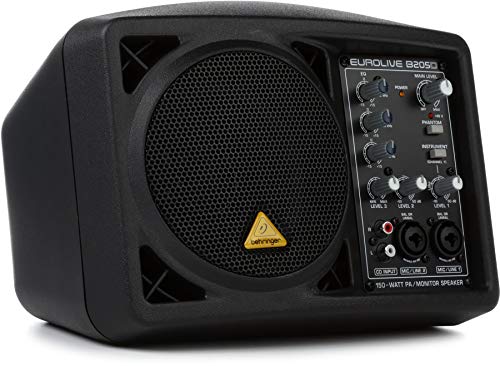
- 150-watt active monitor system
- 5.25-inch full-range neodymium driver
- Two mic preamps with phantom power
Best For: Small rooms needing a flexible monitor with mic support and moderate output
Compact Powered Wedge – Behringer F1220D 12" Powered Monitor
If you want stage monitors for small rooms with extra headroom, the Behringer EUROLIVE F1220D brings a 12-inch driver, 250 watts of power, and a built-in feedback filter for more controlled vocal and instrument monitoring. It uses Class-D amplification for a lighter setup, and its mono, wired design keeps things straightforward for live use.
Best For: Small venues, rehearsal spaces, and performers who want a simple powered wedge with solid output.
Pros:
- 12-inch woofer gives it more low-end and presence than smaller monitors.
- Adjustable feedback filter helps tame squeal in tighter setups.
- Integrated limiter adds speaker protection and system control.
- Class-D amp keeps the cabinet relatively light for a powered monitor.
Cons:
- Mono-only output may not suit users wanting stereo monitoring.
- Larger 12-inch cabinet is less compact than 8-inch alternatives.
- No built-in wireless or mixer features are listed.
Overall, this is a practical pick if you need a fuller-sounding powered stage monitor and have enough floor space to accommodate the larger cabinet. It leans more toward straightforward live reinforcement than portable all-in-one convenience.
Compact Bluetooth Monitor – ALTO TX408 8" Powered PA Speaker
The ALTO TX408 is a strong fit for stage monitors for small rooms when you want compact size without giving up useful features. It delivers 350W of bi-amplified power, an 8-inch LF driver, and a wedge-monitor mounting option, plus Bluetooth and a built-in 2-channel mixer for flexible small-venue use.
Best For: Small gigs, home studios, fitness spaces, and performers who want a compact powered monitor with Bluetooth.
Pros:
- 8-inch design is easy to place in tight rooms and on small stages.
- 350W output provides plenty of power for intimate performance spaces.
- Bluetooth and TWS support add simple streaming flexibility.
- 2-channel mixer supports microphone, line, and Bluetooth sources.
Cons:
- Smaller 8-inch driver won’t move as much air as a 12-inch monitor.
- Best suited to intimate rooms rather than larger stages.
- Features are strong, but it is still a single powered speaker, not a full monitoring system.
If your priority is easy setup in a small room, the TX408 offers a modern mix of portability, wireless convenience, and stage-monitor-friendly form factor. It is especially appealing when you need one speaker to cover monitoring and playback duties.
Classic Floor Wedge – Yamaha BR12M 12-Inch Floor Monitor
For stage monitors for small rooms that still need a traditional live-sound feel, the Yamaha BR12M offers a 12-inch woofer, 1-inch compression driver, and 300W program / 600W peak handling. Its floor-monitor design, bass reflex cabinet, and built-in pole socket give it flexibility for stage or stand use.
Best For: Bands, public address setups, and stage monitoring where a passive floor wedge with more output is preferred.
Pros:
- 12-inch woofer and 1-inch compression driver support fuller monitoring.
- 600W peak handling gives it strong headroom for live use.
- Floor-mount design is purpose-built for stage monitoring.
- Built-in pole socket adds extra placement flexibility.
Cons:
- Passive design means you’ll need amplification and speaker cabling.
- Larger cabinet is less discreet in very tight rooms.
- Heavier build is not as portable as smaller powered monitors.
This is a good choice if you want a tried-and-true monitor shape with enough size to deliver punch and clarity. It makes the most sense when your setup already includes the external gear needed to drive a passive wedge.
Ultra-Compact Vocal Monitor – Behringer B207MP3 6.5" Powered Speaker
Behringer EUROLIVE B207MP3 Active 150 Watt 6.5" PA/Monitor Speaker System with MP3 Player
Check Price On AmazonThe Behringer EUROLIVE B207MP3 is a compact option for stage monitors for small rooms, especially when space is tight and you want built-in playback support. It combines a 6.5-inch powered speaker, a four-channel mixer, and an MP3 player for quick, self-contained monitoring in vocal, keyboard, and small-event settings.
Best For: Vocal and keyboard monitoring, home recording, meetings, and very small intimate gigs.
Pros:
- Compact 6.5-inch cabinet is easy to place in crowded spaces.
- Four-channel mixer adds useful input flexibility.
- Built-in MP3 player can play audio from a USB stick.
- Lightweight powered design is convenient for transport and setup.
Cons:
- Smaller driver limits low-end compared with 8-inch or 12-inch monitors.
- 150W output is better for intimate spaces than louder stages.
- Feature set is geared toward small-scale use, not larger live systems.
In practice, this speaker is best when convenience matters as much as sound. It gives you a compact monitor with mixer and playback features built in, which can simplify simple rooms and fast setups.
Compact Wedge Monitor – Seismic Audio SA-10MTSingle 10" Titanium Horn
Seismic Audio - SA-10MTSingle - 10" Floor / Stage Monitor Wedge Style with Titanium Horn
Check Price On AmazonIf you need stage monitors for small rooms, the Seismic Audio SA-10MTSingle is a straightforward wedge-style option built around a 10-inch woofer and titanium horn driver. Its floor-mount design and 2-way layout make it a practical pick when you want a simple, stage-ready monitor that can sit close to performers without taking much space.
Best For: Small venues, rehearsal spaces, and budget-minded setups that need a basic floor wedge monitor.
Pros:
- 10-inch 2-way design with titanium compression horn driver
- 300 watts peak power handling for a compact wedge
- Floor-mounted, stage-ready enclosure for straightforward placement
- 8-ohm wired connectivity with 1/4" and Speakon support
Cons:
- Not water resistant
- Single-speaker setup only
- No built-in mixer or wireless features
For small-room monitoring, this model focuses on the essentials: wedge placement, simple wired connections, and enough output for practical live use. It makes sense if you want an uncomplicated monitor rather than a feature-heavy powered speaker.
Powered Performance Monitor – Yamaha DBR10 700W Powered Speaker
The Yamaha DBR10 is a strong choice when you’re comparing stage monitors for small rooms and want a powered speaker with more headroom. Its 10-inch bi-amped design, 700 watts of clean digital power, and 129 dB SPL give it the kind of output that can work as a main speaker or a monitor in tighter performance spaces.
Best For: Musicians and small venues that want a powered monitor with higher output and flexible positioning.
Pros:
- 700 watts of clean digital power
- Bi-amped 10-inch 2-way bass-reflex design
- Can be used as a main speaker or monitor
- Combo input and XLR output for wired setups
Cons:
- Heavier than a small passive wedge at 21 pounds
- No dedicated monitor-angle enclosure listed
- Bluetooth is present, but the unit is still primarily a wired live speaker
For small rooms, the DBR10 offers more output than many compact monitor options, which can be helpful when you need clarity without pushing the system hard. It is a versatile pick if you want one speaker that can handle both monitoring and front-of-house duties.
Personal Nearfield Monitor – Galaxy Audio NSPA Nano Spot
If your stage monitors for small rooms need to stay compact and close to the performer, the Galaxy Audio NSPA Nano Spot is a very small personal-monitor option. With a 3-inch ceramic driver, 25 watts of output, and stand or wall mounting included, it is aimed at nearfield monitoring where space is tight.
Best For: Personal monitoring, desktop-style rehearsal setups, and very small spaces where a compact speaker is enough.
Pros:
- Extremely compact 3-inch monitor speaker
- 25 watts output for close-range use
- Stand/wall mount kit and rubber feet included
- Can run from 24VDC phantom power or 18VDC supply
Cons:
- Limited frequency response compared with larger wedges
- Not designed for high-volume stage coverage
- Best suited to personal monitoring rather than full-band reinforcement
The NSPA makes sense when you need a monitor that takes almost no room and serves one performer or one position. It is less about loud stage output and more about compact, practical monitoring in very small setups.
Big-Stage Power – Behringer EUROLIVE F1320D 12" Active Monitor
If you need stage monitors for small rooms with a lot of output headroom, the Behringer EUROLIVE F1320D brings a 300-watt active design, 12-inch woofer, and feedback filter in a format that can still work well where space is tight. It is built for live and playback use, so it makes sense when you want a monitor that can handle louder rehearsals without feeling underpowered.
Best For: Small rooms where you want a powerful floor monitor with strong feedback control and a full-size sound.
Pros:
- 300-watt active 2-way monitor with a 12-inch woofer for bigger-room style output.
- Adjustable feedback filter and integrated limiter help with control and protection.
- Class-D amplifier keeps the unit relatively light for its power level.
- Designed for both live performance and playback applications.
Cons:
- At 19.5″ x 19.5″ x 18″ and 33.1 pounds, it is the least compact option here.
- Its larger format may be more monitor than some very small rooms actually need.
For buyers who want maximum monitor presence in a compact venue, this model is the strongest fit in the group. It is best when power, protection, and feedback management matter more than saving every inch of floor space.
Compact Convenience – Behringer B105D 5" Powered Monitor
For stage monitors for small rooms where footprint matters, the Behringer B105D keeps things compact with a 5-inch powered design and a built-in 3-channel mixer. It is aimed at vocal and keyboard monitoring, and its Bluetooth plus USB playback features make it a practical choice for simple setups and quick changeovers.
Best For: Small rooms, home studios, and lightweight monitor setups where a compact powered speaker is more important than sheer output.
Pros:
- Very compact 5-inch powered monitor that is easy to place in tight spaces.
- 3-channel mixer with 3-band EQ adds useful control for monitoring.
- Bluetooth and USB playback support increase versatility for small setups.
- Lightweight Class-D design is made for easy handling.
Cons:
- 50 watts of output is modest compared with larger stage monitors.
- Best suited to vocal, keyboard, and multimedia use rather than bigger live setups.
This is the most space-saving pick in the list, and that makes it appealing when your room is small and your monitoring needs are simple. It favors convenience and flexibility over maximum volume.
Mid-Size Monitor Choice – Behringer Eurolive B205D Active PA/Monitor
If you are comparing stage monitors for small rooms and want a balance of size and capability, the Behringer Eurolive B205D sits in the middle with 150 watts and a 5.25-inch full-range driver. It is built for vocal and keyboard monitoring, and the onboard 3-channel mixer with phantom power makes it especially useful when you need a compact active monitor that can also handle mic-based setups.
Best For: Small rooms that need a flexible PA/monitor with more output and input options than an ultra-compact model.
Pros:
- 150-watt active design offers more output than the smallest monitor in this group.
- 5.25-inch premium full-range neodymium driver helps keep the cabinet compact.
- Two mic preamps with phantom power support condenser microphones.
- 3-channel mixer with 3-band EQ gives practical control for monitoring.
Cons:
- Single-speaker design may not be enough for larger monitoring needs.
- Less compact than the 5-inch B105D, so placement space still matters.
This model makes sense when you want a small-room monitor that is still versatile enough for multiple inputs. It is a good middle ground if you need more capability than the smallest option without jumping to a much larger cabinet.
How We Picked the Best Stage Monitors for Small Rooms
For Stage Monitors for Small Rooms, we prioritized compact size, usable output at low to moderate volumes, feedback resistance, and flexibility for vocals, keys, acoustic instruments, and rehearsal use. We also looked for models that are easier to place in cramped setups and less likely to overwhelm the room.
Quick Comparison
The right choice depends on room size and how much headroom you need. Smaller personal monitors are best when space is tight and vocal clarity matters most. Larger 10-inch and 12-inch options can work well if you need broader coverage or stronger low-end support, but they can be more than you need in very small rooms.
Key Buying Factors for Stage Monitors for Small Rooms
Size and Coverage
Smaller cabinets are easier to position near performers and reduce the chance of excessive spill. In compact rooms, that often means cleaner mixes and less feedback risk. If the stage area is very limited, a low-profile wedge or personal monitor can be the most practical fit.
Power and Volume Control
More wattage is not always better in a small room. Look for enough output to stay clear at rehearsal or gig volume, but not so much that the monitor dominates the space. Smooth level control matters as much as raw power.
Feedback Management
Features such as feedback filters, narrower coverage, and monitor-friendly tuning can make a big difference. These help keep vocals intelligible when the speaker must sit close to microphones.
Inputs and Versatility
Some buyers need a simple powered wedge for vocals, while others want a monitor that can also serve as a small PA speaker. Consider whether you need line-level inputs, multiple connection options, or built-in playback features.
Who Should Buy Which Stage Monitors for Small Rooms?
If you need the smallest possible footprint, compact personal monitors are a smart fit for rehearsal rooms and tight stages. If you sing lead or play with a louder band, an 8-inch powered model can offer a better balance of output and control. For players who want more fullness or may use the speaker beyond monitor duty, a 10-inch or 12-inch option can be worthwhile, provided the room can handle the extra output.
For most buyers shopping Stage Monitors for Small Rooms, the best choice is the one that stays clear at moderate volume, fits the available space, and gives performers confidence without adding unnecessary noise or bulk.